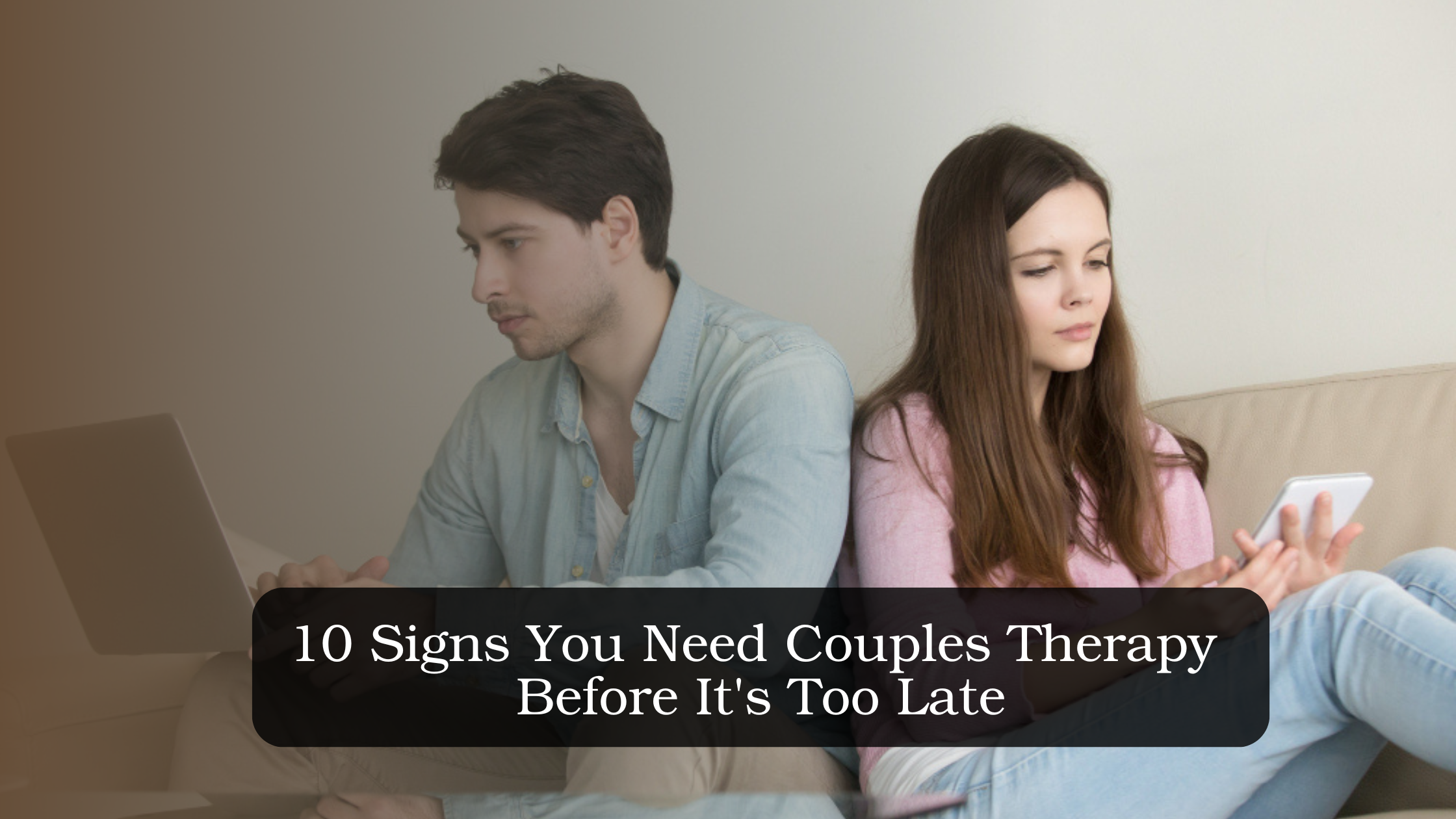
10 Signs You Need Couples Therapy Before It’s Too Late
Most couples do not wake up one morning and realize their relationship has fallen apart. Problems usually develop gradually. Conversations become shorter, disagreements become more predictable, affection becomes less frequent, and unresolved issues accumulate quietly.
This is one reason couples therapy is often most useful when partners seek help before the relationship reaches a crisis point. You do not need to be on the verge of separation, dealing with infidelity, or having constant explosive arguments to benefit from professional support. Sometimes the earliest signs are subtle: feeling unheard, avoiding difficult conversations, or no longer feeling emotionally close.
Recognizing these patterns does not automatically mean your relationship is failing. It may simply mean that the ways you and your partner currently handle stress, conflict, or emotional needs are no longer working. The earlier those patterns are understood, the more opportunity there may be to change them.
10 Signs You May Need Couples Therapy

1. You Keep Having the Same Argument
Every couple disagrees. The concern is not disagreement itself but repetition without resolution.
You may argue about money, household responsibilities, intimacy, family, parenting, or time together. The subject changes slightly, but the interaction remains remarkably similar.
One partner raises an issue. The other becomes defensive. The conversation escalates. Someone withdraws. Nothing gets resolved, and the same argument returns weeks or days later.
If you can predict how an argument will end before it begins, it may be worth examining the recurring relationship pattern rather than continuing to debate the individual issue.
2. You Have Stopped Talking About Important Things
Some couples appear peaceful because they have learned to avoid conflict.
You may no longer bring up concerns because you already know how your partner will respond. Perhaps difficult conversations lead to defensiveness, anger, silence, or withdrawal, so avoiding them feels easier.
But avoiding conflict does not necessarily resolve it.
Over time, unspoken concerns can become resentment or emotional distance. If you are regularly thinking, “It’s not worth bringing this up,” that can be an important sign that something needs attention.
3. You Feel Lonely Even When You’re Together
Physical proximity does not necessarily create emotional connection.
You may live together, eat together, manage responsibilities together, and still feel as though you are emotionally alone.
Perhaps conversations revolve almost entirely around work, children, schedules, finances, or household tasks. There may be little curiosity about what the other person is actually experiencing.
Feeling lonely inside a relationship can be particularly difficult because the person you want to feel closest to is right beside you.
4. Criticism Has Become Your Default Way of Communicating
There is an important difference between expressing a complaint and attacking a partner’s character.
“I wish you would let me know when you’re going to be late” communicates a specific concern.
“You never think about anyone but yourself” turns the concern into a judgment about the person.
When criticism, sarcasm, contempt, or constant fault-finding become normal parts of communication, couples can gradually stop feeling emotionally safe with each other.
Therapy can help identify what is underneath the criticism and develop fair fighting rules that replace criticism with something more constructive.
5. One of You Constantly Pursues While the Other Withdraws
This is a common relationship cycle.
One partner wants to talk immediately, seeks reassurance, or keeps returning to the issue. The other feels overwhelmed and pulls away, becomes quiet, or asks for space.
The more one pursues, the more the other withdraws.
The more the other withdraws, the more urgently the first partner pursues.
Eventually, both feel misunderstood this is a textbook description of the pursuer-distancer cycle.
The problem is not necessarily that one person cares too much and the other cares too little. Both may be responding to emotional discomfort in ways that unintentionally intensify the cycle.
6. Resentment Is Building
Resentment often develops from unresolved experiences rather than one dramatic event.
You may feel that you give more, compromise more, manage more responsibilities, or make more effort. Your partner may have their own version of the same story.
When these perceptions remain unaddressed, small incidents can start carrying the emotional weight of everything that came before them.
A forgotten task may trigger anger that is actually connected to months of feeling unsupported.
If you find yourself keeping a mental list of everything your partner has done wrong, it may be time to address the larger pattern.
7. You Are Emotionally or Physically Disconnected
Changes in affection, sexual intimacy, emotional openness, or physical closeness can happen for many reasons.
Stress, parenting, work demands, health concerns, relationship conflict, and major life transitions can all affect connection.
The warning sign is not simply that intimacy has changed. It is when the distance becomes persistent and neither partner knows how to address it.
Sometimes couples become so focused on the lack of intimacy that they overlook the emotional experiences underneath it, such as hurt, rejection, resentment, insecurity, or feeling unseen.
8. Trust Has Changed
Trust can be affected by infidelity, secrecy, repeated broken promises, financial dishonesty, or other experiences that make a partner question the reliability of the relationship.
Rebuilding trust usually requires more than deciding to “move on.”
The injured partner may need reassurance and transparency. The other partner may feel frustrated that the past continues to influence the present.
Without a way to process what happened and establish new expectations, couples can become trapped between wanting to repair the relationship and repeatedly revisiting the injury.
Couples therapy can provide a structured setting for addressing these issues.
9. You Are Staying Together Mainly Because of Circumstances
Sometimes couples remain together because separating feels complicated.
There may be children, finances, housing, family expectations, shared businesses, or years of history involved.
Those circumstances are real, but they do not necessarily address the state of the relationship itself.
If you have started thinking, “We’re functioning as a family, but we’re no longer functioning as partners,” it may be worth exploring what has changed and whether the relationship can be rebuilt.
Therapy does not have to be about deciding whether to stay or leave. It can help couples understand their relationship and make more deliberate decisions.
10. You Want Things to Improve, But You Don’t Know How
This may be the most important sign of all.
You may still love each other. You may both want the relationship to work. You may have tried talking, taking breaks, making promises, or starting over several times.
Yet you keep returning to the same place.
That does not necessarily mean the relationship is beyond repair. It may mean that the strategies you have been using are not addressing the underlying pattern.
A therapist can provide an outside perspective and help identify dynamics that are difficult to see when you are emotionally involved in them.

Do You Need Couples Therapy If Your Relationship Isn’t in Crisis?
No relationship needs to be in crisis before therapy becomes appropriate.
Couples may seek therapy because they want to improve communication, strengthen emotional intimacy, navigate a major transition, recover from a difficult experience, or understand recurring conflict.
In fact, waiting until both partners are completely exhausted can make the work more difficult.
Think of couples therapy as an opportunity to address patterns while both people still have the motivation and emotional capacity to work on the relationship.
What If Only One Partner Wants Therapy?
This is common.
One partner may believe therapy is necessary while the other thinks the relationship problems are manageable. Rather than using therapy as proof that one person is right, it can help to explain what you hope will change.
Instead of saying:
“You need therapy because you don’t communicate.”
Try:
“I don’t want us to keep having the same conversations without resolving anything. I’d like us to understand what keeps happening between us.”
The goal is to move away from assigning blame and toward addressing the relationship itself.
How Dr. Harel Papikian Can Help
Dr. Harel Papikian is a licensed clinical psychologist in Los Angeles with more than 16 years of experience working with individuals and couples.
His work with couples can focus on identifying recurring relationship patterns, understanding the emotional factors behind conflict, and helping partners develop healthier ways of communicating and responding to one another.
His ARM Method, centered on Awareness, Release, and Mastery, provides a structured framework for this process. Couples can work toward recognizing patterns, addressing emotional barriers that keep those patterns in place, and developing skills that support healthier interactions.
Couples Therapy is not about determining which partner is the problem. It is about understanding what is happening between two people and identifying what can change.
Final Thoughts
Needing couples therapy does not mean your relationship has failed.
Sometimes it means you have recognized a problem before it becomes even more difficult to change.
Repeated arguments, emotional distance, resentment, criticism, withdrawal, and unresolved trust concerns are worth taking seriously, particularly when they have become persistent patterns rather than temporary difficulties.
You do not have to wait for a major crisis before asking for help. If both partners still want to understand the relationship and work toward something healthier, addressing concerns earlier can provide more room for meaningful change.
The question is not whether a healthy relationship should ever have problems.
It is whether the two of you have a way to work through those problems without continually hurting each other in the process.
FAQs
There is no minimum level of conflict required. Repeated unresolved arguments, emotional distance, resentment, communication difficulties, intimacy concerns, or major life transitions can all be appropriate reasons to seek couples therapy.
No. Many couples seek therapy specifically because they want to strengthen their relationship and prevent problems from becoming more serious.
Yes. Repeated arguments can be a sign that the underlying issue has not been addressed. Therapy can help identify the interactional cycle and explore what keeps bringing the couple back to the same conflict.
Ideally, both partners participate willingly. However, one partner can begin by expressing why therapy matters to them without framing it as an accusation or assigning blame.
It can provide a structured environment for addressing the impact of betrayal, rebuilding communication, establishing boundaries and expectations, and determining what is needed to move forward. The appropriate approach depends on the circumstances of the relationship.
Not necessarily. There is no point at which therapy can guarantee that a relationship will recover, but seeking help does not require waiting for things to become worse. Earlier intervention can give couples an opportunity to address persistent patterns before they become even more entrenched

Harel Papikian
Dr. Harel Papikian is a clinical psychologist and couples therapist with more than 15 years of experience. He offers marriage counseling and couples therapy in los Angeles. It help’s couples navigate their relationship challenges and deepen their connection. Our clinic uses a unique ARM method (Awareness, Release, Mastery) to achieve rapid and profound results for our clients. We serve a diverse clientele, including LGBTQ+ and heterosexual couples, addressing issues like communication breakdowns, conflict resolution, intimacy, and trust. You can also get individual therapy sessions for concerns like depression, anxiety, and trauma.
Leave a Reply