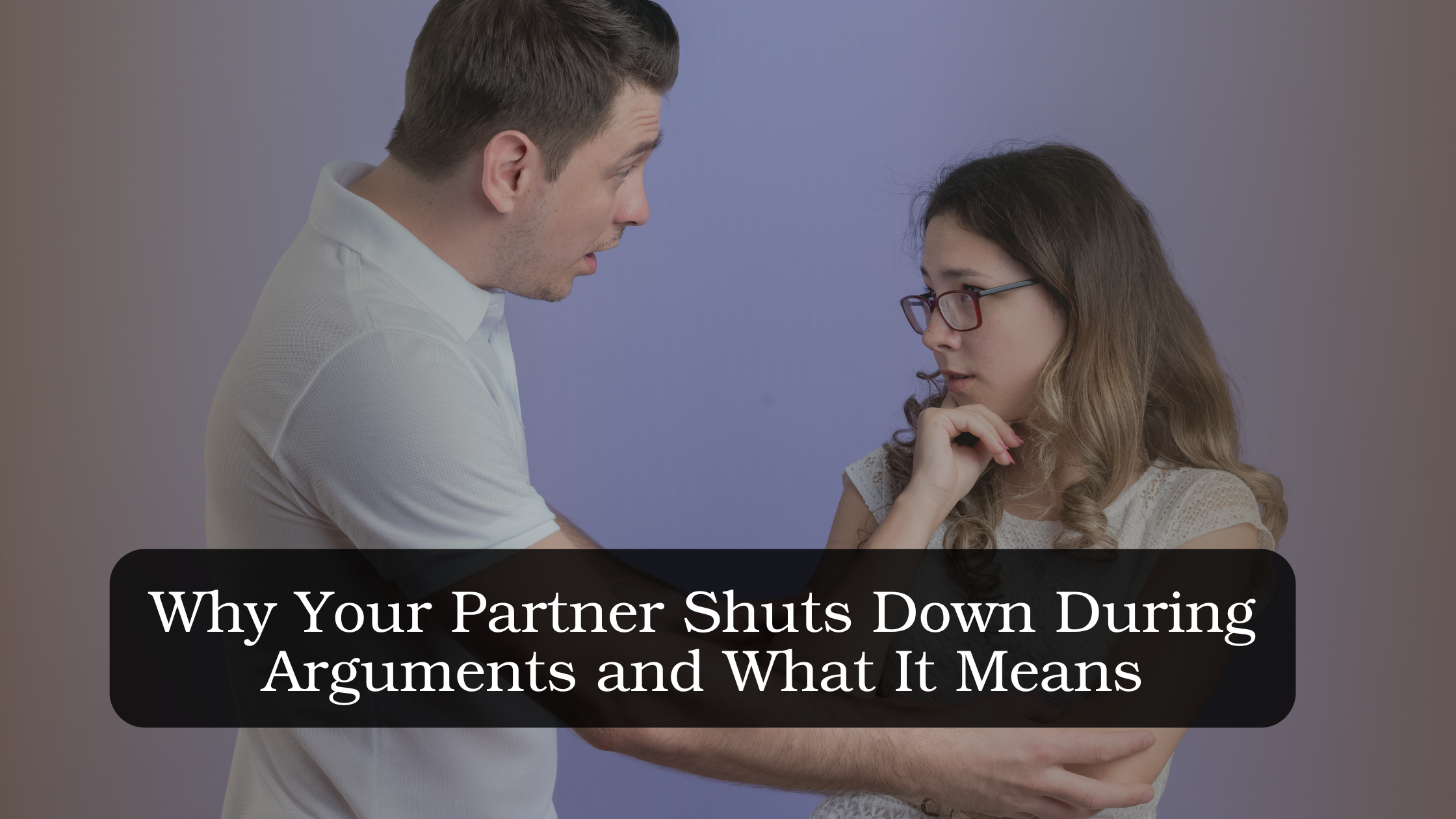
Why Your Partner Shuts Down During Arguments and What It Means
When an argument becomes intense, some people become quiet, stop responding, leave the room, or seem emotionally unreachable. If your partner shuts down during conflict, you may experience their silence as rejection or unwillingness to work on the relationship. Your instinct may be to keep asking questions or push for an answer, which can make the situation more tense.
Shutting down can have several explanations. Intense conflict may cause emotional overwhelm, while past experiences may have taught someone that staying quiet feels safer than expressing disagreement. Withdrawal can also become a way of avoiding difficult conversations.
Understanding what happens beneath the silence can help couples respond differently and recognize whether the shutdown is a temporary response, a learned coping pattern, or part of a more harmful relationship dynamic.
What Does It Mean When Your Partner Shuts Down During an Argument?
“Shutting down” is a broad term. It can describe anything from becoming quieter and needing a few minutes to think to completely disengaging from a conversation.
A partner may:
- Stop answering questions
- Give very short responses
- Avoid eye contact
- Leave the room
- Become emotionally expressionless
- Say they do not know what they feel
- Change the subject
- Stop participating in the discussion
- Ask to talk about it later
These behaviors do not have one universal meaning.
Some people become quiet because they are overwhelmed and genuinely need time to regulate themselves. Others may withdraw because they do not know how to communicate their feelings. In some cases, silence can be intentional avoidance or a way of punishing a partner.
The context, duration, and what happens afterward matter.
Why Does Your Partner Shut Down During Conflict?

Emotional overwhelm
An intense argument can produce a strong stress response. When emotions become overwhelming, a person may have difficulty thinking clearly, finding words, or processing what their partner is saying.
They may not be deliberately refusing to communicate. Their ability to communicate effectively may temporarily decrease.
Fear of making things worse
Some people become silent because they are afraid that anything they say will escalate the argument.
They may think:
“If I say the wrong thing, this will become even worse.”
Silence can then become a form of self-protection.
Learned communication patterns
People often develop their conflict habits from their early family environments.
Someone who grew up around frequent yelling may have learned to disappear emotionally during conflict. Someone whose feelings were dismissed may have learned that expressing vulnerability is pointless.
These patterns can continue into adult relationships without the person consciously choosing them.
Difficulty identifying emotions
Not everyone can immediately identify what they are feeling during an argument.
A person may know that they are upset but struggle to distinguish anger from fear, shame, disappointment, or hurt.
Saying “I don’t know” may sometimes be an accurate description rather than an attempt to avoid the conversation.
Shame or feeling attacked
When people feel criticized or blamed, they may become defensive or withdraw.
If an argument quickly turns into statements about someone’s character, they may stop feeling capable of having a productive conversation.
This does not mean that the concerns being raised are invalid. It means that the way the conflict is unfolding may affect their ability to engage.
Is Shutting Down During an Argument the Same as Stonewalling?
The terms are sometimes used interchangeably, but they can describe different experiences.
Shutting down may refer to becoming overwhelmed and temporarily losing the ability to communicate effectively.
Stonewalling generally refers to withdrawing from interaction or refusing to engage with the other person. In some cases, it can become a persistent pattern during conflict.
The distinction matters because the appropriate response may be different.
Someone who is overwhelmed may benefit from a structured break and time to regulate before returning to the conversation.
Someone who repeatedly refuses to discuss important relationship issues may need to address a broader pattern of avoidance.
And if silence is deliberately used to intimidate, punish, control, or isolate a partner, the issue is more serious than simply having different conflict styles. That distinction is explored further in the silent treatment and why it’s more damaging than yelling.
Why Pursuing Your Partner Can Make Their Shutdown Worse
A common relationship pattern involves one partner pursuing conversation while the other withdraws.
For example:
Partner A: “Why won’t you talk to me?”
Partner B: “I just need some time.”
Partner A: “You always do this. Answer me.”
Partner B: “I can’t do this right now.”
The more Partner A pushes for immediate engagement, the more overwhelmed Partner B becomes. The more Partner B withdraws, the more anxious Partner A becomes.
This can create a cycle in which both people unintentionally reinforce each other’s behavior. This is the pursuer-distancer cycle in its most literal form.
The solution is not necessarily for one partner to stop communicating and the other to stop caring. Instead, the couple may need a different structure for handling moments of high emotional intensity.
When Taking a Break From an Argument Is Healthy
A temporary break from an argument can be constructive when it has a clear purpose and an agreed-upon return to the conversation.
For example:
“I’m too overwhelmed to have this conversation well right now. I need 30 minutes to calm down, and I want to come back and talk about it afterward.”
This is different from disappearing without explanation. This distinction is central to fair fighting rules for couples.
A useful break should generally communicate:
- That the relationship or issue is not being abandoned
- How much time is needed, when reasonably possible
- That the conversation will be revisited
- What each person can do during the break to regulate
The purpose is to make the eventual conversation more productive, not to avoid it indefinitely.
When Shutting Down During Conflict Becomes a Relationship Problem
Occasional withdrawal during an intense disagreement is different from a chronic refusal to communicate.
It may become a relationship problem when one partner:
- Regularly refuses to discuss important issues
- Disappears for extended periods without explanation
- Uses silence to punish the other person
- Refuses reasonable attempts to reconnect
- Never returns to conversations that were postponed
- Uses withdrawal to gain control
- Leaves the other partner constantly uncertain about where the relationship stands
A partner can legitimately need space. At the same time, the other partner can reasonably need communication and follow-through.
Both needs can exist at once.
What to Do When Your Partner Shuts Down During an Argument

Stop escalating the conversation
If your partner is clearly overwhelmed, repeatedly demanding an immediate response may not produce better communication.
Lowering the intensity can create more room for both people to think.
Ask whether they need a break
Instead of assuming what the silence means, ask:
“Are you overwhelmed and need some time, or are you not ready to discuss this at all?”
This creates an opportunity to clarify what is happening.
Agree on when to return
If your partner needs space, try to establish when the conversation will resume.
It does not need to be an exact time if that is unrealistic. The important part is creating an expectation that the issue will not simply disappear.
Discuss the pattern when you are both calm
The middle of an argument is rarely the best time to analyze how you argue.
Later, talk about what happens when conflict becomes intense.
You might ask:
“What happens for you when we start arguing?”
“What makes it difficult to keep talking?”
“What would help you feel safe enough to stay engaged?”
Express your own experience without assigning motives
Instead of:
“You shut down because you don’t care.”
try:
“When you stop responding, I feel uncertain about whether we’re going to resolve the issue. I’d like us to find a way for you to take space without leaving me unsure about what happens next.”
This focuses on the impact rather than assuming the partner’s intention.
When Couples Therapy May Help With Conflict and Withdrawal
Couples therapy may be useful when shutting down has become a recurring pattern that the couple cannot resolve independently.
It can be particularly helpful when one partner feels ignored and the other feels overwhelmed, criticized, or pressured during conflict.
Therapy can provide a structured setting to slow the interaction down and identify what happens immediately before each person’s response.
If withdrawal is connected to trauma, severe anxiety, depression, or other individual concerns, individual therapy may also be appropriate.
How Dr. Harel Approaches Shutdown During Arguments
Dr. Harel can help couples understand what happens in the interaction when one partner withdraws and the other pursues.
The focus is not simply on getting the quieter partner to talk more. Therapy can explore what each person’s behavior is communicating and what emotional response is driving it.
For the withdrawing partner, this may involve understanding what makes conflict feel overwhelming, threatening, or difficult to navigate.
For the pursuing partner, therapy may explore what happens internally when communication stops and whether repeated questioning or reassurance-seeking unintentionally increases the other person’s withdrawal.
Together, the couple can work toward a more predictable conflict process. Dr. Harel’s ARM Method offers one structured framework for this work. This may include recognizing escalation earlier, communicating the need for a break, agreeing on how to reconnect, and practicing ways of discussing difficult subjects without immediately becoming overwhelmed.
The goal is not to eliminate disagreement. Healthy couples can disagree. The goal is to create a relationship in which conflict does not automatically lead to pursuit, withdrawal, or prolonged disconnection.
Final Thoughts
When your partner shuts down during an argument, the silence can leave you feeling rejected, confused, or alone in trying to resolve the problem. At the same time, pushing harder for an immediate response can sometimes increase the very withdrawal you are trying to stop.
Understanding the cycle between pursuit and withdrawal can help both partners respond differently. Dr. Harel can help couples identify what happens beneath these reactions, develop healthier ways to take space, and create a clearer path back to communication.
The goal is not to eliminate conflict or require either partner to communicate perfectly in the middle of intense emotions. It is to build a way of handling difficult moments that allows both people to feel heard, respected, and connected even when they need a pause.
Frequently Asked Questions
Not necessarily. Withdrawal during conflict does not reliably indicate a lack of love or commitment. It may reflect overwhelm, fear, learned communication habits, or difficulty processing emotions. The broader relationship pattern matters more than one argument.
Giving someone space can help if they are genuinely overwhelmed, but indefinite withdrawal can leave important issues unresolved. Ideally, space should have some communication around it and be followed by an agreed attempt to reconnect.
If “space” consistently becomes a way to avoid every difficult conversation, the pattern deserves attention. A healthy break should eventually lead back to communication rather than becoming a permanent escape from conflict.
Some people become less outwardly expressive when overwhelmed. Emotional shutdown can look like indifference even when the person is experiencing strong internal emotions. It is better to ask about their experience than assume that a lack of visible emotion means a lack of concern.
Yes. People can carry forward conflict patterns learned in childhood, including avoiding disagreement, becoming highly defensive, staying silent, or trying to keep everyone calm. These patterns can change, particularly when a person becomes aware of them and practices different responses.
Recognizing the pattern is already useful. You can begin by identifying the point at which you become overwhelmed and learning to communicate that you need a break rather than simply disappearing. Developing a clear way to return to the conversation can also make taking space safer for both partners.
Individual therapy can still help you understand your own responses and determine how you want to approach the relationship. If your partner eventually becomes willing to participate, couples therapy can address the interaction between both partners directly.

Harel Papikian
Dr. Harel Papikian is a clinical psychologist and couples therapist with more than 15 years of experience. He offers marriage counseling and couples therapy in los Angeles. It help’s couples navigate their relationship challenges and deepen their connection. Our clinic uses a unique ARM method (Awareness, Release, Mastery) to achieve rapid and profound results for our clients. We serve a diverse clientele, including LGBTQ+ and heterosexual couples, addressing issues like communication breakdowns, conflict resolution, intimacy, and trust. You can also get individual therapy sessions for concerns like depression, anxiety, and trauma.
Leave a Reply