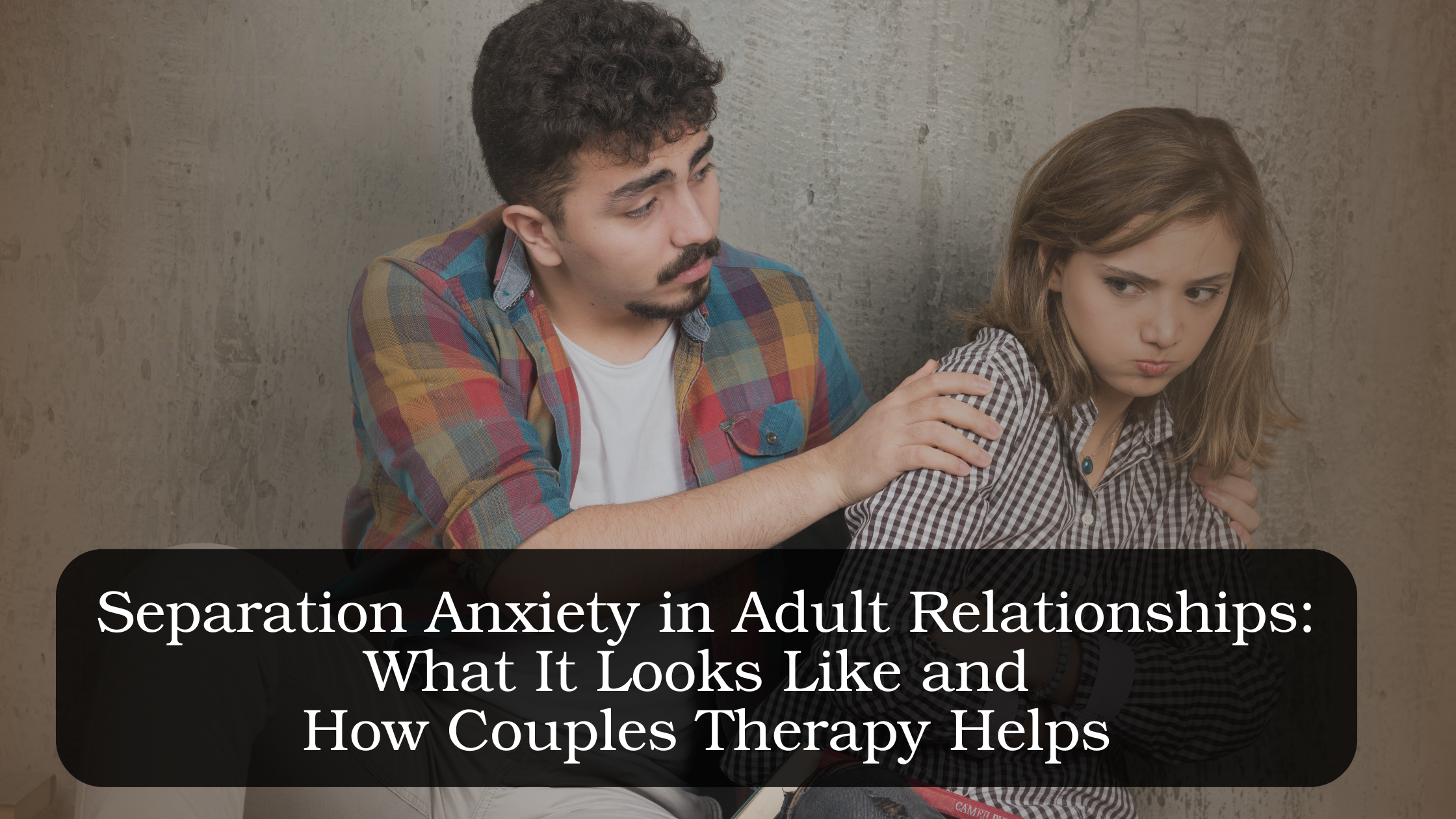
Separation Anxiety in Adult Relationships: What It Looks Like and How Couples Therapy Helps
Separation is a normal part of adult relationships. Partners have work, friendships, family responsibilities, and time apart. For some people, however, being away from a partner can trigger intense anxiety. A missed call, change in plans, or even a few hours apart may lead to persistent worry.
Separation anxiety in an adult relationship is more than simply missing someone. It can involve repeated reassurance seeking, difficulty sleeping when a partner is away, or an overwhelming need to remain connected. Over time, these reactions can place pressure on the relationship.
Understanding these reactions can help partners recognize the difference between healthy closeness and anxiety-driven dependence. It can also make it easier to communicate needs, manage time apart, and maintain a sense of connection without losing independence.
What Is Separation Anxiety in an Adult Relationship?
Separation anxiety involves significant distress related to being apart from an attachment figure.
While separation anxiety is often discussed in children, adults can also experience intense distress when separated from someone important to them. In some cases, persistent symptoms may meet the criteria for adult separation anxiety disorder, while in others, separation-related fears may be connected to attachment patterns, previous experiences, relationship insecurity, or current life circumstances.
The important distinction is between normal attachment and anxiety that begins interfering with everyday functioning or the relationship.
Missing your partner while they are traveling is normal.
Feeling unable to function, sleep, work, socialize, or relax whenever your partner is away may indicate that something more significant is happening.
What Does Separation Anxiety Look Like in Adults?
Separation anxiety can appear in different ways.
Constant worry when your partner is away
You may repeatedly wonder whether your partner is safe, whether something has happened, or whether they will return as planned.
Even when there is no evidence of a problem, the worry may feel difficult to switch off.
Repeated checking and reassurance seeking
You may frequently text or call your partner while they are away.
If they do not respond quickly, anxiety may increase.
A delayed message that would normally be insignificant can become a source of intense concern.
Difficulty sleeping alone
Some people experience significant discomfort when their partner is not physically present.
They may struggle to fall asleep, wake frequently, or feel unusually anxious at night.
Avoiding time apart
You may turn down invitations, travel opportunities, hobbies, or social activities because you do not want to be away from your partner.
Alternatively, you may encourage your partner to avoid activities that involve separation.
Fear of abandonment
Being apart may trigger thoughts that your partner will realize they do not need you, become interested in someone else, or decide to leave.
The physical separation becomes connected to a deeper fear of losing the relationship.
Strong reactions to changes in plans
A partner who unexpectedly stays late at work or changes travel arrangements may trigger significant distress.
The reaction may seem disproportionate to the event because the change represents uncertainty and separation rather than simply a scheduling problem.
Separation Anxiety vs. Missing Your Partner
It is normal to miss someone you love.
The difference often lies in the intensity, persistence, and impact of the reaction.
| Missing your partner | Separation anxiety |
| You notice that you miss them | You feel unable to settle without them |
| You continue with your day | Worry interferes with work or activities |
| You can tolerate delayed communication | Delayed communication creates significant distress |
| You enjoy reconnecting afterward | You may spend the separation anticipating problems |
| Time apart can be healthy | Time apart may feel threatening |
This distinction is not a diagnostic tool. A mental health professional can determine whether symptoms meet criteria for a specific anxiety disorder.
Why Separation Can Feel So Threatening
Fear of abandonment
For some people, physical distance activates fears of being left.
The underlying concern may not actually be about the hours apart. It may be about what the separation seems to represent.
“What if they realize they are happier without me?”
“What if they stop loving me?”
“What if something changes while we are apart?”
Previous experiences of loss or inconsistency
Past relationships and important early experiences can influence how someone responds to separation.
Experiences involving sudden loss, inconsistent caregiving, betrayal, or previous abandonment may contribute to heightened sensitivity to distance.
This does not mean that everyone with separation anxiety has experienced childhood abandonment. There can be many contributing factors.
Difficulty tolerating uncertainty
Being apart means you cannot observe what your partner is doing or know exactly how they are feeling at every moment.
For someone who struggles with uncertainty, that lack of information can become uncomfortable.
Checking messages or asking for reassurance may temporarily restore a sense of control.
Low confidence in the relationship
Sometimes separation anxiety develops alongside uncertainty about the stability of the relationship.
Frequent conflict, inconsistent communication, unresolved betrayal, or unclear commitment can understandably make time apart more difficult.
In these situations, it is important not to assume that all anxiety is internal. Relationship circumstances can genuinely contribute to insecurity.
How Separation Anxiety Can Affect Both Partners
Separation anxiety affects more than the person experiencing it.
The other partner may initially respond with frequent reassurance and increased availability.
Over time, however, they may begin to feel monitored or responsible for preventing anxiety.
They may feel pressure to answer immediately, provide constant updates, avoid independent plans, or explain their whereabouts.
This can create resentment.
The anxious partner may then sense that their partner is becoming distant, which can increase their fear and lead to even more checking or reassurance seeking.
The relationship can become caught in a cycle:
Separation → anxiety → checking or reassurance → temporary relief → partner feels pressured → partner pulls back → anxiety increases
The cycle, rather than either individual, becomes the focus for therapeutic work. This is a version of the pursuer-distancer cycle.
When Reassurance Starts Reinforcing Anxiety
Reassurance is a normal part of close relationships.
Telling your partner that you love them or letting them know you arrived safely can be healthy.
The difficulty arises when reassurance becomes the primary way one partner manages anxiety.
For example, a person may need their partner to respond immediately to every message, repeatedly confirm their feelings, or provide detailed explanations about where they are.
These behaviors may reduce anxiety temporarily but can make future separation more difficult.
Therapy can help couples find ways to remain connected without requiring constant reassurance.
How Couples Therapy Can Help With Separation Anxiety

Identifying the underlying fear
Therapy can explore what separation represents emotionally.
The fear may involve abandonment, rejection, loss of control, loneliness, uncertainty, or previous experiences of instability.
Understanding the underlying fear can make it easier to work with the anxiety rather than simply reacting to each episode.
Developing tolerance for time apart
The goal is not necessarily to eliminate discomfort immediately.
Therapy can help a person gradually become more comfortable spending time independently while remaining emotionally connected to their partner.
This might involve developing routines, reconnecting with friends, pursuing hobbies, or learning to tolerate periods without checking messages.
Challenging catastrophic assumptions
An anxious mind can quickly move from a small event to a feared outcome.
For example:
Partner does not answer → something is wrong → they are losing interest → the relationship is ending.
Therapy can help slow this sequence down and examine the assumptions between the event and the feared conclusion.
Reducing reassurance and checking cycles
A therapist can help identify behaviors that temporarily reduce anxiety but maintain it over time.
This may include repeated texting, checking a partner’s location, asking the same questions, or repeatedly seeking confirmation about the relationship.
The aim is not to eliminate communication. It is to make communication more intentional and less driven by escalating anxiety.
Strengthening a sense of self outside the relationship
Healthy relationships involve connection and individuality.
Therapy can help someone rebuild parts of life that may have become secondary to the relationship, including friendships, interests, work, routines, and personal goals.
Having a fuller life outside the relationship can make separation feel less threatening.
What If One Partner Needs More Independence?
Couples do not always have the same comfort level with closeness.
One partner may enjoy frequent communication throughout the day, while the other prefers more independent time.
Neither preference automatically means that something is wrong.
The challenge is determining whether the difference can be discussed and accommodated without either person feeling controlled or abandoned.
Couples therapy can help partners negotiate practical expectations around communication, travel, social plans, time alone, and reconnection.
The goal is not to establish one correct amount of independence.
It is to create an arrangement that respects both partners’ needs.
When Should You Consider Therapy?
Consider individual or couples therapy when separation anxiety repeatedly interferes with daily life or the relationship.
It may be particularly useful when:
- You cannot relax when your partner is away
- You repeatedly check or contact your partner for reassurance
- Time apart leads to significant conflict
- You avoid normal activities because of separation
- Your partner feels responsible for managing your anxiety
- You experience intense fear of abandonment
- Your relationship has become increasingly restrictive
- You struggle to maintain friendships or interests outside the relationship
- Separation anxiety continues despite repeated reassurance
Couples Therapy can help you build greater emotional security without requiring you to become less attached to your partner.
The goal is not emotional distance. It is the ability to remain connected while also functioning independently.
How Dr. Harel Approaches Separation Anxiety in Relationships
Dr. Harel can help couples understand what happens between them when separation triggers anxiety.
Rather than focusing only on the anxious partner’s behavior, therapy can examine the interaction that develops afterward.
For example, one partner may become increasingly anxious and seek reassurance, while the other begins feeling pressured and withdraws. That withdrawal then confirms the first partner’s fear and intensifies the cycle.
Therapy can help both partners recognize this pattern and respond differently.
The work may involve exploring fears of abandonment, difficulty tolerating uncertainty, reassurance seeking, communication habits, boundaries, and the couple’s expectations around independence. Dr. Harel’s ARM Method offers one structured framework for this work.
Dr. Harel can also help distinguish anxiety-driven fears from genuine relationship concerns. If there are actual problems involving trust, inconsistent commitment, or unresolved conflict, those issues need to be addressed rather than automatically attributed to anxiety.
Final Thoughts
Separation anxiety can make time apart feel much more threatening than it needs to be. The goal is not to stop needing your partner or to create emotional distance. It is to build enough security within yourself and the relationship to tolerate separation while maintaining connection.
If anxiety, reassurance seeking, or fear of abandonment is creating tension between you and your partner, couples therapy can help you understand the cycle and develop healthier ways to communicate, set boundaries, and support each other. Dr. Harel Papikian can help you work through these patterns and build a relationship where closeness and independence can exist together.
Frequently Asked Questions
They can overlap, but they are not necessarily the same. Attachment-related insecurity describes patterns in how someone experiences closeness, trust, and relationships. Adult separation anxiety disorder is a specific clinical condition with diagnostic criteria. A professional assessment is needed to determine whether symptoms meet those criteria.
A healthy relationship itself does not necessarily cause separation anxiety. However, becoming deeply attached to someone can make the possibility of loss feel more significant. Anxiety may become more noticeable when the relationship becomes important, even when the partner has done nothing wrong.
Frequent communication is not automatically unhealthy. Couples have different preferences. It becomes more concerning when contact is driven by intense fear, feels compulsory, interferes with daily functioning, or becomes necessary for one partner to feel safe.
Anxiety can sometimes lead to behaviors that feel controlling, such as monitoring a partner’s location, questioning their plans, discouraging independent activities, or demanding frequent updates. Understanding that anxiety is involved does not make controlling behavior acceptable. Therapy can help address both the underlying fear and the behavior.
Those concerns deserve attention. If there has been infidelity, dishonesty, inconsistent communication, or another breach of trust, anxiety may be responding to a real relationship issue. Couples therapy can help distinguish unresolved trust problems from anxiety that persists independently of the relationship circumstances.
Yes. Couples therapy can address how the anxiety affects communication, boundaries, reassurance, and independence. Individual therapy may also be appropriate when the symptoms are significant or meet criteria for an anxiety disorder.
Sometimes increased connection provides temporary reassurance, but simply increasing time together does not necessarily address the underlying anxiety. If a person becomes increasingly dependent on constant proximity to feel safe, separation can become even more difficult later.
You can acknowledge their feelings without taking responsibility for eliminating them. This might mean offering affection, communicating clearly about plans, and following agreed-upon boundaries while avoiding endless reassurance or changing your entire life to prevent anxiety. A therapist can help couples determine what this balance looks like in their specific relationship.

Harel Papikian
Dr. Harel Papikian is a clinical psychologist and couples therapist with more than 15 years of experience. He offers marriage counseling and couples therapy in los Angeles. It help’s couples navigate their relationship challenges and deepen their connection. Our clinic uses a unique ARM method (Awareness, Release, Mastery) to achieve rapid and profound results for our clients. We serve a diverse clientele, including LGBTQ+ and heterosexual couples, addressing issues like communication breakdowns, conflict resolution, intimacy, and trust. You can also get individual therapy sessions for concerns like depression, anxiety, and trauma.
Leave a Reply