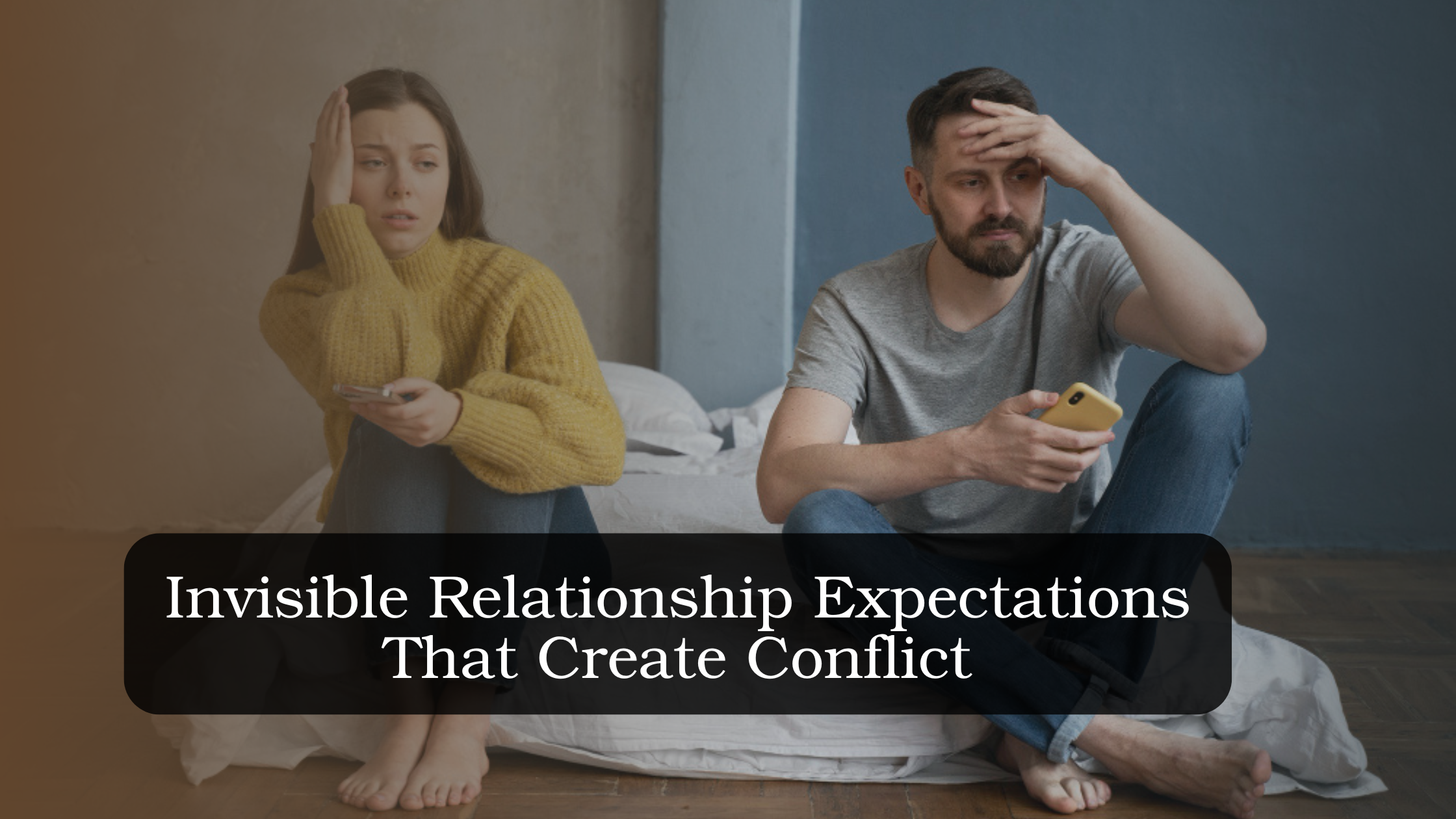
Invisible Relationship Expectations That Create Conflict
Relationship conflict can grow from expectations that neither partner has actually expressed. One person may feel hurt because their partner did not call, offer reassurance, or respond as expected, while the other has no idea anything was wrong. The emotional reaction can seem disproportionate, but often the event is only the surface.
In his work with individuals and couples across Los Angeles, Dr. Harel, a licensed clinical psychologist with more than 16 years of experience, often sees these moments shaped by invisible expectations: private ideas about what love, care, support, and partnership should look like.
The difficulty is not having expectations. It is treating personal expectations as shared relationship rules without realizing it. When that happens, disappointment can quickly become resentment, and ordinary misunderstandings can begin to feel like evidence that something is fundamentally wrong.
The Expectations Partners Rarely Think to Explain
Every relationship develops expectations. Partners gradually form ideas about how the other person should communicate, respond when they are upset, show affection, make time for them, or offer support.
The problem is that many of these expectations are never actually discussed.
A person may think, “If my partner knows me, they should know when I need comfort.” Another may believe, “If something is wrong, my partner should tell me rather than expect me to figure it out.”
Neither perspective is necessarily unreasonable. Conflict begins when each person assumes their way of experiencing closeness is obvious and should therefore be shared by the other.
Relationship expectations are influenced by much more than the current relationship. Research suggests that expectations about romantic relationships can be shaped by previous experiences and family relationships. This helps explain why two people can enter the same relationship with very different ideas about what a partner should be.
What feels natural to one person may feel unnecessary, intrusive, distant, or even rejecting to another.
When Love Becomes a Form of Mind-Reading
One of the most emotionally charged expectations is the belief that love should eliminate the need to explain oneself.
“If they really know me, they should know I’m upset.”
“If they loved me, they would know what I needed.”
“If I have to ask for it, it doesn’t feel genuine.”
These thoughts are understandable. People want to feel known by their partners. But being known and being able to read another person’s internal experience are very different things.
A partner may notice that something has changed without knowing whether the other person needs reassurance, space, affection, practical help, or simply someone to listen.
When the need is not communicated, the partner can effectively be asked to pass a test they do not know they are taking. If they fail, that failure may then be interpreted as evidence that they do not care.
That is where a small misunderstanding can become a much larger emotional injury.

Why Small Relationship Moments Can Feel So Significant
The intensity of a relationship argument is not always determined by what happened. It can be determined by what the event represents.
A small event can take on a much deeper meaning:
- A missed call may feel like, “You are not important to me.”
- A request for space may feel like, “You are pulling away from me.”
- A disagreement may feel like, “You do not respect or understand me.”
- A forgotten responsibility may feel like, “I cannot rely on you.”
The behavior itself may have a straightforward explanation. But once it passes through an invisible expectation, it can acquire an emotional meaning much larger than the original event.
This is why couples may find themselves arguing intensely about texting, household routines, social plans, time together, or how one partner responded during a difficult day and often, handling conflict the right way starts with recognizing this gap between behavior and meaning.The disagreement is rarely only about the behavior. It is about what each person believes that behavior says about the relationship.
How Different Internal Rulebooks Create Relationship Conflict
Dr. Harel often encounters couples who appear to be arguing about the same issue while actually operating from entirely different internal rulebooks.
One partner may have learned that closeness means frequent communication. The other may experience closeness as feeling secure enough not to communicate constantly.
One may believe that conflict should be resolved immediately. The other may need time to regulate before talking.
One may experience helping without being asked as an important expression of love. The other may believe that respecting a partner means waiting until they ask.
Neither person necessarily has bad intentions.
They simply may not realize that the other person is using a different definition of care.
That distinction matters. When a difference is interpreted as a character flaw, partners become defensive. When it is recognized as a difference in expectations, there is much more room for understanding.
Where Unspoken Relationship Expectations Come From
These expectations often have histories.
Someone who grew up in a family where people stayed closely connected throughout the day may associate frequent communication with security. Someone from a more independent family may have learned that giving someone space is a sign of respect.
Past relationships can have a similar influence. A previous partner may have been highly attentive, emotionally expressive, or constantly available. Without realizing it, a person may carry those experiences into a new relationship and expect similar behaviors from someone whose relational style is completely different.
Cultural and family norms can also shape assumptions about roles, emotional expression, privacy, affection, and responsibility.
None of this means an expectation is necessarily wrong. It means the expectation has a context.
Understanding that context can change the conversation from “Why aren’t you behaving the way you should?” to “Why is this particular behavior so important to me?”
That is often a much more productive question.

How Unspoken Expectations Turn Into Resentment
Resentment often does not develop from one major event. It can build through a repeated pattern of expectations, disappointment, and misunderstanding.
One partner expects something.
The other partner does not realize it.
The expectation is not met.
The disappointment comes out through withdrawal, criticism, irritation, or emotional distance.
The other partner may then feel confused or defensive, while the original expectation remains unexplained this is exactly where fair fighting rules can prevent a misunderstanding from becoming a bigger fight. When the same situation happens again, the cycle becomes easier to repeat.
Over time, one partner may begin to feel chronically unseen, while the other may feel that nothing they do is ever enough.
This is one way resentment can develop without either partner intentionally trying to hurt the other. Instead of approaching each other with curiosity, partners may gradually begin expecting disappointment.
How Couples Can Make Invisible Expectations Visible
For Dr. Harel, understanding recurring relationship conflict often requires looking beyond the immediate disagreement and identifying what each partner expected the other person to understand.
That may involve exploring questions such as:
- What did each partner expect to happen?
- Was that expectation ever clearly communicated?
- What did the partner’s behavior come to represent emotionally?
- Where did that meaning come from?
- Is the issue the behavior itself, or what the behavior is believed to say about the relationship?
- Is the expectation a genuine need, a preference, a boundary, or an assumption?
These questions do not determine who is right.
Instead, they create a clearer picture of why a seemingly minor event can carry significant emotional weight.
How Dr. Harel Helps Couples Understand Unspoken Relationship Expectations
In his Los Angeles practice, Dr. Harel works with individuals and couples experiencing recurring conflict, emotional disconnection, communication difficulties, and relationship distress. His approach emphasizes understanding the patterns beneath the immediate problem rather than treating each disagreement as an isolated event.
His ARM Method, Awareness, Release, and Mastery reflects this broader process. It begins with developing awareness of relationship dynamics and personal history, followed by addressing unresolved emotional patterns and building healthier relational skills.
In the context of invisible expectations, this work can help couples examine:
- what each partner considers “normal” in a relationship;
- how family and past experiences shaped those expectations;
- how expectations become connected to emotional triggers;
- whether a particular expectation reflects a need or a preferred behavior;
- how differences can be communicated without becoming accusations;
- where expectations may need flexibility or negotiation.
The objective is not to teach partners to expect less from each other. It is to help them understand what they are expecting, why it matters, and whether the other person has ever had a genuine opportunity to understand it work that couples therapy can support even outside a crisis.
Turning Relationship Assumptions Into Understanding
A relationship can become more secure when partners are able to express what previously remained unspoken.
Instead of “You should know what I need,” the conversation can become, “When I’m overwhelmed, reassurance helps me feel connected.”
Instead of “You never make time for me,” it can become, “Regular time together is important to me, and I want us to find a rhythm that works for both of us.”
Instead of “Why do you need space from me?” it can become, “When you need space after an argument, help me understand what that means for you.”
The difference may seem small, but it changes the emotional structure of the conversation.
The first version assigns meaning and blame. The second provides information.
That information gives both partners something they can actually work with.
Final Thoughts
Invisible expectations can turn ordinary differences into deeply personal injuries. An unanswered message, request for space, disagreement, or missed gesture can acquire a meaning the other person never intended.
Healthy relationships do not require two people to have identical expectations. Differences are inevitable. What matters is whether those differences remain invisible and become ammunition during conflict, or become something partners can understand and negotiate.
A partner cannot consistently meet a rule they were never told existed.
When couples begin noticing the expectations underneath their conflicts, the meaning of the disagreement can change. A missed call can become a conversation about connection. A request for space can become a conversation about how each person manages conflict. A disagreement can become an opportunity to understand what respect means to both people.
The goal is not to remove expectations from love.
It is to make them visible enough that two people can decide, together, what their relationship should look like.
Frequently Asked Questions
No. Expectations are normal in relationships. They become problematic when rigid, unspoken, or treated as universal standards a partner should automatically understand.
Consider what lies beneath the desired behavior. A need may involve reassurance or connection, while the expectation is simply one way of receiving it.
Feeling deeply known can become associated with feeling loved. This can make direct communication feel unnecessary, disappointing, or less meaningful than spontaneous understanding.
Yes. Partners can deeply love one another while differing in communication, affection, independence, conflict, or time together. Differences do not automatically indicate incompatibility.
Rather than silently resisting them, couples can explore their origins and underlying needs. Some expectations may require flexibility, while others may reflect important boundaries.
Yes. One partner may repeatedly feel disappointed while the other believes they are doing enough. Without identifying the expectation, both can gradually become frustrated.
They can describe their experience, explain why something matters, and invite their partner’s perspective instead of framing the issue around what the partner should do.
Differences do not automatically mean incompatibility. Couples can explore which expectations are negotiable, which reflect deeper values, and where mutual adaptation is possible.

Harel Papikian
Dr. Harel Papikian is a clinical psychologist and couples therapist with more than 15 years of experience. He offers marriage counseling and couples therapy in los Angeles. It help’s couples navigate their relationship challenges and deepen their connection. Our clinic uses a unique ARM method (Awareness, Release, Mastery) to achieve rapid and profound results for our clients. We serve a diverse clientele, including LGBTQ+ and heterosexual couples, addressing issues like communication breakdowns, conflict resolution, intimacy, and trust. You can also get individual therapy sessions for concerns like depression, anxiety, and trauma.
Pingback: How Resentment Builds in a Relationship and What to Do About It