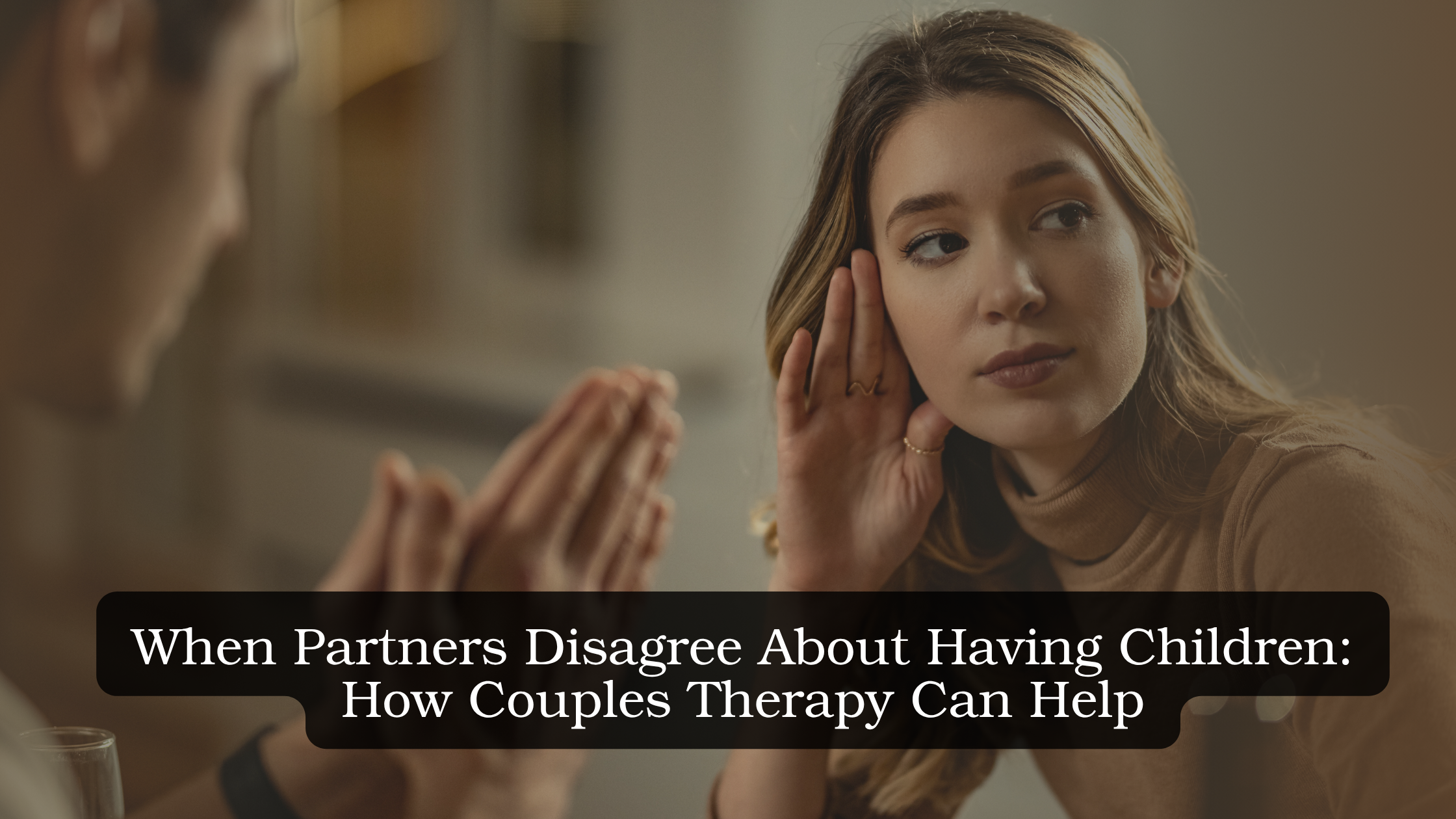
When Partners Disagree About Having Children: How Couples Therapy Can Help
Few relationship decisions carry as much emotional weight as deciding whether to have children. One partner may want to become a parent, while the other feels uncertain, unprepared, or prefers to remain child-free. This difference can raise difficult questions about the couple’s future, even when they share a strong relationship.
Their views may be shaped by concerns about finances, careers, health, personal freedom, or family expectations. When conversations lead to repeated arguments or avoidance, both partners may feel misunderstood and struggle to express what matters most to them.
Couples therapy offers a space to explore these differences without pressuring either partner to change their decision. It can help couples understand each other’s priorities, consider whether their expectations are compatible, and make an informed decision about their future together.
Why Couples Disagree About Having Children
Disagreements about parenthood can develop for many reasons. Sometimes partners have different long-term goals. In other relationships, their preferences have changed over time, or a previously unspoken difference becomes more pressing as the relationship progresses.
One partner may imagine raising children as an important part of family life. The other may value independence, worry about the responsibilities of parenting, or feel no desire to become a parent.
Neither position automatically indicates a lack of love or commitment.
Some people want children but worry about financial stability, career disruption, health concerns, or the state of the relationship. Others are comfortable with their lives as they are and do not want the demands of parenthood. Some remain genuinely uncertain.
Understanding the reason behind each person’s position is an important first step. A partner who says, “I’m not ready,” may be expressing a concern about timing rather than rejecting parenthood altogether. Someone who says, “I don’t want children,” may be communicating a settled preference rather than asking for reassurance.
These differences deserve careful attention rather than assumptions.
When the Disagreement Becomes a Relationship Problem
The disagreement itself may not damage a relationship as much as the way partners handle it.
One person may repeatedly raise the subject because they fear time is passing. The other may avoid the conversation because every discussion ends in conflict. Over time, one partner feels ignored while the other feels pressured.
A familiar cycle can develop:
- One partner asks for a decision or reassurance.
- The other becomes defensive or withdraws.
- The first partner interprets the response as indifference.
- The second feels increasingly controlled or misunderstood.
- Both become less willing to discuss the subject openly.
The original question about children gradually becomes a conflict about trust, respect, and whether each person’s needs matter, the pursuer-distancer cycle in a high-stakes setting.
Couples therapy can help identify this pattern and create a more productive way to discuss the decision without repeating the same argument.

Understand What Each Partner Really Wants
Before deciding what to do, couples need to understand the meaning parenthood holds for each person.
For one partner, having children may represent family continuity, a deeply held personal goal, or the experience of raising another generation. For the other, remaining child-free may represent a positive and deliberate choice involving independence, personal fulfilment, or a different vision of family life.
Some partners may also carry fears shaped by their childhood experiences, as covered in how childhood experiences affect adult relationships. Someone who grew up in a stressful household may worry about repeating those patterns. Another person may associate parenthood with belonging, connection, or a sense of purpose.
These possibilities should be explored rather than assumed.
Useful questions include:
- What does becoming a parent mean to me?
- What concerns me most about having children?
- Is my position based on personal preference, practical circumstances, fear, or a combination?
- Has my view changed over time?
- What do I imagine my life will look like in ten or twenty years?
- What would I feel I had lost if I agreed to the other person’s preference?
The purpose is not to find a hidden reason that invalidates someone’s answer. It is to understand the decision more fully.
Is It About Having Children or About When to Have Them?
Sometimes partners disagree about timing rather than parenthood itself.
One person may want children soon, while the other wants to become more financially stable, complete a qualification, advance professionally, or spend more time travelling before starting a family.
In these situations, it can help to distinguish between a clear preference and a condition that might change.
For example, “I want children, but I need us to be more financially prepared” is different from “I do not want to become a parent.”
If timing is the primary concern, couples can discuss what readiness means, which conditions are realistic, and when they will revisit the conversation. They should be careful not to turn an uncertain future promise into an indefinite postponement.
If one partner firmly wants children and the other firmly does not, waiting may not resolve the underlying incompatibility. Recognising that distinction can prevent years of uncertainty and resentment.
How Finances, Careers, and Lifestyle Affect the Decision
The decision to have children often involves practical considerations that deserve direct discussion.
Couples may need to consider childcare costs, housing, and career changes, where financial stress often becomes relationship stress.
One partner may worry about losing professional opportunities or becoming responsible for most of the childcare. The other may believe those concerns can be managed with planning.
Rather than dismissing practical concerns as excuses or assuming every difficulty can be solved financially, couples can examine what parenthood would realistically require.
They might discuss:
- How parental leave and childcare would be managed.
- Whether either partner expects to reduce working hours.
- How night-time care and household responsibilities would be divided.
- What financial changes they anticipate.
- How they would approach parenting if family support were limited.
- How much flexibility they would need in their careers.
These conversations may clarify whether a partner’s hesitation is connected to specific concerns that can be addressed or to a deeper lack of desire to become a parent.
The Pressure of Age, Family Expectations, and Social Norms
Couples do not make decisions about children in isolation. Family members, friends, cultural expectations, and social norms can influence how they think about parenthood.
A partner may feel pressure because relatives repeatedly ask about grandchildren. Someone may worry that they will regret remaining child-free because people around them are becoming parents. Others may feel that having children is expected after marriage, regardless of their personal preferences.
Age and fertility considerations can also make the conversation feel urgent for some couples. When relevant, these concerns may warrant an informed discussion with a qualified healthcare professional rather than relying on assumptions or general advice.
External pressure can make it difficult to distinguish personal desire from fear of disappointing others.
Couples therapy can help partners explore what they genuinely want, what they feel obligated to want, and how to make decisions without allowing outside expectations to dominate the relationship.

What If One Partner Hopes the Other Will Change Their Mind?
This is one of the most difficult situations couples can face.
A partner who wants children may believe the other person will eventually feel differently. Someone who does not want children may assume their partner will eventually realise that parenthood is unnecessary for a fulfilling life.
Both may be holding on to the hope that time will resolve the disagreement.
However, it is risky to enter or continue a long-term commitment on the assumption that a partner will change a deeply held preference. People can change their minds, but change cannot be guaranteed or demanded.
Couples therapy can help partners distinguish between genuine uncertainty and an attempt to avoid a painful answer, a form of emotional avoidance.. It can also provide space to discuss what each person can accept without pressuring the other to abandon their values.
How Couples Therapy Can Help With This Decision
Couples therapy offers a structured setting where both partners can express their preferences and concerns without the conversation becoming another argument.
Dr. Harel Papikian is a licensed clinical psychologist in Los Angeles with more than 16 years of experience working with individuals and couples.
When partners disagree about having children, therapy can help them:
Understand the disagreement: Explore the personal meaning of parenthood, concerns about responsibility, and expectations for the future.
Improve communication: Identify patterns of pressure, defensiveness, withdrawal, or repeated arguments that prevent productive conversations.
Separate fear from preference: Examine whether concerns relate to timing, practical circumstances, uncertainty, or a firm decision about parenthood.
Clarify shared and differing values: Identify where partners agree and where their long-term goals may genuinely differ.
Consider realistic options: Discuss possible paths forward without assuming that one partner must eventually give in.
Make a thoughtful decision: Reach greater clarity about the relationship, even when the final outcome is difficult.
Therapy is not intended to persuade someone to become a parent or convince someone to give up that possibility. The process should respect both partners’ autonomy while helping them understand the implications of their choices.
What If There Is No Compromise?
Some relationship disagreements allow for compromise. Partners can negotiate finances, household responsibilities, where to live, or how to balance work and family life.
Having children is different. There is no straightforward middle ground between becoming a parent and remaining child-free.
Adoption, fostering, assisted reproduction, or other family-building options may be relevant for some couples, but these are not automatic compromises. They require genuine interest, careful consideration, and agreement from both partners.
If one person strongly wants children and the other firmly does not, the couple may need to consider whether their long-term goals are compatible.
That possibility can be painful, particularly when there is considerable love and shared history. Yet avoiding the decision does not necessarily protect the relationship. It may prolong uncertainty while resentment grows.
Therapy can help couples face this possibility honestly, without treating separation as inevitable or marriage as an obligation to compromise on parenthood.
What If You Are Still Unsure?
Not everyone has a clear answer about having children. Some people feel genuinely undecided and need time to understand their preferences.
If both partners are uncertain, they can explore what information, reflection, or practical experience might help them make a more informed decision. They can also agree on a reasonable time to revisit the discussion, particularly if age, fertility, or other circumstances make timing important.
If one partner is certain and the other is undecided, it is important to acknowledge that difference rather than interpreting uncertainty as an eventual yes.
The goal is to create room for honest reflection, so the decision doesn’t happen by default, which is the risk explored in sliding vs. deciding.
Moving Forward With Greater Clarity
Disagreeing about having children does not automatically mean a relationship has failed. It does, however, raise a significant question about the future that deserves more than repeated arguments or assumptions that one partner will eventually change.
Couples therapy can help partners understand their preferences, communicate without pressure, and explore whether their visions for the future can coexist.
For couples in Los Angeles facing this decision, Dr. Harel can provide a space to examine the relationship dynamics involved and work toward clarity about the next step. That may mean reaching a shared decision, recognising that more reflection is needed, or acknowledging a fundamental difference in long-term goals.
The aim is not to guarantee that the couple stays together. It is to help both partners make a thoughtful decision that respects their values, autonomy, and understanding of the life they want to build.
Frequently Asked Questions
It depends on the nature of the disagreement and whether both partners’ long-term goals are compatible. If one firmly wants children and the other firmly does not, the difference may be difficult to reconcile.
No. Becoming a parent primarily to prevent a breakup can create significant emotional difficulties. The decision should reflect a genuine willingness to take on parenthood, not pressure or fear of losing a partner.
Ask what readiness means to them. They may have concerns about finances, timing, career, or the relationship, or they may be uncertain about parenthood itself. Understanding the distinction matters.
Therapy cannot guarantee that someone will change their preference. It can help both partners understand their positions, communicate honestly, and determine whether their goals are compatible.
There is no universal timeline. The appropriate timeframe depends on the couple’s circumstances, personal preferences, and any relevant fertility or health considerations. Agreeing on when to revisit the discussion can help prevent indefinite postponement.
Couples therapy can help you distinguish your own preferences from external expectations and discuss how you and your partner want to handle family pressure.
No. Choosing not to become a parent is a legitimate personal preference. What matters in a relationship is communicating that preference honestly and understanding its implications for your shared future.
Yes. Unmarried couples can seek therapy when deciding whether their long-term goals, including parenthood, are compatible.
Therapy can help partners discuss expectations around caregiving, discipline, finances, careers, and the division of responsibilities before making a decision about becoming parents.
Dr. Harel helps couples explore their values, expectations, communication patterns, and concerns about parenthood. Therapy provides a structured setting to discuss differences and make informed decisions without pressuring either partner toward a predetermined outcome.

Harel Papikian
Dr. Harel Papikian is a clinical psychologist and couples therapist with more than 15 years of experience. He offers marriage counseling and couples therapy in los Angeles. It help’s couples navigate their relationship challenges and deepen their connection. Our clinic uses a unique ARM method (Awareness, Release, Mastery) to achieve rapid and profound results for our clients. We serve a diverse clientele, including LGBTQ+ and heterosexual couples, addressing issues like communication breakdowns, conflict resolution, intimacy, and trust. You can also get individual therapy sessions for concerns like depression, anxiety, and trauma.
Leave a Reply