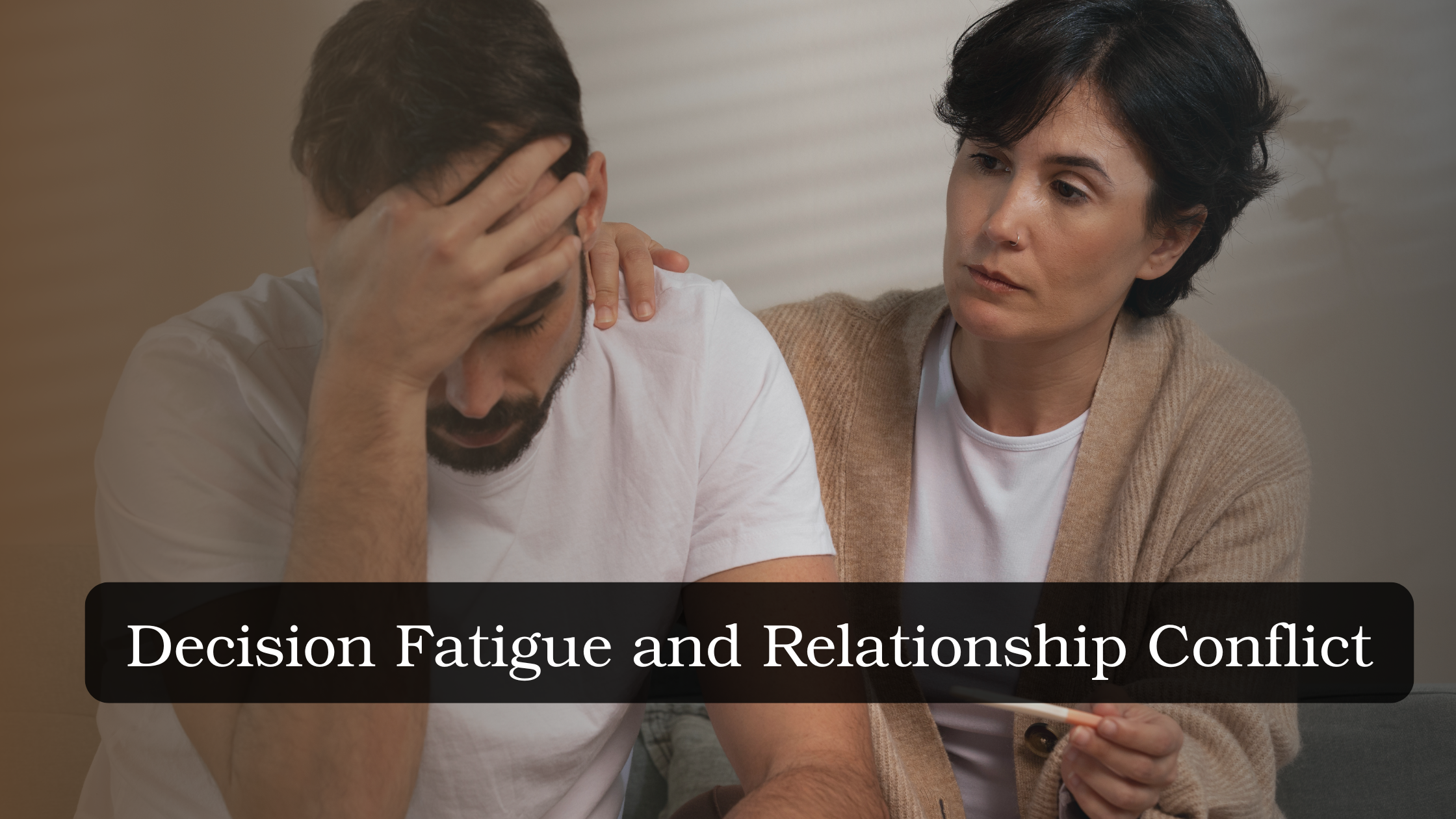
Decision Fatigue and Relationship Conflict
A demanding day does not always end when work is finished. Hours spent making choices, solving problems, managing responsibilities, and responding to competing demands can leave people mentally depleted by the time they reconnect with their partners. That depletion can make ordinary conversations feel harder than they normally would.
Decision fatigue describes the reduced willingness or capacity to keep making choices after sustained decision-making. While the concept does not explain every emotional reaction, mental exhaustion can make patience, attention, and self-regulation more difficult. Research on self-regulation and decision-making suggests that cognitive demands can influence how people respond to later challenges.
In relationships, this can turn a small disagreement about dinner, errands, or schedules into a larger argument. Recognizing the role of mental exhaustion can help couples pause, reduce blame, and choose a better time to communicate.
What Is Decision Fatigue?
Decision fatigue refers to the difficulty people may experience when they have made or evaluated many decisions over time. Everyday life requires continuous choices, from prioritizing work tasks to deciding what to eat, responding to messages, managing finances, and coordinating family responsibilities.
These decisions may include:
- Prioritizing work tasks
- Managing emails and phone calls
- Solving workplace problems
- Coordinating children’s schedules
- Making financial decisions ( one of the areas where financial stress can spill into the relationship even outside of an argument about money itself.)
- Planning meals
- Navigating traffic
- Responding to unexpected situations
Not every decision has the same psychological impact, and decision fatigue should not be treated as a simple depletion of a fixed mental resource. However, sustained cognitive demands can contribute to feeling overwhelmed, less motivated to make additional choices, or more likely to rely on simple responses.
That can become relevant in relationships, particularly when difficult conversations happen after an already demanding day.

Why Mental Exhaustion Can Make Conflict More Difficult
Healthy communication requires attention and emotional regulation. During disagreements, partners need to listen, interpret what the other person means, manage their own reactions, consider another perspective, and decide how to respond.
Mental exhaustion can make these processes more difficult.
A simple request such as, “Can you stop by the grocery store on your way home?” may feel disproportionately demanding after an exhausting day. The resulting response might sound irritated or dismissive even though the request itself is reasonable.
The disagreement may therefore be about more than groceries. The person’s reduced capacity to process another demand may be contributing to the reaction.
This does not mean every argument is caused by decision fatigue. It means exhaustion can influence the conditions under which conflict occurs.
When Small Decisions Start Feeling Overwhelming
One common experience associated with decision fatigue is becoming less willing to make additional choices.
Questions such as:
- “What should we have for dinner?”
- “Where should we go this weekend?”
- “Which option should we choose?”
- “Can you help me decide?”
may feel surprisingly difficult after a demanding day.
One partner may respond, “I don’t care,” avoid choosing, or become frustrated by having to evaluate another option. The other partner may interpret this as indifference or a refusal to participate.
They may think:
- “You don’t care.”
- “You’re leaving everything to me.”
- “You’re not participating.”
But the underlying issue may simply be that the person has reached their tolerance for additional decision-making.
Recognizing that possibility can prevent a moment of exhaustion from becoming a judgment about the relationship.
How Decision Fatigue Can Affect Emotional Patience
Mental exhaustion can also affect how people respond emotionally. When someone is already overloaded, relatively minor frustrations may feel harder to tolerate.
A person may become:
- Less patient
- More irritable
- More easily frustrated
- More defensive
- Less flexible during disagreements
This does not automatically mean they have negative feelings toward their partner. Their reaction may reflect the interaction between stress, fatigue, and the immediate circumstances.
However, understanding the possible role of exhaustion does not excuse hurtful behavior. Partners remain responsible for how they communicate. The useful distinction is between explaining a reaction and justifying it.
A couple can acknowledge, “We’re both exhausted right now,” while still returning later to address what was said or done.
Why Partners Can Misread Mental Exhaustion
Decision fatigue may not always look like exhaustion. A mentally overloaded partner might give shorter answers, forget details, avoid making plans, or appear uninterested in conversation.
The other partner may interpret these behaviors personally.
For example, someone who arrives home after a day filled with complex decisions may need quiet time before engaging in an emotionally demanding conversation. Their silence may reflect a need to decompress rather than rejection.
Misinterpretation can create a cycle: one partner withdraws because they are overwhelmed, the other seeks reassurance, and the first partner feels even more pressured. Without recognizing the underlying stress, both may respond to assumptions rather than what is actually happening.
A simple check-in—“Do you need some time before we talk?”—can sometimes interrupt that cycle.
How Decision Fatigue Affects Parenting
Parenting can involve a continuous stream of practical decisions, including:
- Meals and meal planning
- School schedules and homework
- Healthcare and appointments
- Activities and social plans
- Discipline and bedtime
- Household responsibilities
By the end of the day, parents may have little patience left for another discussion about who should handle the next task.
This can make parenting disagreements especially vulnerable to escalation. One partner may feel that they are carrying too much of the mental load, while the other may feel overwhelmed by constant demands.
The underlying issue may involve both exhaustion and a genuine imbalance in responsibilities. Recognizing decision fatigue should therefore not be used to dismiss concerns about unequal labor.
Instead, couples can ask two questions: “Are we exhausted right now?” and “Is there a recurring responsibility that needs to be redistributed?”
High-Pressure Careers and Cognitive Overload
Some occupations involve sustained attention, complex problem-solving, or frequent decisions. Healthcare professionals, business leaders, attorneys, entrepreneurs, teachers, emergency responders, and technology professionals may experience particularly demanding workdays.
Long commutes and unpredictable schedules can add another layer of strain.
By the time partners reconnect, they may have little cognitive or emotional capacity available for complicated conversations.one of many ways stress impacts romantic relationships beyond the argument itself. A discussion that might have been manageable earlier can therefore become harder late at night.
This does not mean couples should avoid important conversations. Instead, timing matters. A conversation requiring patience and problem-solving is more likely to be productive when both partners have enough capacity to participate.

Signs Mental Exhaustion May Be Affecting Your Relationship
Patterns can provide useful clues that fatigue is contributing to conflict.
Possible signs include:
- Arguments occurring mainly after demanding days
- Feeling overwhelmed by routine decisions
- Increased irritation over minor choices
- Frequently saying “I don’t care” when asked to choose
- Difficulty concentrating during conversations
- Forgetting details or previous discussions
- Reduced patience during disagreements
- Avoiding conversations that require problem-solving
These signs do not prove that decision fatigue is the cause of relationship conflict. They simply suggest that couples may benefit from examining whether stress, workload, and timing are influencing their interactions.
How Couples Can Reduce the Impact of Decision Fatigue
Small changes can reduce unnecessary cognitive demands and improve opportunities for productive communication.
Helpful strategies include:
- Choose better timing: Avoid major relationship discussions when both partners are exhausted.
- Create predictable routines: Simplifying recurring decisions can reduce unnecessary daily choices.
- Share the mental load: Responsibility should include planning and decision-making, not only completing tasks. ( a habit tied to broader relationship maintenance.)
- Allow decompression time: Give each partner a reasonable opportunity to transition from work into home life.
- Prioritize important conversations: Not every issue needs to be resolved immediately.
- Return to unresolved issues: Postponing a conversation should involve an intention to revisit it rather than avoiding it indefinitely. ( one of several fair fighting rules worth applying even after a pause.)
- Notice patterns: Track when arguments happen and whether fatigue consistently plays a role.
These strategies do not replace communication. They create conditions in which communication is more likely to work.
When Decision Fatigue May Be Masking a Larger Problem
Mental exhaustion can contribute to conflict, but it should not become an explanation for every recurring relationship difficulty.
If resentment, emotional distance, unequal responsibilities, or communication problems continue even when both partners are rested, there may be deeper concerns that require attention.
Similarly, repeated disrespect, controlling behavior, emotional withdrawal, or persistent unresolved conflict should not simply be attributed to fatigue.
Decision fatigue can intensify an existing problem without being its underlying cause. Distinguishing between temporary overload and persistent relationship patterns allows couples to address both appropriately.
How Dr. Harel Helps Couples Address Relationship Stress
In his Los Angeles practice, Dr. Harel Papikian works with individuals and couples experiencing relationship difficulties, communication challenges, and periods of significant stress. Therapy can provide a structured environment for understanding how external demands influence patterns between partners.
Rather than viewing every argument as evidence of incompatibility, couples can examine what happens before, during, and after conflict. This can help identify whether exhaustion, workload, communication habits, or deeper relationship concerns are contributing to recurring disagreements.
Dr. Harel’s work can help couples:
- Identify recurring patterns of conflict
- Communicate needs more clearly
- Understand how stress affects interactions
- Address resentment and unmet expectations
- Develop healthier approaches to disagreement
- Strengthen emotional connection and repair
Therapy is not simply about determining who is right. It can help partners understand the cycle they have developed and find more effective ways to respond to each other couples therapy can help even outside of a crisis.
Final Thoughts
Decision fatigue can be an overlooked factor in relationship conflict. After a day filled with choices, responsibilities, and problem-solving, people may have less patience for another demanding conversation. A minor disagreement can then feel much larger than it would under different circumstances.
Recognizing mental exhaustion does not mean ignoring genuine relationship problems. It means considering whether timing, stress, and cognitive overload are influencing the interaction.
Sometimes the healthiest response is to pause rather than push toward immediate resolution. Resting, simplifying decisions, and returning to the conversation when both partners have greater capacity can create better conditions for understanding.
Strong relationships are built not only through what couples communicate, but also through knowing when and how to communicate effectively.
Frequently Asked Questions
Accumulated mental and emotional demands may leave both partners with less patience and flexibility. If disagreements consistently occur after particularly demanding days, exhaustion may be contributing to the pattern.
It can contribute to irritability and reduced tolerance for frustration. A minor behavior may feel much more bothersome when someone is already mentally overloaded. However, persistent negative feelings should not automatically be attributed to fatigue.
After a demanding day, additional choices may feel burdensome. Difficulty choosing dinner, making plans, or answering routine questions can sometimes reflect mental overload rather than laziness or indifference.
Often, yes. If neither person has enough capacity for a productive discussion, taking a break and agreeing to revisit the issue later may be more constructive than continuing while both are depleted.
Look for patterns across different circumstances. If conflict decreases significantly when both partners are rested, fatigue may be contributing. If the same concerns remain regardless of workload or timing, deeper relationship issues may deserve attention.
Yes. Repeatedly carrying a large share of household or parenting decisions can contribute to frustration and resentment. In that situation, couples should address the distribution of responsibility rather than treating exhaustion as the entire problem.
The immediate task may be only the trigger. Accumulated stress, unequal responsibilities, or mental exhaustion can make a minor request feel much more significant and increase the likelihood of escalation.
A shared agreement can help. Couples may decide to avoid major discussions when either person is extremely tired and choose a predictable time when both can listen and respond thoughtfully.
It can. Creating routines for meals, errands, schedules, and other recurring choices may reduce unnecessary cognitive demands and leave more attention available for meaningful conversations.
If mental exhaustion repeatedly contributes to conflict, resentment, withdrawal, or communication breakdowns, therapy can help identify the pattern. It can also clarify whether stress is the primary issue or whether deeper relationship concerns are present.

Harel Papikian
Dr. Harel Papikian is a clinical psychologist and couples therapist with more than 15 years of experience. He offers marriage counseling and couples therapy in los Angeles. It help’s couples navigate their relationship challenges and deepen their connection. Our clinic uses a unique ARM method (Awareness, Release, Mastery) to achieve rapid and profound results for our clients. We serve a diverse clientele, including LGBTQ+ and heterosexual couples, addressing issues like communication breakdowns, conflict resolution, intimacy, and trust. You can also get individual therapy sessions for concerns like depression, anxiety, and trauma.
Leave a Reply