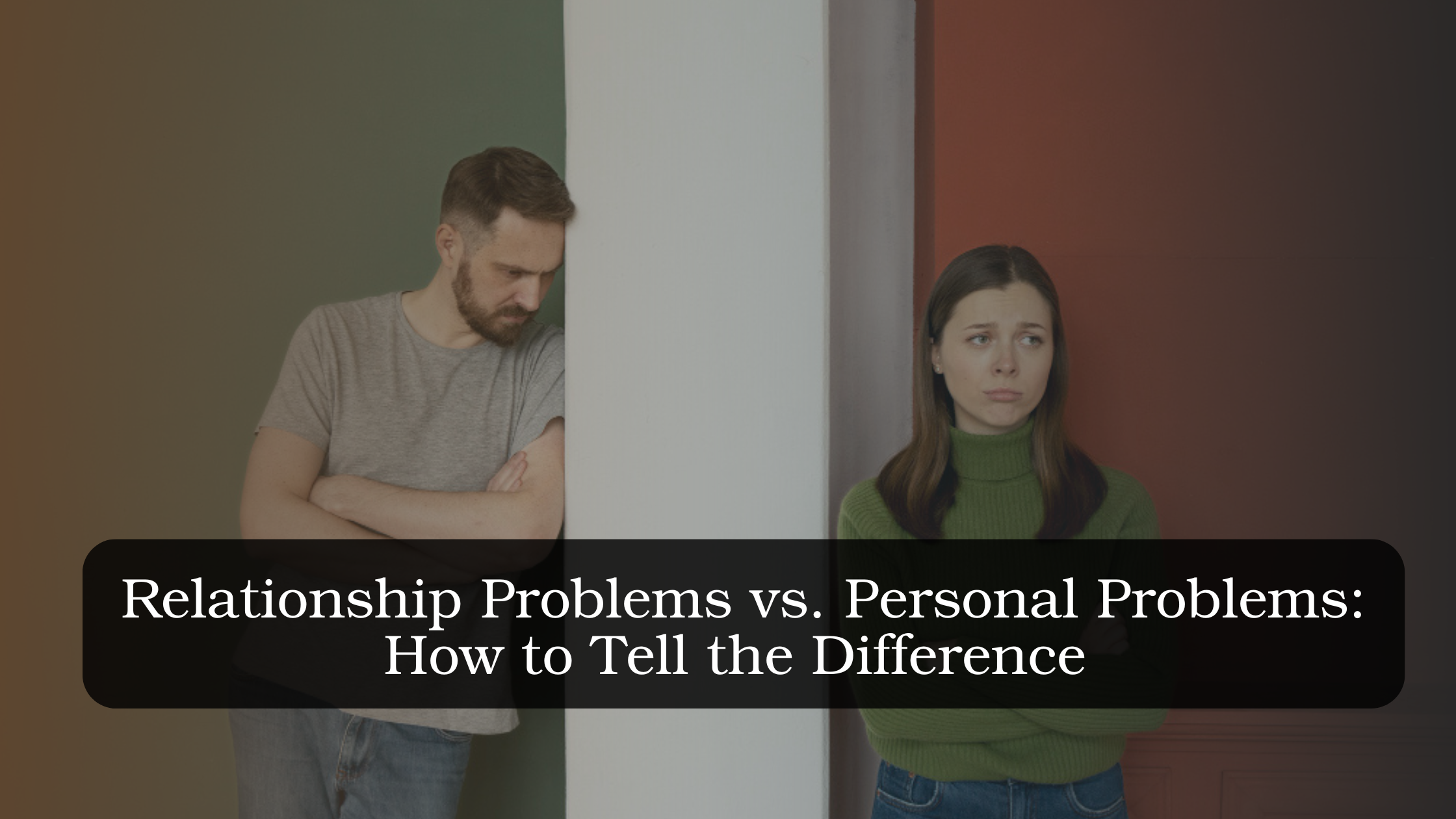
Relationship Problems vs. Personal Problems: How to Tell the Difference
When a relationship feels difficult, it is natural to look at your partner and ask, “What are we doing wrong?” After all, if the conflict is happening between you, it can seem logical to assume the relationship itself must be the problem. But that is not always the case.
Sometimes a relationship creates unhealthy patterns that need to be addressed together. Other times, personal fears, unresolved experiences, anxiety, or insecurities become activated within the relationship. The challenge may involve both.
Dr. Harel, a licensed clinical psychologist in Los Angeles with over 16 years of experience, often helps couples look beneath recurring conflict to understand where their distress is actually coming from. Identifying whether an issue belongs primarily to one person, the relationship, or both can make it easier to determine what needs to change.
What Makes Something a Relationship Problem?
A relationship problem develops within the interaction between two people. It is usually maintained by a recurring pattern in how partners communicate, respond, or react to one another.
Consider a couple in Sherman Oaks. One partner tries to discuss a difficult issue, while the other becomes quiet and withdraws. Feeling ignored, the first partner pushes harder for a response. The second partner feels increasingly overwhelmed and withdraws even more.
Eventually, they become stuck.
One pursues. One retreats. Each person’s response reinforces the other’s. ( a textbook version of the pursuer-distancer cycle.)
The issue is not simply that one person talks too much or the other avoids communication. The interaction between them has become the problem.
Common relationship problems include:
- Repeated unresolved arguments
- Communication breakdowns
- Emotional disconnection
- Mismatched expectations
- Trust difficulties
- Problems adjusting to major life changes
These issues generally require both partners to examine their contribution to the pattern.

What Makes Something a Personal Problem?
A personal problem originates within an individual’s emotional or psychological experience, even though it can strongly affect their relationship.
These patterns may have existed before the current relationship and can sometimes appear in friendships, family relationships, or previous partnerships.
For example, someone who grew up with inconsistent affection may become highly sensitive to rejection as an adult. A delayed text, canceled plan, or partner asking for some space may trigger intense anxiety.
The current situation may be real, but the emotional intensity may be influenced by an older experience.
Personal struggles can include:
- Anxiety
- Low self-esteem
- Unresolved trauma
- Fear of abandonment
- Unresolved grief
- Perfectionism
- Emotional regulation difficulties
- Depression
This does not mean the relationship is irrelevant. Personal struggles can significantly influence communication, trust, intimacy, and conflict.
Why Is It So Difficult to Tell the Difference?
Personal wounds often become most visible inside intimate relationships.
Close relationships require vulnerability. You depend on another person, share your emotions, and become exposed to the possibility of rejection or disappointment. As a result, experiences that remain manageable elsewhere can become intensely activated with a partner.
Someone who grew up feeling constantly criticized may hear constructive feedback as an attack. one of many ways childhood experiences shape adult relationships.
Someone with a history of abandonment may experience their partner needing alone time as a sign that they are being left.
In both situations, the present interaction matters. But the emotional reaction may also be connected to the past.
This is why couples can spend hours arguing about what happened without understanding why the event affected them so strongly.
When Personal Issues Begin Affecting the Relationship
Personal and relationship problems are not separate boxes. A personal struggle can become part of a couple’s recurring dynamic.
| Personal Challenge | How It May Affect the Relationship |
| Anxiety | Reassurance seeking and constant worry |
| Low self-esteem | Difficulty accepting affection or compliments |
| Fear of abandonment | Jealousy or emotional dependence |
| Unresolved trauma | Difficulty trusting or being vulnerable |
| Depression | Withdrawal and reduced emotional connection |
| Perfectionism | Excessive self-criticism or criticism of a partner |
For example, fear of abandonment may lead someone to repeatedly seek reassurance. Their partner may eventually feel pressured and withdraw. closely related to what’s often called relationship anxiety. That withdrawal then reinforces the original fear.
A personal issue has now become part of a relationship cycle.
Understanding that connection can help couples move away from labels such as “needy,” “cold,” or “controlling” and begin looking at what is happening underneath the behavior.
What Happens When Couples Misidentify the Problem?
Misunderstanding the source of a problem can lead couples to work on the wrong thing.
If an individual struggle is treated only as a relationship problem, partners may spend years trying to fix communication while an underlying issue remains unaddressed.
For example, reassurance from a partner may temporarily calm abandonment fears, but it may not resolve the deeper fear itself.
The opposite can happen too.
Sometimes one partner dismisses legitimate relationship concerns as “your insecurity” or “your anxiety.” This can prevent them from acknowledging behavior that genuinely contributes to the problem.
Healthy relationships require both perspectives.
Personal responsibility should not become an excuse for unhealthy relationship behavior, and relationship accountability should not become a way of avoiding individual work.
Questions That Can Help You Understand Where the Problem Comes From
When emotions are high, determining the source of a problem can be difficult. Instead of immediately asking who is responsible, consider asking:
Have I experienced this pattern in previous relationships?
Does my reaction feel much stronger than the situation itself?
Would I likely struggle with this regardless of who my partner was?
Does this concern also appear in my friendships, family relationships, or work?
Is our interaction creating the problem, or is something from my past being activated?
These questions are not about assigning blame. They are about creating awareness.
Sometimes the answer is clearly personal. Sometimes it is clearly relational. Often, both are involved.

How Couples Therapy Can Help Untangle the Two
When couples are caught in recurring conflict, it can be difficult to step outside the pattern long enough to understand it.
Therapy creates space to slow that process down.
Instead of focusing only on who is right, therapy can explore what happens before, during, and after conflict. It can help identify communication patterns, attachment dynamics, emotional triggers, unresolved experiences, and behaviors that keep the cycle going.
The goal is not to determine which partner is “the problem.”
It is to understand the problem accurately enough to know what needs to change. This is exactly why couples therapy can help even outside a crisis.
Dr. Harel’s Approach to Personal and Relationship Problems
In his Los Angeles practice, Dr. Harel Papikian works with individuals and couples who may initially describe their difficulties as communication problems, recurring arguments, emotional distance, or relationship dissatisfaction.
His approach involves looking beneath those presenting concerns to understand the patterns influencing them.
This may include exploring:
- How past experiences affect present reactions
- Whether emotional triggers are personal or relational
- How each partner contributes to recurring cycles
- Attachment and communication patterns
- Individual emotional needs and vulnerabilities
- What each person can take responsibility for changing
Rather than automatically placing responsibility on one partner, the work focuses on creating a clearer picture of what is actually happening.
That distinction matters because different problems require different forms of change. A relationship pattern may require work between both partners, while an individual wound may require more personal therapeutic attention. Sometimes, both forms of work are necessary.
Final Thoughts
Not every problem that appears inside a relationship originates within the relationship.
Sometimes two partners have developed an unhealthy interaction pattern. Sometimes one person’s unresolved experiences are being activated. And often, personal struggles and relationship dynamics reinforce one another.
The goal is not to determine who is at fault. It is to understand where the distress is coming from.
When couples replace “Whose fault is this?” with “What is creating this pattern?”, they can begin approaching conflict with greater curiosity and responsibility.
That shift can make it easier to address personal issues, improve relationship dynamics, and build a healthier form of connection.
Frequently Asked Questions
Look at whether the same difficulties occur primarily with your current partner or across different relationships and situations. A therapist can also help identify whether the issue is relational, individual, or both.
They can create significant strain if they remain unaddressed. Anxiety, unresolved trauma, insecurity, or fear of abandonment can influence trust, communication, and intimacy even in otherwise healthy relationships.
No. Relationships involve two people. Recognizing your own patterns does not mean ignoring behaviors from your partner that genuinely contribute to the problem.
Yes. Couples therapy can help partners understand how individual struggles affect their dynamic. Depending on the situation, individual therapy may also be recommended alongside couples work.
That is common. Each person’s experiences can interact with the other’s, creating a cycle that neither partner can easily understand alone. Therapy can help identify these overlapping patterns.
Not necessarily. Couples therapy can be useful precisely because personal and relationship issues often overlap. The appropriate approach depends on what you and your partner are experiencing.

Harel Papikian
Dr. Harel Papikian is a clinical psychologist and couples therapist with more than 15 years of experience. He offers marriage counseling and couples therapy in los Angeles. It help’s couples navigate their relationship challenges and deepen their connection. Our clinic uses a unique ARM method (Awareness, Release, Mastery) to achieve rapid and profound results for our clients. We serve a diverse clientele, including LGBTQ+ and heterosexual couples, addressing issues like communication breakdowns, conflict resolution, intimacy, and trust. You can also get individual therapy sessions for concerns like depression, anxiety, and trauma.
Leave a Reply