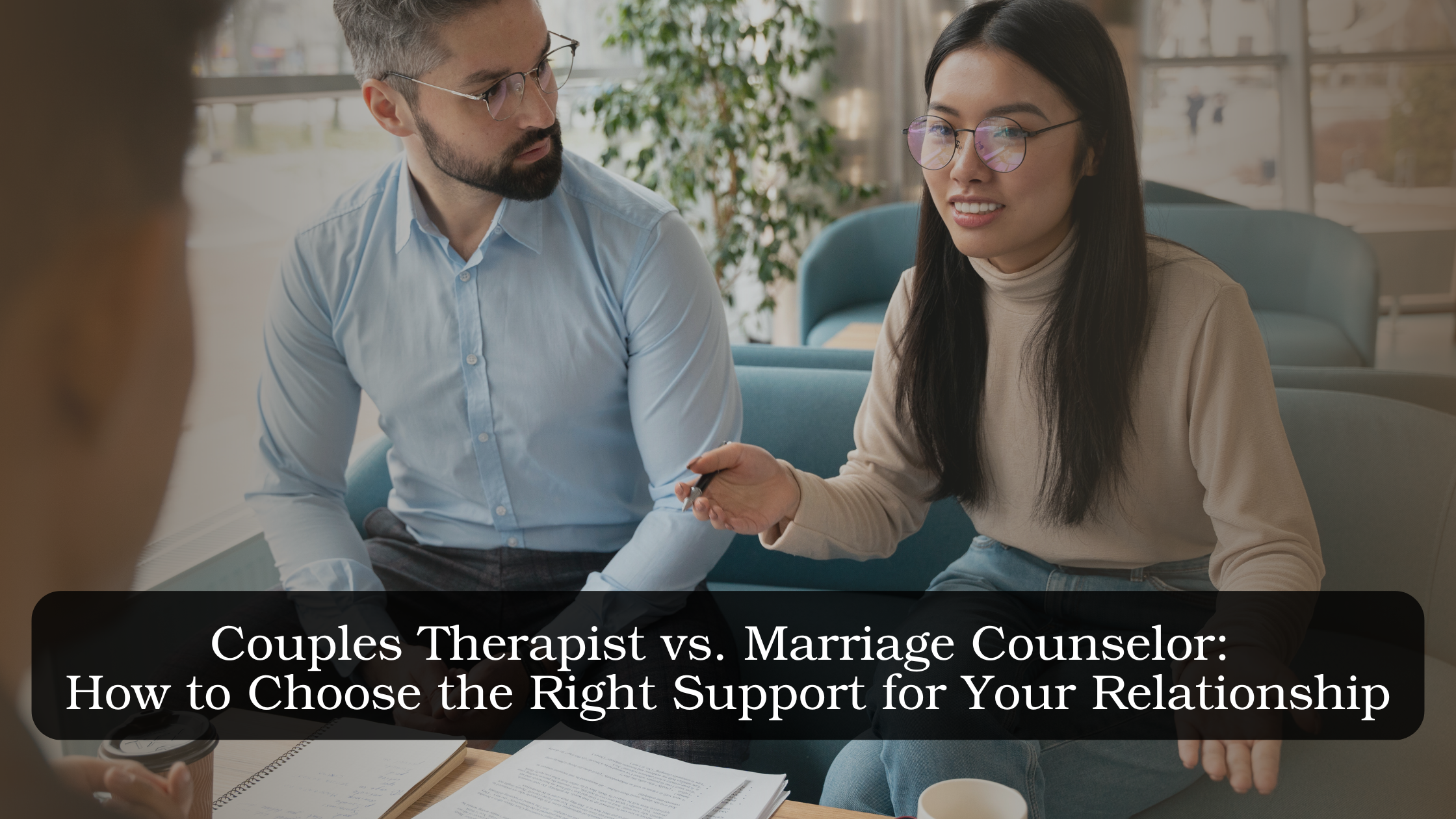
Couples Therapist vs. Marriage Counselor: How to Choose the Right Support for Your Relationship
When a relationship becomes difficult, many couples know they need support but aren’t sure what type of professional to choose. Searches for “couples therapist,” “marriage counselor,” “relationship therapist,” and “marriage counseling” can produce thousands of results
The terms “couples therapist” and “marriage counselor” are often used interchangeably. In many cases, the more important difference isn’t the title but the professional’s training, experience, therapeutic approach, and ability to address your specific concerns
.
Whether you’re married, engaged, dating, or in a long-term partnership, the key question is whether the professional understands the dynamics affecting your relationship and can provide the support you need.
Couples Therapist vs. Marriage Counselor: Is There Really a Difference?
There isn’t always a clear clinical distinction between the two terms.
A marriage counselor may work with married couples experiencing communication problems, recurring arguments, intimacy concerns, infidelity, or major life transitions. A couples therapist may work with married and unmarried partners dealing with many of the same concerns.
The term “marriage counseling” is also commonly used as a general description of relationship support.
Instead of focusing only on the title, consider:
- What professional license does the provider hold?
- What training do they have in couples therapy?
- How much experience do they have working with relationship concerns?
- What therapeutic approaches do they use?
- Do they have experience with your specific concerns?
- Do both partners feel comfortable with their approach?
These questions can tell you much more than whether someone calls themselves a therapist or counselor.

What Does a Couples Therapist Do?
A couples therapist focuses on the relationship between two people.
Therapy may address recurring conflict, communication difficulties, emotional disconnection, intimacy, infidelity, trust, or major changes within the relationship.
Rather than determining who is right during an argument, therapy can examine the pattern between partners.
For example, one partner may become critical when feeling ignored, while the other withdraws because they feel attacked. The more one criticizes, the more the other withdraws, creating an escalating cycle.
The original disagreement may no longer be the central problem often it’s a version of the pursuer-distancer cycle playing out underneath iA couples therapist can help partners recognize these cycles and develop healthier ways of responding.
What Does a Marriage Counselor Do?
Marriage counseling traditionally focuses on helping married partners address relationship difficulties.
Common concerns include:
- Communication problems
- Frequent conflict
- Emotional distance
- Infidelity
- Intimacy concerns
- Parenting disagreements
- Financial conflict
- Family issues
- Major life transitions
- Trust problems
- Separation or divorce considerations
Despite the name, marriage counseling isn’t necessarily limited to legally married couples. Many professionals use the term to describe relationship therapy more broadly.
Again, qualifications and experience matter more than the label.
When Should You Consider Couples Therapy?
Couples therapy may be appropriate when the central concern involves the relationship itself.
You might consider it if:
- You keep having the same arguments.
- Communication frequently becomes defensive or hostile.
- You feel emotionally disconnected.
- You’re struggling to rebuild trust.
- Intimacy has changed.
- Resentment has accumulated.
- You’re dealing with parenting or family disagreements.
- You’re facing a major life transition.
- You’re considering separation.
- You want to strengthen the relationship before problems become more serious.
Couples therapy isn’t only for relationships in crisis. Some couples seek support to improve communication or prepare for marriage, parenthood, relocation, retirement, or other significant changes.
What Should You Consider When Choosing a Couples Therapist?
When choosing a professional, investigate their actual credentials and experience.
Depending on the provider, couples therapy may be offered by a licensed clinical psychologist, marriage and family therapist, clinical social worker, professional counselor, or another appropriately licensed mental health professional.
Look at their education, licensing, specialized training, and experience.
Someone who primarily treats individual anxiety or depression may not necessarily have extensive experience working with complex relationship dynamics. If couples therapy is what you need, look for someone who regularly works with couples.
Consider Their Therapeutic Approach
Different therapists may approach relationship therapy differently.
Some focus on communication skills, while others explore attachment, emotional patterns, family history, conflict cycles, or long-standing relationship dynamics. Some approaches are highly structured, while others focus more on emotional experiences and underlying patterns.
There isn’t one approach that is automatically right for every couple.
The most appropriate approach depends on what you’re experiencing and what you want to accomplish.
Consider Whether You Feel Comfortable With Your Therapist
Even a highly qualified therapist may not be the right fit for every couple.
Both partners should ideally feel that the therapist understands their perspectives without automatically taking sides. You should also feel comfortable discussing sensitive subjects such as sexuality, betrayal, anger, family conflict, and disappointment.
A good therapeutic relationship doesn’t mean the therapist agrees with everything either partner says. It means both people feel heard while being encouraged to examine the relationship honestly.

Questions to Ask Before Choosing a Therapist
Before scheduling a first session, consider asking:
- Do you regularly work with couples?
- What relationship concerns do you commonly treat?
- What is your therapeutic approach?
- Do you work with unmarried couples?
- Do you offer online sessions?
- How do you handle situations where partners strongly disagree?
The answers can help you determine whether the therapist’s experience and approach match your needs.
What If Only One Partner Wants Therapy?
This is common.
One partner may feel that professional help is urgently needed while the other believes the relationship isn’t that serious.
You can still discuss the situation with a therapist. In some circumstances, changing your own communication patterns can influence the overall relationship dynamic. In others, individual therapy may be a more appropriate starting point.
A qualified professional can help determine what type of support makes sense.
What If You’re Unsure Whether to Stay Together?
You don’t necessarily need to know whether you want to remain together before seeking therapy.
Some couples enter therapy wanting to repair their relationship. Others are uncertain about whether continuing together is the right decision.
Therapy can provide a structured setting to understand what has happened, what each partner wants, and whether meaningful change is possible.
The purpose isn’t necessarily to pressure a couple toward staying together or separating. It is to help both partners understand their situation more clearly.
How Dr. Harel Approaches Couples Therapy
When choosing a couples therapist, it can be helpful to consider whether the professional looks beyond the surface argument.
Dr. Harel works with couples to explore communication patterns, emotional needs, conflict cycles, relationship expectations, and experiences that may influence how partners respond to each other.
For couples who have been stuck in the same patterns for years, Dr. Harel’s ARM Method offers a structured way to understand why those patterns continue.
His work focuses on helping partners develop greater awareness of what happens within their relationship and create more effective ways of responding to one another.
Don’t Wait Until the Relationship Is in Crisis
Couples therapy isn’t only something to consider when a relationship is close to ending.
By the time a couple seeks help, resentment and emotional distance may already be deeply established. Seeking support earlier can provide an opportunity to address recurring problems before they become entrenched.
You don’t have to be constantly fighting to benefit from relationship therapy couples therapy can help even outside of a crisis for exactly this reason.
Choosing the Right Support for Your Relationship
The difference between a couples therapist and a marriage counselor is often less important than finding a qualified professional whose experience and approach match your needs.
Look beyond the title. Consider credentials, specialized training, experience, therapeutic approach, availability, and whether both partners feel comfortable with the therapist.
Whether you call it couples therapy or marriage counseling, the goal is to create a space where partners can understand each other more clearly, address difficult patterns, and make thoughtful decisions about their relationship.
Frequently Asked Questions
Often, yes. The terms are frequently used interchangeably. The more important considerations are the professional’s license, training, experience, and therapeutic approach.
No. Couples therapy can be appropriate for dating partners, engaged couples, long-term partners, and married couples.
No. Couples may seek therapy for communication problems, emotional distance, intimacy concerns, life transitions, or to strengthen an already healthy relationship.
Ideally, yes. If you’re dealing with infidelity, intimacy concerns, high-conflict communication, or another significant issue, relevant experience can be particularly helpful.
You can discuss the situation individually with a therapist. Depending on your circumstances, individual therapy may help you understand your own responses and determine how to approach the relationship.
It can provide a structured setting for addressing betrayal, rebuilding communication, understanding relationship dynamics, and determining what both partners need moving forward.
Consider whether both partners feel heard, respected, and comfortable discussing difficult topics. You can also ask about the therapist’s training, experience, and approach.
Yes. Many therapists offer telehealth sessions when appropriate, which can be convenient for couples with demanding schedules or other practical limitations.
Dr. Harel works with couples to understand recurring relationship patterns, communication difficulties, emotional needs, and sources of disconnection. His approach focuses on helping partners develop greater awareness and more constructive ways of relating.
You don’t have to wait for a crisis. If the same problems keep recurring, communication is becoming difficult, or you feel increasingly disconnected, seeking support earlier may help prevent these patterns from becoming more deeply established.

Harel Papikian
Dr. Harel Papikian is a clinical psychologist and couples therapist with more than 15 years of experience. He offers marriage counseling and couples therapy in los Angeles. It help’s couples navigate their relationship challenges and deepen their connection. Our clinic uses a unique ARM method (Awareness, Release, Mastery) to achieve rapid and profound results for our clients. We serve a diverse clientele, including LGBTQ+ and heterosexual couples, addressing issues like communication breakdowns, conflict resolution, intimacy, and trust. You can also get individual therapy sessions for concerns like depression, anxiety, and trauma.
Leave a Reply