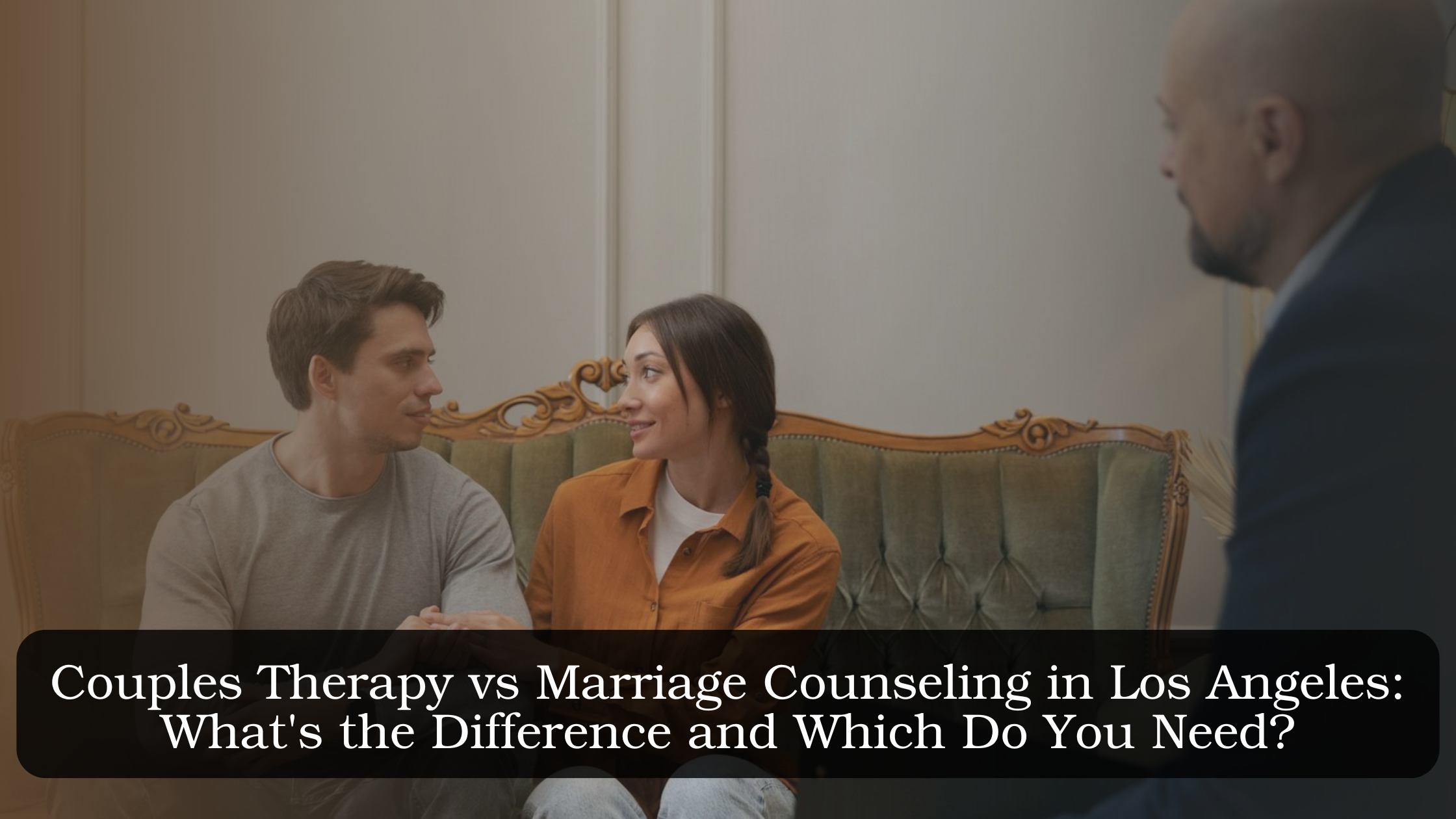
Couples Therapy vs Marriage Counseling in Los Angeles: What’s the Difference and Which Do You Need?
If you have started looking for relationship support, you may have noticed two terms appearing repeatedly: couples therapy and marriage counseling. They are often used interchangeably, which can make choosing the right type of support confusing.
Both can help partners address communication problems, conflict, emotional disconnection, trust concerns, and major life changes. The terminology also varies between clinicians, so the name of the service does not always tell you exactly what treatment will involve.
In general, marriage counseling is often associated with addressing current relationship problems and developing practical ways to manage them, while couples therapy may involve more exploration of emotional patterns and longstanding relationship dynamics. The right choice depends less on the label and more on what is happening in your relationship.

What Is Marriage Counseling?
Marriage counseling generally focuses on helping partners address specific problems affecting their relationship.
Depending on the couple’s needs, sessions may focus on:
- Communication difficulties
- Parenting disagreements
- Financial stress
- Major life transitions
- Conflict resolution
- Differences in expectations
- Reduced emotional connection
- Premarital concerns
For example, a couple who recently became parents may be arguing about childcare, household responsibilities, and how much time each partner has for themselves.
They may still have a strong relationship but need help communicating more effectively and creating a workable approach to their new responsibilities.
Marriage counseling in this situation may be relatively practical and focused on the challenges the couple is facing now.
What Is Couples Therapy?
Couples therapy can also address immediate relationship problems, but it may go further by exploring the emotional and relational patterns underneath them.
Instead of only asking:
“How can we stop arguing about money?”
therapy may also explore:
“Why does talking about money trigger anxiety in one partner and withdrawal in the other?”
A couple may discover that their financial arguments are connected to very different experiences of security, responsibility, control, or trust one of many ways financial stress affects a relationship.
Couples therapy may therefore involve examining:
- Recurring relationship patterns
- Emotional triggers
- Attachment and connection
- Trust and vulnerability
- Unresolved experiences
- Patterns of pursuing and withdrawing often called the pursuer-distancer cycle.
- How each partner interprets the other’s behavior
The goal is not simply to resolve one argument. It may be to understand why similar conflicts continue appearing in different forms.
Couples Therapy vs. Marriage Counseling: What’s the Difference?
There is significant overlap between the two.
| Marriage Counseling | Couples Therapy |
| Often emphasizes current relationship concerns | May explore current concerns and deeper relational patterns |
| Frequently focuses on practical strategies | May combine practical strategies with deeper emotional work |
| Can address specific situational problems | Can address recurring or longstanding patterns |
| May focus on communication and problem-solving | May explore emotional triggers, attachment, and relationship dynamics |
| Can be useful during major life transitions | Can be useful when relationship patterns have become entrenched |
This is a general distinction rather than a strict clinical rule. A therapist may use elements of both approaches depending on the couple and the concerns they bring to treatment.
When Marriage Counseling May Be a Good Fit
Marriage counseling may be appropriate when your relationship is generally stable but you are struggling with a specific challenge.
You Are Facing a Major Life Transition
Becoming parents, relocating, changing careers, retirement, or adjusting to an empty nest can alter the way partners relate to each other.
You Are Struggling With Communication
You may care about each other but repeatedly misunderstand one another or struggle to discuss difficult subjects without becoming defensive.
Parenting Has Created Tension
Differences in discipline, responsibilities, routines, or expectations can create conflict even in otherwise healthy relationships.
A Specific Problem Has Created Stress
Financial difficulties, changes in work, family pressures, or other circumstances can temporarily strain a relationship.
In these situations, practical guidance can help partners communicate more effectively and develop strategies for managing the problem together.
When Couples Therapy May Be More Appropriate
Couples therapy may be particularly useful when the problem feels bigger than the issue you are arguing about.
You Keep Having the Same Argument
If the subject changes but the emotional pattern remains the same, there may be an underlying dynamic that needs attention.
One partner pursues. The other withdraws. One becomes anxious. The other becomes defensive. The argument ends, but nothing actually changes a hallmark of recurring relationship patterns.
You Feel Emotionally Disconnected
You may still live together, share responsibilities, and care about each other while feeling lonely or more like roommates than romantic partners.
Trust Has Been Damaged
Infidelity, secrecy, betrayal, or repeated breaches of trust can create relationship wounds that are difficult to resolve through practical communication strategies alone.
Past Experiences Affect the Relationship
Childhood experiences or previous relationships can influence how people respond to rejection, conflict, intimacy, criticism, or separation.
For example, one partner may experience a request for space as abandonment while the other sees it simply as a need for time alone.
Understanding these patterns can help couples respond to the underlying emotional experience rather than continuing to fight about the surface issue patterns often traced back to how childhood experiences affect adult relationships.
What About Couples in Los Angeles?
Los Angeles couples may be managing demanding careers, long commutes, parenting, financial pressures, travel, and unpredictable schedules alongside their relationships.
A couple may not have a major relationship crisis. Instead, they may simply have very little time or emotional energy left for each other.
Over time, this can contribute to:
- Emotional distance
- Reduced affection
- Repeated arguments
- Resentment
- Communication problems
- Feeling more like a team than a couple
Seeking couples therapy does not require a relationship to be in crisis. Couples can seek support when they notice patterns they want to change before those patterns become more entrenched.

How Do You Know Which One You Need?
Ask yourself what best describes your situation.
You may be looking for more practical relationship counseling if:
- Your relationship is generally strong
- A recent situation has created stress
- You need help communicating about a specific issue
- You are adjusting to a major life change
- You want practical strategies for solving problems together
You may benefit from deeper couples therapy if:
- The same conflicts keep repeating
- You feel chronically disconnected
- Arguments trigger unusually strong emotional reactions
- Trust has been significantly damaged
- You struggle to understand each other’s reactions
- One partner repeatedly pursues while the other withdraws
- You suspect past experiences are affecting the relationship
- Previous attempts to solve the problem have not worked
You do not necessarily have to determine the answer before contacting a therapist. A qualified clinician can assess what is happening and help determine an appropriate approach.
The Therapist Matters More Than the Label
Searching specifically for “marriage counseling” or “couples therapy” can be useful, but the terminology should not become the deciding factor.
When choosing a therapist, consider whether they have experience with the concerns affecting your relationship and whether their approach fits your needs.
A good initial conversation should help clarify:
- What you are experiencing
- What you hope will change
- What patterns are causing difficulty
- Whether both partners are willing to participate
- What type of therapeutic approach may be appropriate
How Dr. Harel Papikian Can Help
Dr. Harel Papikian is a licensed clinical psychologist in Los Angeles with more than 16 years of experience working with individuals and couples.
Dr. Harel works with couples experiencing communication difficulties, emotional disconnection, recurring relationship patterns, and other concerns affecting their ability to connect.
His work can involve both practical relationship strategies and deeper exploration of the emotional patterns underlying a couple’s difficulties including the structured framework behind his ARM Method.
Whether you initially describe what you need as marriage counseling or couples therapy, the more important question is what kind of support will best address your relationship.
Final Thoughts
Couples therapy and marriage counseling overlap considerably, and there is no universal rule that one is appropriate for a particular type of couple.
Marriage counseling is often associated with practical support for current relationship challenges, while couples therapy may involve greater exploration of recurring emotional and relational patterns. In practice, a therapist may draw from both depending on the couple’s circumstances.
If you are dealing with a specific life challenge, practical relationship support may be enough. If you are caught in longstanding cycles of conflict, disconnection, mistrust, or emotional reactivity, deeper couples therapy may be worth considering.
The goal is not to choose the most impressive-sounding service. It is to find support that addresses what is actually happening between you and your partner.
FAQs
They overlap significantly, and clinicians may use the terms differently. Marriage counseling is often associated with practical, present-focused relationship concerns, while couples therapy may involve more exploration of emotional and relational patterns.
No. Couples therapy can be appropriate for married, engaged, dating, or long-term partners.
No. Couples can seek therapy to improve communication, strengthen emotional connection, navigate transitions, or address recurring problems before they become more serious.
You do not necessarily need to decide beforehand. A qualified therapist can discuss your concerns, understand the relationship dynamics, and recommend an approach based on your needs.
It can. When couples repeatedly have the same arguments, therapy can help identify the interactional and emotional patterns underneath those conflicts and develop different ways of responding.

Harel Papikian
Dr. Harel Papikian is a clinical psychologist and couples therapist with more than 15 years of experience. He offers marriage counseling and couples therapy in los Angeles. It help’s couples navigate their relationship challenges and deepen their connection. Our clinic uses a unique ARM method (Awareness, Release, Mastery) to achieve rapid and profound results for our clients. We serve a diverse clientele, including LGBTQ+ and heterosexual couples, addressing issues like communication breakdowns, conflict resolution, intimacy, and trust. You can also get individual therapy sessions for concerns like depression, anxiety, and trauma.
Leave a Reply