Health Anxiety in Relationships: How It Affects Your Partner and How Anxiety Therapy Helps
Health concerns can affect a relationship even when only one partner is experiencing them. When worries about illness become persistent, the relationship may gradually become organized around checking symptoms, seeking reassurance, researching medical conditions, or repeatedly discussing what might be wrong. The partner may become involved in these behaviors without knowing how much reassurance is helpful.
For the person experiencing health anxiety, the fear can feel very real. A small physical sensation may lead to thoughts about a serious illness, followed by an urgent need for certainty. When reassurance fades and the worry returns, both partners can become frustrated or exhausted.
Couples Therapy can help couples understand how health anxiety affects their interactions without dismissing genuine physical symptoms. It can also help the person experiencing anxiety develop healthier ways of responding to uncertainty while helping the other partner establish supportive boundaries.
What Is Health Anxiety?
Health anxiety refers to persistent worry about having or developing a serious illness, often despite limited evidence that a serious medical condition is present.
A person may become highly attentive to normal bodily sensations and interpret them as signs of illness. They may repeatedly check their body, search symptoms online, seek medical reassurance, or monitor changes in how they feel.
Health anxiety can also occur in someone who has previously experienced a genuine medical problem. A past diagnosis, frightening medical experience, or serious illness affecting someone close to them may increase vigilance about health.
Importantly, health anxiety does not mean that physical symptoms are imaginary. Physical symptoms should be appropriately evaluated by a healthcare professional. Therapy addresses the anxiety and behavioral patterns surrounding health concerns rather than replacing medical assessment.
How Health Anxiety Can Affect a Relationship
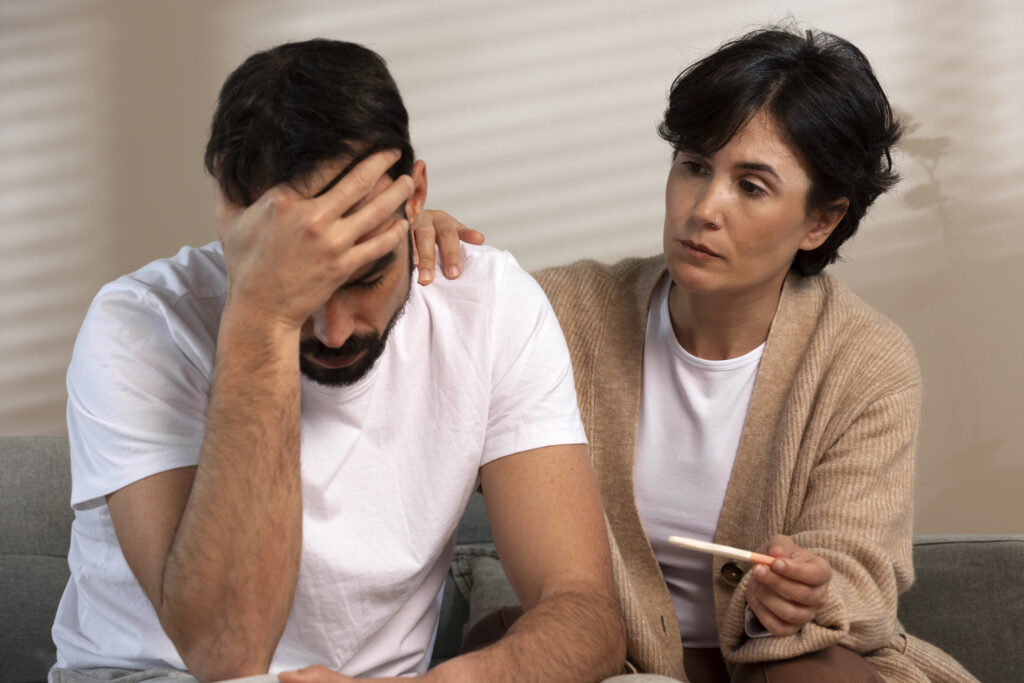
Repeated reassurance seeking
One of the most common relationship patterns involves repeatedly asking a partner for reassurance.
Questions may include:
“Do you think this looks normal?”
“Do you think something is seriously wrong?”
“Are you sure I don’t need to worry?”
The partner may reassure them, and the anxiety may decrease temporarily.
However, if the worry returns repeatedly, reassurance can become a cycle rather than a lasting solution.
Constant symptom discussions
Health concerns may begin to dominate conversations.
A headache, stomach sensation, tiredness, heart sensation, skin change, or other physical experience can become the focus of the evening.
Over time, the other partner may feel that there is little space for ordinary conversation, shared activities, or emotional connection outside health concerns.
Internet searching
Searching for health information can feel like a way to regain control.
However, online searches often expose people to a wide range of possible explanations, including rare and serious conditions. This can increase anxiety rather than resolve it.
A partner may become involved by helping research symptoms, comparing diagnoses, or repeatedly checking medical information together.
Medical reassurance seeking
Some people repeatedly schedule appointments, request tests, seek second opinions, or contact healthcare professionals whenever a new symptom appears.
Appropriate medical care is important. The difficulty arises when medical reassurance becomes an attempt to obtain complete certainty about every bodily sensation.
No test or appointment can guarantee that a person will never become ill in the future.
Avoidance
Health anxiety does not always lead to more checking.
Some people begin avoiding activities they believe could make them ill.
They may avoid travel, exercise, certain foods, crowded places, medical procedures, or situations where they fear becoming unwell.
The partner may begin changing plans to accommodate these fears.
Over time, avoidance can restrict the couple’s shared life.
When Your Partner Becomes Part of the Anxiety Cycle
Partners often become involved because they genuinely want to help.
If one person is frightened, reassurance may seem like the obvious response.
For example:
Health worry → partner reassures → anxiety decreases temporarily → new symptom or thought appears → reassurance is requested again
The partner may gradually learn that reassurance is expected whenever anxiety rises.
The person experiencing health anxiety may also learn that they cannot feel settled without their partner’s confirmation.
Neither person necessarily intends for this to happen. This reassurance-seeking cycle mirrors the dynamic described in relationship anxiety, though the trigger here is health rather than the relationship itself.
It can develop gradually through repeated attempts to reduce distress.
Why This Can Be Difficult for the Other Partner
Living alongside health anxiety can create emotional strain.
The partner may feel:
- Responsible for keeping the other person calm
- Frustrated when reassurance does not seem to help
- Worried that saying the wrong thing will increase anxiety
- Exhausted by repeated health-related conversations
- Guilty when they need space from the topic
- Confused about when a symptom requires medical attention
- Resentful when plans repeatedly change because of health fears
These reactions do not mean the partner lacks understanding.
It can be difficult to remain supportive when the same cycle happens repeatedly.
Supporting a Partner Without Becoming Their Reassurance System
A partner can acknowledge someone’s fear without repeatedly trying to prove that nothing is wrong.
For example, instead of responding to every new concern with extensive reassurance, they might say:
“I can see that you’re worried. I don’t think I can give you the certainty you’re looking for, but we can talk about what you need to do next.”
The exact response will depend on the situation and any treatment recommendations.
The distinction is important because emotional support and reassurance are not always the same thing.
Support may involve listening, accompanying someone to an appropriate medical appointment, helping them follow a treatment plan, or spending time together during a difficult moment.
Reassurance seeking often involves repeatedly asking for certainty that cannot realistically be provided.
Health Anxiety Does Not Mean Ignoring Real Symptoms
One of the most important issues in this area is finding the balance between appropriate medical attention and anxiety-driven checking.
A person should not be told to ignore a new, persistent, or concerning physical symptom simply because they have experienced health anxiety before.
Medical concerns should be evaluated appropriately by a qualified healthcare professional.
At the same time, once a clinician has evaluated a symptom and provided appropriate guidance, repeatedly seeking additional reassurance may not resolve the underlying anxiety.
Therapy can help address that distinction.
How Anxiety Therapy Can Help

Understanding the anxiety cycle
Therapy can help identify what happens when a physical sensation appears.
For example:
Sensation → catastrophic interpretation → anxiety → checking or reassurance → temporary relief → increased attention to bodily sensations
Understanding this sequence can make the pattern easier to recognize.
Learning to tolerate uncertainty
Complete certainty about health is impossible.
Therapy can help a person gradually develop the ability to experience uncertainty without immediately checking, researching, or seeking reassurance.
This does not mean ignoring health concerns. It means learning to respond proportionately after appropriate medical guidance.
Changing checking behaviors
Repeatedly checking a pulse, skin, temperature, bodily sensation, or other symptom can increase attention to the body.
The more closely someone monitors a sensation, the more noticeable ordinary fluctuations may become.
Therapy can help identify checking behaviors and develop healthier responses.
Addressing catastrophic thinking
Health anxiety can involve rapidly moving from a minor symptom to a serious conclusion.
Therapy can help a person examine the assumptions between the symptom and the feared outcome.
The goal is not to replace every negative thought with a positive one. It is to develop a more balanced way of evaluating uncertainty.
Improving communication between partners
Couples therapy can help partners discuss health anxiety without falling into criticism or defensiveness.
The anxious partner may need to communicate fear more directly rather than repeatedly asking for certainty.
The other partner may need to express boundaries without sounding dismissive the same skill covered in therapist-approved communication skills.
For example, instead of saying, “You’re worrying about this again,” they may learn to communicate, “I know this is frightening for you. I also notice that we have been talking about this for hours, and I think continuing to research it together is making both of us more anxious.”
How Health Anxiety Can Affect Physical and Emotional Intimacy
Health anxiety can affect physical and emotional intimacy in several ways.
A person may become preoccupied with symptoms and find it difficult to remain present with their partner.
They may avoid physical affection because they fear becoming sick or making an existing symptom worse.
Alternatively, they may repeatedly ask their partner to confirm that physical sensations during intimacy are normal.
The partner may then associate intimacy with anxiety-related conversations rather than connection.
Therapy can create space to understand these patterns without treating either partner as the problem.
What If the Partners Disagree About a Health Concern?
Disagreement can be particularly difficult.
One partner may believe a symptom needs immediate attention, while the other believes anxiety is making the situation seem more serious than it is.
Couples should avoid trying to diagnose each other.
When there is a genuine medical concern, appropriate medical evaluation should take priority. Once a healthcare professional has assessed the issue, the couple can focus on how anxiety, reassurance, communication, or uncertainty is affecting their relationship.
This helps keep medical decision-making separate from relationship conflict, similar to how fair fighting rules help separate the issue from the person.
When Should a Couple Consider Therapy?
Couples therapy may be useful when health anxiety is repeatedly affecting the relationship.
Signs may include:
- Health concerns dominate conversations
- One partner feels responsible for providing constant reassurance
- Repeated checking or researching creates conflict
- Plans are frequently changed because of health fears
- One partner feels dismissed while the other feels overwhelmed
- Health anxiety is affecting intimacy
- Arguments repeatedly follow the same pattern
- The couple struggles to set boundaries around reassurance
- Anxiety continues to affect the relationship despite appropriate medical care
Therapy is not about deciding whether someone’s health concern is “real.” It is about addressing the anxiety and relationship patterns that may develop around health concerns.
How Dr. Harel Approaches Health Anxiety in Relationships
Dr. Harel can help couples examine how health anxiety has become part of their relationship dynamic.
The focus is not simply on telling the anxious partner to stop worrying or asking the other partner to provide more reassurance. Instead, therapy can explore what happens between the partners when health fears arise.
This may include identifying reassurance cycles, checking behaviors, avoidance, communication patterns, and the ways each partner responds to distress.Dr. Harel’s ARM Method offers one structured framework for this work.
The work can also help partners establish clearer boundaries. The partner without health anxiety can learn how to remain emotionally available without becoming responsible for eliminating every fear. The person experiencing anxiety can work toward managing uncertainty without making the relationship the primary source of reassurance.
Where appropriate, couples therapy can complement individual treatment for health anxiety and coordinate with the person’s existing healthcare needs.
Final Thoughts
Health anxiety can affect more than the person experiencing the fear. Over time, reassurance, checking, avoidance, and repeated health-related conversations can shape how both partners communicate and experience closeness. Understanding this pattern can help couples respond to anxiety without allowing it to take over the relationship.
If health concerns are creating repeated conflict, affecting intimacy, or making one partner feel responsible for managing the other’s anxiety, couples therapy can provide a space to address these patterns. Dr. Harel can help partners understand the cycle, communicate their needs more clearly, and develop healthier boundaries while remaining emotionally supportive of each other.
Frequently Asked Questions
“Health anxiety” is the term commonly used today. In clinical contexts, persistent health-related anxiety may be associated with conditions such as illness anxiety disorder or somatic symptom disorder, depending on the person’s symptoms and clinical presentation. A mental health professional would need to assess the individual rather than relying on the label alone.
Not necessarily. Emotional reassurance and affection can be healthy parts of a relationship. The concern is repeated reassurance that provides only short-term relief and becomes necessary every time anxiety rises. A therapist can help couples determine how to respond differently.
You can express concern about how the searching affects both of you without trying to control your partner’s behavior. If online searching is frequent and increases distress, it may be useful to discuss the pattern with a mental health professional.
Yes. A genuine medical experience can sometimes increase vigilance about future symptoms. Someone may become highly alert to bodily sensations because they have learned that physical changes can sometimes signal a serious problem. Therapy can help address the anxiety that develops around that experience.
Therapy does not require both partners to agree on a diagnosis before beginning. A therapist can focus on the relationship patterns that both people recognize, such as repeated reassurance, conflict, avoidance, or communication difficulties.
Yes. Worry about illness, bodily sensations, contamination, medication effects, or physical symptoms can interfere with comfort and presence during intimacy. Relationship tension created by repeated reassurance seeking can also affect closeness.
Resentment can be a signal that the current pattern is placing too much responsibility on one partner. Couples therapy can provide a structured setting to discuss these feelings without turning them into blame and to establish healthier boundaries around support.
Yes. Individual treatment can address the person’s anxiety symptoms, while couples therapy can address communication, reassurance cycles, boundaries, intimacy, and other relationship effects. The two forms of support can serve different but complementary purposes.

Harel Papikian
Dr. Harel Papikian is a clinical psychologist and couples therapist with more than 15 years of experience. He offers marriage counseling and couples therapy in los Angeles. It help’s couples navigate their relationship challenges and deepen their connection. Our clinic uses a unique ARM method (Awareness, Release, Mastery) to achieve rapid and profound results for our clients. We serve a diverse clientele, including LGBTQ+ and heterosexual couples, addressing issues like communication breakdowns, conflict resolution, intimacy, and trust. You can also get individual therapy sessions for concerns like depression, anxiety, and trauma.
Pingback: How Couples Therapy Helps When One Partner Has Generalized Anxiety Disorder