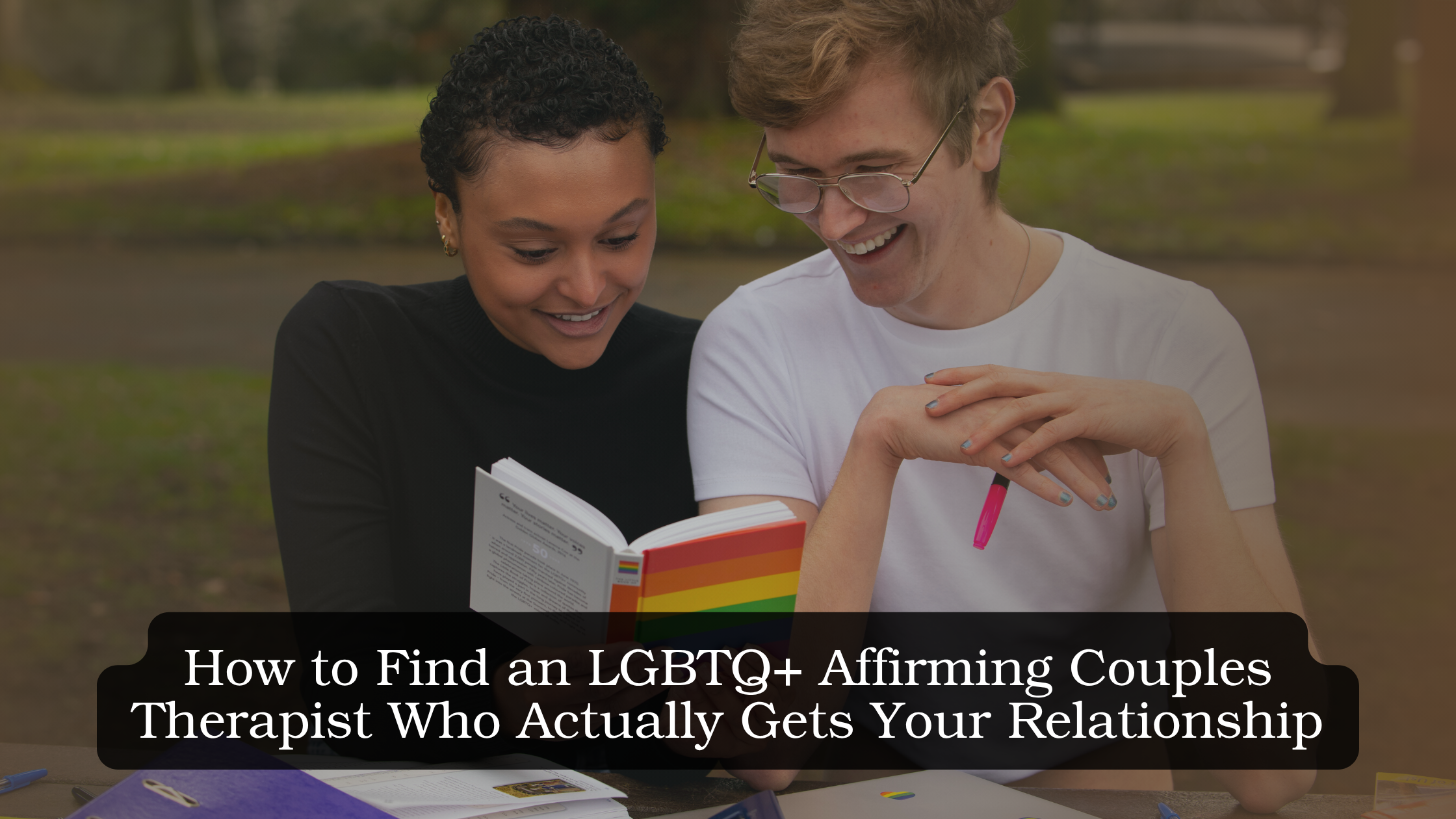
How to Find an LGBTQ+ Affirming Couples Therapist Who Actually Gets Your Relationship
Finding a couples therapist can be difficult when you are already dealing with relationship concerns. For LGBTQ+ couples, the search may involve another question: Will this therapist understand our relationship without making us explain or defend who we are?
A therapist may describe their practice as inclusive, but genuine affirmation involves more than welcoming language on a website. It means understanding how identity, family expectations, discrimination, privacy, and social pressures can shape a relationship, while also recognizing that these factors do not explain every disagreement.
The goal is to find someone who can work with your relationship as it is, not fit it into assumptions about what a couple should look like. Here are some practical ways to assess whether a therapist is equipped to support you both.
What Does LGBTQ+ Affirming Couples Therapy Actually Mean?
LGBTQ+ affirming couples therapy recognizes that sexual orientation, gender identity, and relationship structure are valid parts of a person’s life. They are not problems to be corrected or treated as the cause of every relationship difficulty.
An affirming therapist does not assume that one partner is more masculine, feminine, dominant, or responsible for emotional care based on gender or sexuality. They also avoid assuming that every couple follows the same expectations around commitment, intimacy, marriage, parenting, or family involvement.
More importantly, affirmation is reflected in how the therapist works. They use the names and pronouns you provide, ask rather than assume, and make room for experiences such as coming out, family rejection, minority stress, or navigating different levels of openness.
This does not mean the therapist will automatically agree with both partners, an idea also covered in LGBTQIA+ affirming therapy in West Hollywood. Their role is to understand each person’s perspective, identify harmful interaction patterns, and help the couple work through conflict without treating their identity as the problem.
Identify What You Need From Couples Therapy
Before looking at therapist profiles, consider what has brought you to couples therapy. The concerns you want to address can help you identify the experience and approach you need.
You may be dealing with recurring arguments, emotional distance, trust concerns, differences in sexual desire, or difficulty making decisions together. Perhaps family rejection has created tension, one partner is not out to their family, or you disagree about how visible your relationship should be.
Some couples want support during major life transitions such as these moving in together, getting married, becoming parents, or navigating gender transition. Others want a space to discuss relationship concerns without having to explain LGBTQ+ experiences from the beginning.
Write down two or three priorities. You do not need to have a complete explanation of your relationship difficulties before your first session. A clear starting point is enough to help you assess whether a therapist’s experience is relevant.

Look Beyond the Words “LGBTQ+ Friendly” When Choosing a Therapist
Many therapists use terms such as LGBTQ+ friendly, inclusive, or affirming. These descriptions can help you begin your search, but they do not tell you everything about a therapist’s experience.
Read individual therapist biographies rather than relying only on a practice’s general statement. Look for specific references to working with LGBTQ+ individuals and couples, gender diversity, family rejection, minority stress, or relationship concerns relevant to your situation.
You can also look for information about professional training, continuing education, supervision, and the therapist’s approach to couples work. A therapist does not need to share your identity to provide affirming care, but they should be able to explain how they have developed the knowledge and skills to work with LGBTQ+ clients.
Be cautious about treating a list of identity-related keywords as proof of expertise. What matters is whether the therapist can describe how their understanding informs their clinical work.
Questions to Ask Before Booking a Session
A brief consultation can help you understand whether a therapist’s approach is suitable. You are allowed to ask direct questions before sharing personal details or committing to ongoing sessions.
1. What experience do you have working with LGBTQ+ couples?
Ask about their experience with couples whose concerns are similar to yours. If you are a lesbian couple navigating family rejection, for example, you can ask whether they have worked with couples dealing with family pressure, disclosure, or disagreements about boundaries.
You do not need a therapist who has encountered your exact circumstances. You do need someone who can speak thoughtfully about the issues you want to address.
2. What does LGBTQ+ affirming care mean in your couples work?
Listen for an explanation that goes beyond saying they treat everyone equally. A therapist should be able to describe how they avoid assumptions, respect each partner’s identity, and account for external pressures without reducing the relationship to those experiences.
3. How do you handle conflict when identity or discrimination is part of the disagreement?
This question is especially useful if one partner feels that the other does not understand the impact of discrimination, family rejection, or social expectations.
A therapist should be able to explore both partners’ experiences without dismissing the external context or automatically assigning blame.
4. How do you approach different levels of openness about our relationship?
Partners may have different views about coming out, attending family events, sharing photographs, or introducing each other socially. Ask how the therapist works with these differences while respecting each person’s safety, privacy, and autonomy.
5. How do you respond if one of us feels misunderstood in a session?
No therapist will communicate perfectly at every moment. What matters is whether they can listen to feedback, acknowledge an assumption or mistake, and make an effort to repair the interaction.
A consultation should feel like a conversation, not an examination. You should be able to ask questions without feeling that you are being difficult.
Green Flags and Warning Signs of an LGBTQ+ Affirming Therapist
A therapist’s responses can tell you a great deal, but pay attention to their communication throughout the consultation too.
| Signs of affirming practice | Possible warning signs |
| They ask how you describe your relationship and identities. | They assume your roles based on gender or sexuality. |
| They can discuss relevant LGBTQ+ experiences with specificity. | They rely on vague statements such as “love is love” without explaining their approach. |
| They understand that discrimination and family pressure can affect relationships. | They treat identity as the cause of every conflict. |
| They respect each partner’s name, pronouns, and privacy preferences. | They dismiss or repeatedly overlook these preferences. |
| They welcome questions about their experience and training. | They become defensive when asked about their qualifications. |
| They can acknowledge the limits of their experience. | They expect you to educate them about basic LGBTQ+ concerns. |
A single awkward moment does not necessarily tell you everything about a therapist. However, repeated dismissal, defensiveness, or assumptions deserve attention, particularly if you have already explained why something matters to you.
Make Sure They Understand Both LGBTQ+ Issues and Couples Therapy
A therapist may have experience supporting LGBTQ+ individuals but limited experience working with couples. These are related, but distinct, areas of practice.
Couples therapy requires the therapist to understand how partners interact, how conflict escalates, and how each person’s attempts to protect themselves may affect the other. The therapist also needs to avoid becoming an advocate for one partner at the expense of the relationship.
For example, one partner may want to maintain contact with family members who reject the relationship, while the other may feel that continued contact communicates acceptance of hurtful behaviour. This is the exact dynamic explored in how couples therapy helps lesbian couples navigate family rejection differently. An affirming couples therapist should be able to explore the meaning of these choices for both partners.
The same applies to disagreements about intimacy, finances, parenting, commitment, or household responsibilities. The therapist should be able to address these concerns as relationship issues without assuming that they are unique to LGBTQ+ couples or unrelated to the couple’s social context.
Consider Privacy, Safety, and Practical Details Before Starting Therapy
Privacy can be particularly important when partners have different levels of openness about their relationship. Before booking, ask how the practice handles intake forms, appointment reminders, billing communications, and information shared during sessions.
If one or both partners are not out to family members, employers, or others, clarify whether communications could reveal that you are attending couples therapy. Ask about confidentiality and its limits, including how information shared in individual conversations is handled during couples work.
Practical considerations matter too. Check the therapist’s qualifications, fees, availability, cancellation policy, and whether sessions are offered online or in person. If you are considering virtual therapy, ask how the therapist protects privacy and manages sessions when partners are joining from different locations.
You should also confirm that the therapist is appropriately qualified to practise in the location where you will receive services.

Pay Attention to Your Experience in the First Few Therapy Sessions
A therapist’s profile and consultation can help you narrow your options, but the working relationship becomes clearer once therapy begins.
Notice whether both partners have room to speak. Do you feel that the therapist understands the concern you brought in, or does the conversation repeatedly shift toward explaining your identity? Are difficult disagreements explored without stereotyping either partner? Can you raise concerns about the therapist’s approach?
You do not need to feel completely comfortable discussing every subject immediately. Couples therapy can involve difficult conversations. However, you should not have to repeatedly defend the legitimacy of your relationship or correct assumptions that the therapist is unwilling to reconsider.
It is also reasonable to review the fit after a few sessions. If the therapist’s approach does not meet your needs, you can discuss the concern or consider another provider.
Finding an LGBTQ+ Affirming Couples Therapist Who Understands Both Partners
The right LGBTQ+ affirming couples therapist does not need to have lived through the same experiences as you. They do need the professional knowledge, openness, and clinical skill to understand what you bring into the room without relying on stereotypes or expecting you to provide basic education.
Look for someone who can hold two things at once: your relationship may be affected by experiences specific to LGBTQ+ life, and you are also a couple with your own personalities, histories, needs, and patterns.
You deserve a therapeutic space where both partners can speak honestly, where identity is respected without becoming the only subject, and where the work addresses the relationship you are actually trying to build.
How Dr. Harel Approaches Couples Therapy for LGBTQ+ Relationships
For Dr. Harel, couples therapy involves understanding the relationship patterns that keep partners feeling disconnected, misunderstood, or stuck in recurring conflict. LGBTQ+ couples deserve the same depth of attention to communication, emotional needs, trust, and intimacy as any other couple, alongside an understanding of the experiences that may shape their relationship.
Rather than assuming that identity explains the couple’s difficulties, Dr. Harel’s ARM Method can explore how each partner experiences the relationship.This may include discussing family expectations, boundaries, disclosure, emotional safety, or differences in how partners respond to external pressure.
The focus remains on helping both partners understand their interactions, communicate more clearly, and make decisions that reflect their needs and values. Therapy should provide room for the relationship to be understood on its own terms.
Final thoughts
Finding the right LGBTQ+ affirming couples therapist is about more than choosing someone who uses inclusive language. You deserve a therapist who respects your identities, understands the experiences that may affect your relationship, and makes space for both partners to feel heard and understood.
Dr. Harel supports LGBTQ+ couples in exploring relationship concerns while considering the individual experiences, identities, and dynamics each partner brings into the relationship. If you are looking for support with your relationship, book a free phone consultation to discuss your concerns and learn how couples therapy may help.
Frequently Asked Questions
No. A therapist does not have to share your identity to provide affirming care. Relevant training, experience, cultural humility, and the ability to respond thoughtfully to your concerns are important. You can also consider whether working with a therapist who shares an aspect of your identity would help you feel more comfortable.
The terms are not always used consistently. “Friendly” may indicate openness or support, while affirming practice should be reflected in the therapist’s knowledge, language, assumptions, and clinical approach. Rather than relying on the label, ask what affirmation looks like in their work with couples.
You can share as much as you feel comfortable sharing during the consultation. You do not need to disclose every personal detail before deciding whether the therapist is a suitable fit. It may help to briefly explain your main concerns and ask how the therapist approaches similar issues.
Yes, provided the therapist respects both partners’ circumstances and does not pressure either person to disclose. Therapy can help the couple discuss privacy, safety, emotional needs, and the impact of different levels of openness on the relationship.
You can correct the assumption and explain how it affected you. Notice how the therapist responds. A willingness to listen, take responsibility, and adjust is important. If dismissive assumptions continue, you may decide that the therapist is not the right fit.
Yes. LGBTQ+ couples may seek therapy for communication difficulties, trust, intimacy, conflict, parenting, or major life decisions. An affirming approach means these concerns can be addressed without treating sexual orientation or gender identity as a problem.
Consider changing therapists if you repeatedly feel dismissed, stereotyped, pressured to disclose, or unable to discuss your concerns openly. You can first raise the issue if you feel comfortable doing so. The therapist’s response may help you decide whether the working relationship can improve.

Harel Papikian
Dr. Harel Papikian is a clinical psychologist and couples therapist with more than 15 years of experience. He offers marriage counseling and couples therapy in los Angeles. It help’s couples navigate their relationship challenges and deepen their connection. Our clinic uses a unique ARM method (Awareness, Release, Mastery) to achieve rapid and profound results for our clients. We serve a diverse clientele, including LGBTQ+ and heterosexual couples, addressing issues like communication breakdowns, conflict resolution, intimacy, and trust. You can also get individual therapy sessions for concerns like depression, anxiety, and trauma.
Leave a Reply