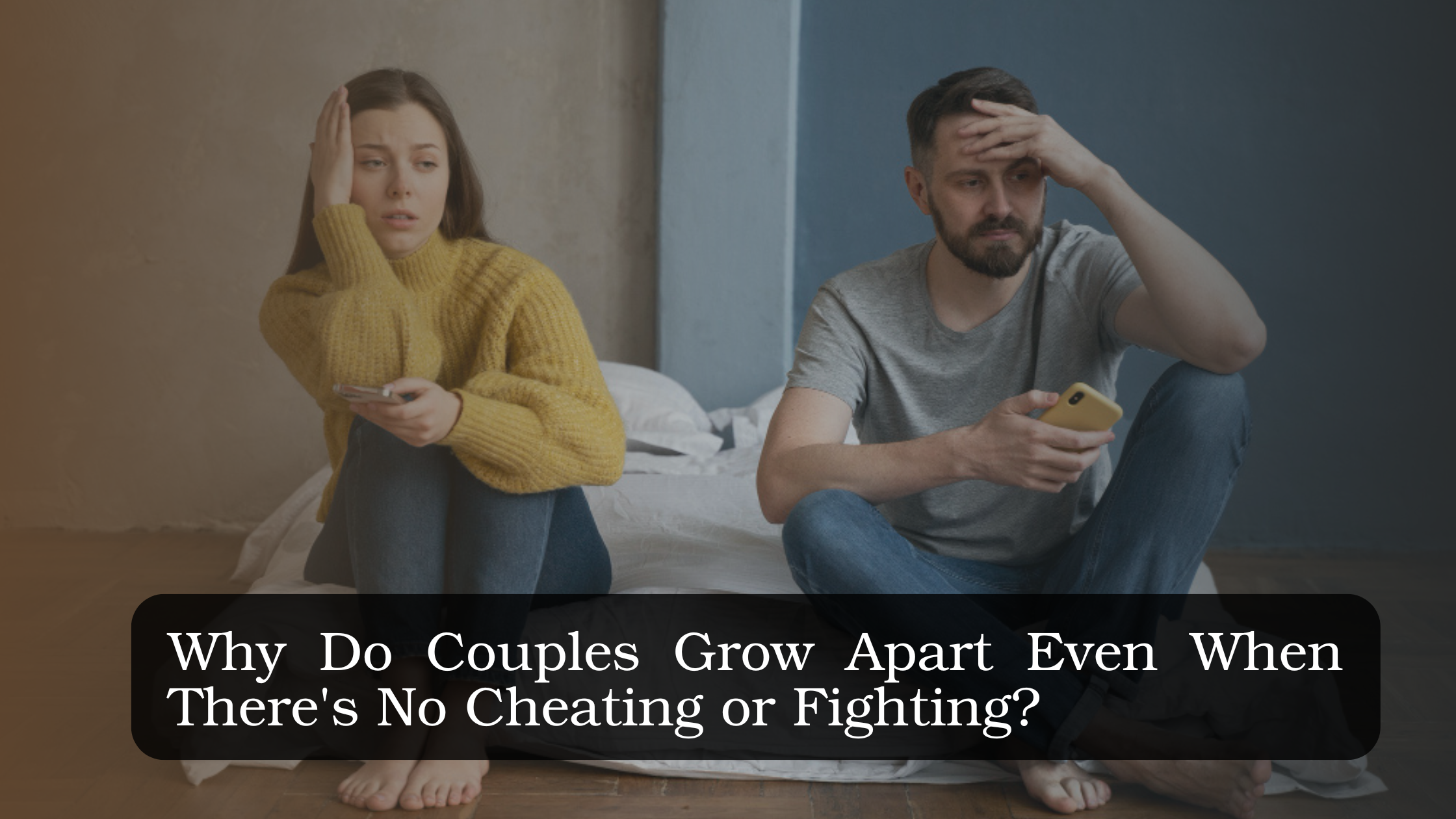
Why Do Couples Grow Apart Even When There’s No Cheating or Fighting?
A relationship does not have to involve infidelity, constant arguments, or a major crisis for two people to start feeling disconnected. Sometimes, the distance develops quietly. Conversations become more practical, routines take over, and the relationship gradually receives less attention than work, family, responsibilities, or individual interests.
This can be confusing for couples who look perfectly fine from the outside. There may be no dramatic problems to point to, yet one or both partners may feel lonely, emotionally distant, or unsure about where the relationship is going. The absence of conflict does not necessarily mean the relationship is emotionally fulfilling.
Understanding why couples grow apart can make it easier to recognize the problem before the distance becomes deeply established. Often, the issue is not one major event but a series of small changes that go unaddressed.
What Causes Couples to Grow Apart?
The reasons couples grow apart are often less dramatic than people expect. There may not be one specific moment when the relationship changed. Instead, small shifts in communication, priorities, routines, and emotional connection can gradually create distance. Some of the most common ways this happens include:

1. Life Becomes More About Managing Than Connecting
Many long-term relationships gradually become organized around responsibilities.
Who is picking up the children? Who is paying the bills? What needs to be bought? When is the next appointment? Who is handling work commitments?
These conversations are necessary, but when most communication becomes logistical, partners can start functioning more like co-managers of a household than romantic partners.
The relationship may be working efficiently while emotional intimacy is quietly declining.
2. You Stop Being Curious About Each Other
Early in a relationship, couples naturally ask questions and pay attention to each other’s experiences. Over time, familiarity can create the assumption that you already know your partner.
You may know what they usually order at a restaurant, how they react to stress, and what they did at work that day. But knowing someone’s routines is not the same as knowing what is happening inside them.
People change. Their priorities, fears, ambitions, friendships, and expectations can change too.
When couples stop asking meaningful questions, they can gradually become strangers who happen to know each other’s schedules the exact pattern explored in the role of curiosity in healthy relationships.
3. Unspoken Resentment Starts Accumulating
Growing apart does not always involve visible arguments. Sometimes, it happens because one or both partners repeatedly swallow disappointments.
Perhaps one partner feels they carry too much responsibility. Another may feel emotionally overlooked or taken for granted. Instead of discussing it, they adapt, become quieter, or stop expecting anything to change.
Over time, this can create emotional withdrawal.
The absence of arguments may therefore reflect resolution, but it can also reflect giving up on being heard a common feature of the pursuer-distancer cycle once one partner stops pursuing.
4. You Stop Sharing Your Inner World
Emotional intimacy requires more than spending time in the same room.
A couple can eat dinner together every night and still become disconnected if neither person shares what they are actually thinking or feeling.
You might stop telling your partner about something that upset you at work. You might keep an important worry to yourself because discussing it feels tiring. Eventually, your partner may no longer be the person you naturally turn to for emotional support.
That shift can create significant distance even when the relationship appears stable.
5. Your Lives Develop in Different Directions
People do not remain exactly the same throughout a long-term relationship.
Career goals can change. One partner may become more ambitious while the other wants a quieter life. Interests, friendships, financial priorities, or ideas about family may evolve.
Differences are not automatically a problem. The difficulty comes when couples stop discussing how those changes affect the relationship.
For example, someone in Santa Monica may become deeply invested in a demanding career while their partner prioritizes family time. Neither person is necessarily wrong, but avoiding the conversation can leave both feeling misunderstood.
6. You Become Too Comfortable With Emotional Distance
Distance can become a habit.
At first, a couple may notice that they are spending less quality time together. Later, separate routines become normal. One person watches television while the other works. Weekends become individual activities. Important conversations are repeatedly postponed.
Because nothing dramatic happens, there may be little motivation to change it.
This is one reason couples sometimes seek therapy after years of gradual disconnection see also the difference between healthy independence and emotional distance.
7. You Are Physically Present but Emotionally Elsewhere
Technology, work, parenting, and everyday distractions can make physical presence very different from emotional availability.
Sitting beside each other while scrolling through separate phones is not necessarily quality time. Neither is spending an entire evening discussing household responsibilities.
Connection requires attention.
Small moments of genuine engagement often matter more than simply being in the same physical space.
8. You Stop Growing as a Couple
Long-term relationships need some shared sense of movement.
That does not mean couples need to have identical hobbies or constantly plan exciting experiences. It means there should still be opportunities to create new memories, discuss future goals, learn about each other, and make decisions together.
When every year looks exactly like the previous one, partners may begin to experience the relationship as repetitive rather than meaningful.

What Can You Do If You Feel Yourself Growing Apart?
You do not necessarily need a dramatic relationship overhaul. Start by identifying what has changed.
Ask each other:
- When did we start feeling less connected?
- What do we miss about our relationship?
- What do we currently need more of from each other?
- Are there conversations we keep avoiding?
- Do we spend time together because we want to, or mainly because we share responsibilities?
- What would feeling closer actually look like for each of us?
The goal is not to immediately decide who is responsible. It is to understand the pattern It is to understand the recurring relationship pattern.
If conversations repeatedly turn into defensiveness, withdrawal, criticism, or silence, couples therapy can provide a structured setting to examine what is happening between you rather than simply arguing about individual incidents.
Do You Need Couples Therapy If You Rarely Fight?
Yes, potentially.
Couples therapy is not only for relationships experiencing infidelity or frequent conflict. It can also be useful when partners feel emotionally disconnected, stuck in repetitive patterns, uncertain about their future, or unable to discuss important issues productively.
In some cases, couples seek therapy precisely because they want to address the growing distance before it becomes a major relationship crisis.
The important question is not, “Do we fight enough to need therapy?”
It is, “Are we still able to connect, communicate, and understand each other?”
How Dr. Harel Papikian Can Help
Dr. Harel Papikian is a licensed clinical psychologist in Los Angeles with more than 16 years of experience working with individuals and couples. His work with couples can help identify patterns that may be difficult to recognize when both partners are caught inside them.
Rather than focusing only on the latest disagreement, couples therapy can look at the underlying dynamics, including emotional disconnection, unresolved resentment, communication patterns, unmet needs, and repeated ways of responding to one another.
For couples who are not in crisis but recognize that they have been gradually drifting apart, this can provide an opportunity to understand what has changed and begin rebuilding connection intentionally.
Final Thoughts
Couples do not always grow apart because something went terribly wrong. Sometimes, the relationship simply receives less attention while life becomes busier. Conversations become practical, emotional needs go unspoken, and separate routines slowly replace shared experiences.
Recognizing that distance does not automatically mean the relationship is failing. It can be a signal that something important needs attention.
The earlier couples become willing to talk honestly about that distance, the more opportunity they have to understand what happened and decide what they want their relationship to look like going forward.
FAQs
Yes. Emotional distance often develops gradually. Because there may be no major argument or obvious crisis, couples may not recognize the change until they begin feeling lonely or disconnected.
Not necessarily. Feeling disconnected does not automatically mean that love has disappeared. Some couples still care deeply about each other but have developed patterns that leave little room for emotional intimacy.
Yes. Couples therapy can address emotional distance, communication difficulties, unresolved resentment, changing expectations, and other relationship concerns even when there are few arguments.
That is still worth discussing. One partner’s experience of distance can affect the relationship as a whole. Starting with an honest conversation can help clarify whether both partners are experiencing the relationship differently.
Start by making space for honest conversations and meaningful time together. Ask about each other’s current needs rather than assuming they have remained unchanged. If attempts to reconnect repeatedly stall, professional guidance can help identify what is keeping the relationship stuck.

Harel Papikian
Dr. Harel Papikian is a clinical psychologist and couples therapist with more than 15 years of experience. He offers marriage counseling and couples therapy in los Angeles. It help’s couples navigate their relationship challenges and deepen their connection. Our clinic uses a unique ARM method (Awareness, Release, Mastery) to achieve rapid and profound results for our clients. We serve a diverse clientele, including LGBTQ+ and heterosexual couples, addressing issues like communication breakdowns, conflict resolution, intimacy, and trust. You can also get individual therapy sessions for concerns like depression, anxiety, and trauma.
Leave a Reply