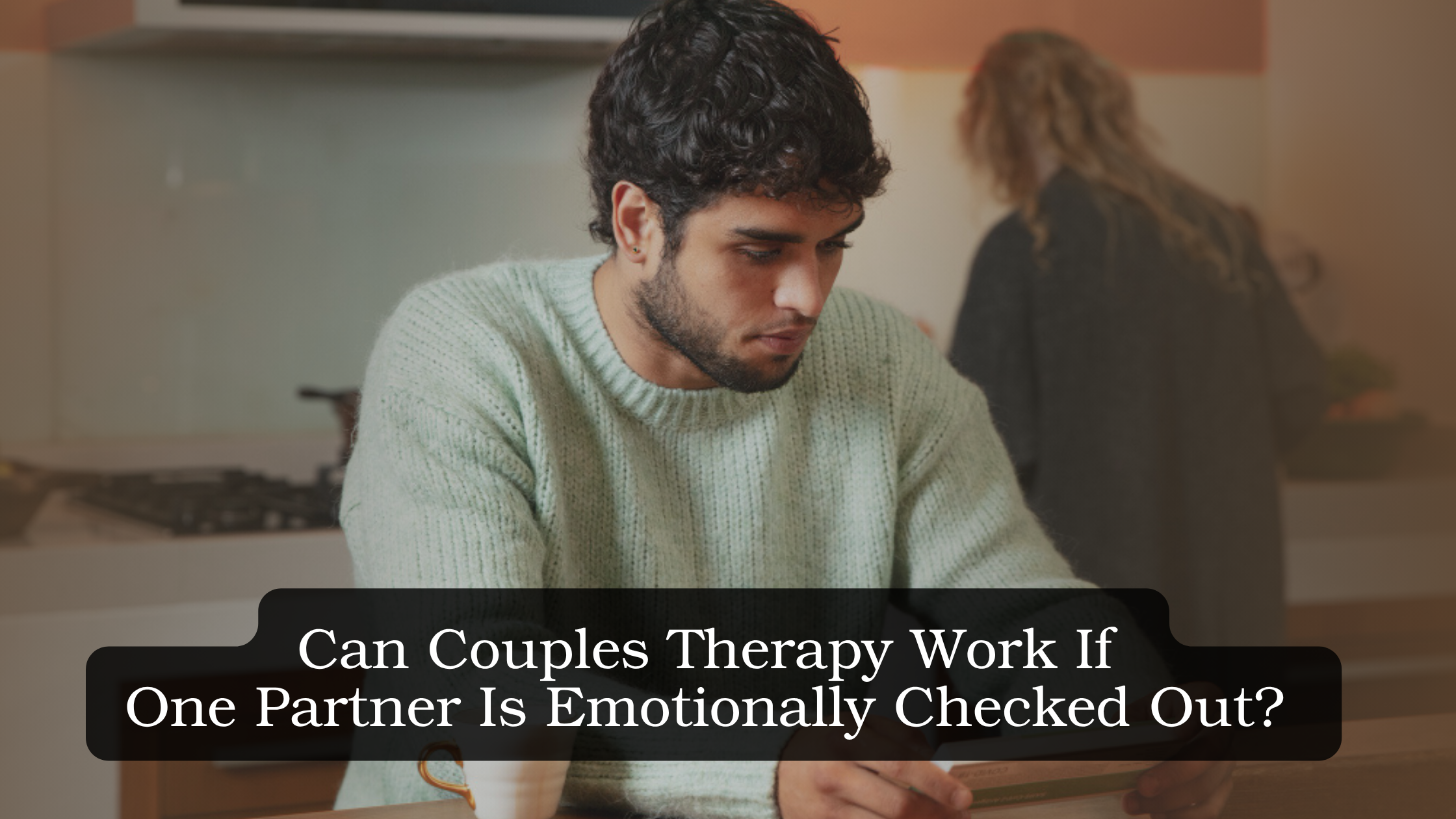
Can Couples Therapy Work If One Partner Is Emotionally Checked Out?
You can be sitting next to someone every evening and still feel completely alone. Maybe your partner barely talks anymore. They stop arguing because they seem to have stopped caring. When you suggest couples therapy, they agree to come, but sit through the session quietly, answer with “I don’t know,” or seem miles away. It can leave you wondering whether therapy can actually help when one person already seems emotionally done.
Sometimes, emotional distance is a sign of deep hurt, exhaustion, or feeling disconnected for a long time. But being checked out does not always mean the relationship cannot change. In this blog, we’ll explore what emotional withdrawal can look like, why it happens, whether therapy can help, what the engaged partner can do, and when both partners need to be honest about what they want.
What Does It Mean To Be Emotionally Checked Out?
Being emotionally checked out does not always look like anger or constant conflict. Sometimes, it looks like silence, distance, or simply no longer trying.
A partner may stop bringing up problems because they no longer believe talking will change anything. They may become less interested in spending time together, avoid affection, or respond with short answers.
Signs Of Emotional Withdrawal
You might notice that your partner:
- Rarely starts conversations.
- Stops sharing how they feel.
- Avoids meaningful conversations or affection.
- Seems uninterested in resolving disagreements.
- Spends more time alone.
- Gives short or detached responses.
- Says, “It doesn’t matter,” when something goes wrong.
For example, you might ask, “Can we talk about what happened last night?” and hear, “Whatever. It’s fine.”
That response can be more confusing than an argument. This pattern is explored further in emotional avoidance and how it slowly destroys relationships. Understanding what is behind the distance is often more useful than trying to force your partner to open up.

Common Reasons You Can Become Emotionally Distant In A Relationship
Emotional withdrawal usually develops for a reason. Someone who seems detached may have spent a long time feeling unheard, disappointed, criticized, or emotionally exhausted.
Emotional distance can develop because of:
- Repeated unresolved conflict.
- Feeling unheard or misunderstood.
- Resentment that has built over time.
- Fear that another conversation will go nowhere.
- Emotional exhaustion.
- Feeling disconnected from the relationship.
- Difficulty expressing vulnerable emotions.
- Uncertainty about staying in the relationship.
Imagine a partner who has raised the same concern several times without seeing change. Eventually, they may stop bringing it up altogether. This is often how resentment builds in a relationship without visible conflict.
From the outside, that can look like indifference. Inside, it may feel more like, “What’s the point of saying it again?”
That difference matters when trying to understand emotional withdrawal.
How Can Couples Therapy Help A Checked-Out Partner?
Couples therapy cannot make an emotionally checked-out partner reconnect. What it can do is slow things down and help both partners understand how the relationship reached this point. For someone who feels exhausted or has stopped believing that conversations will help, being understood may need to come before trying to repair the relationship.
Start With Understanding Instead Of Fixing
Couples Therapy may first explore what is behind the emotional distance rather than immediately pushing the couple to reconnect. This can include:
- When the partner first started pulling away.
- What was happening in the relationship at that time.
- Whether the same conflicts kept repeating.
- Whether they felt unheard, criticized, or disappointed.
- What they tried before they stopped trying.
- What each partner needs from the relationship now.
- Whether there is still some willingness to work on the relationship.
This gives the distant partner room to explain what their withdrawal means instead of being pressured to become emotionally available right away.
Understanding the reason for the withdrawal can then help Couples therapy determine what needs to happen next.
Explore The Pattern Between Both Partners
Emotional withdrawal often happens within a larger relationship pattern. For example, one partner may push harder for connection when they feel rejected, while the other pulls away because they feel pressured. This is the classic pursuer-distancer cycle.
Couples Therapy can help couples notice:
- What usually starts the cycle.
- How each partner reacts.
- How one reaction triggers the next.
- What emotions are underneath those reactions.
- Where the cycle could be interrupted.
Seeing the pattern can shift the conversation from “Who is causing this?” to “What keeps happening between us?”
Once that cycle becomes clearer, couples can begin exploring whether they are willing to respond differently.
Rebuild Connection In Small Steps
A checked-out partner may not suddenly become affectionate or emotionally open. Progress may begin with much smaller changes.
This could mean:
- Having one honest conversation without shutting down.
- Expressing hurt instead of saying, “I don’t care.”
- Listening without immediately becoming defensive.
- Sharing one need or concern.
- Trying a different response during a familiar conflict.
These small changes can show whether emotional engagement can gradually return without forcing it.
The next step is to look at whether the withdrawn partner is willing to participate at all, even in small ways.
What If The Withdrawn Partner Does Not Want To Participate?
A withdrawn partner may not immediately engage in therapy. Even so, participation does not always look like enthusiastic conversation.

Notice Small Signs Of Engagement
A partner may show willingness by:
- Agreeing to attend another session.
- Answering a difficult question honestly.
- Admitting that something hurt them.
- Listening without immediately shutting down.
- Saying they are unsure rather than avoiding the conversation.
- Agreeing to try one small change.
These may seem small, but for someone who has been disconnected for a long time, acknowledging what they feel can be an important step.
At the same time, one partner cannot carry the entire therapy process indefinitely.
What Can The More Engaged Partner Do?
If you are the partner who still wants to repair the relationship, it is natural to want to try harder. However, repeated pressure can sometimes make an emotionally distant partner withdraw further.
Stop Trying To Force A Response
You cannot make someone feel close or ready to talk on command.
Instead of repeatedly asking, “Do you still love me?” or “Why don’t you care anymore?” try creating space for an honest response.
You might say:
“I know you’ve been distant, and I don’t want to pressure you. I do want to understand what has been happening for you.”
Or:
“You don’t have to have all the answers right now. I’d just like to understand where you are.”
This does not guarantee that your partner will open up. It simply leaves room for an honest conversation. This is a practical application of curiosity in healthy relationships.
Work On Your Side Of The Relationship
Therapy can also help you understand your own reactions.
Ask yourself:
- What do I do when I feel rejected?
- Do I pursue my partner when they need space?
- Do I become critical when I feel ignored?
- Am I listening or waiting for my turn to respond?
- What am I asking my partner to change?
This is not about blaming yourself for your partner’s withdrawal. It is about understanding the part of the relationship that you can influence.
Does Emotional Withdrawal Mean The Relationship Is Over?
Not necessarily. A partner can be emotionally distant while still feeling hurt, uncertain, or unsure about what they want.
Look At Willingness, Not Just Warmth
A partner does not need to enter therapy feeling hopeful or affectionate. What matters is whether there is some willingness to explore what has happened.
| What you hear | What it may suggest |
| “I don’t know if this will work, but I’ll try.” | There may still be openness. |
| “I don’t want to talk, but I’ll attend.” | They may need time and safety. |
| “I don’t know what I feel anymore.” | They may be emotionally exhausted. |
| “I don’t want this relationship anymore.” | Their position needs to be taken seriously. |
| Refusing every conversation or session | There may be very limited willingness to participate. |
These statements do not automatically tell you what your partner will ultimately decide. They can, however, help both partners understand where they currently stand.
How Dr. Harel Papikian Works With Disconnected Couples
Dr. Harel Papikian’s couples therapy approach focuses on understanding what is happening beneath recurring relationship problems rather than simply telling couples what they should do.
His ARM Method involves Awareness, Release, and Mastery. The process begins by understanding the relationship, personal history, current challenges, and desired changes before moving toward unresolved emotional experiences and practical relationship skills.
For a couple dealing with emotional distance, that can mean exploring questions such as:
- When did the disconnection begin?
- What patterns keep repeating?
- What does each partner need?
- What experiences have shaped the relationship?
- Is there still a willingness to work together?
Dr. Papikian works with couples as well as individuals and offers couples therapy in Los Angeles, including virtual sessions. His practice describes couples therapy as a process that can address communication, conflict, intimacy, emotional patterns, and relationship challenges.
For couples who feel like they have become strangers to each other, the first step may simply be understanding how they arrived at this point.
What If Partners End Up Making Different Decisions?
Sometimes therapy shows that both partners are not looking for the same outcome. One may want to rebuild the relationship, while the other may still be unsure or may not want to continue. Therapy can provide a space to understand these differences instead of avoiding them.
You may discover that:
- Both partners want to reconnect.
- One partner needs more time to decide.
- Both want change but disagree about what needs to change.
- One partner is unsure about continuing.
- The relationship may require a different decision about the future.
This can be painful to face, especially when one partner is still hoping to repair things. However, knowing where both people genuinely stand is more useful than trying to guess.
The goal is not to force an emotionally distant partner back into the relationship. It is to create enough honesty and space to understand whether both partners are willing to work toward something together.
Final Thoughts: Emotional Distance Does Not Always Mean The End
A partner who feels emotionally checked out may be hurt, exhausted, uncertain, or simply unsure whether things can change. Couples therapy cannot force someone to reconnect, but it can create a structured space to understand what happened and whether there is still willingness to work on the relationship. If you are the partner who wants to try, focus on what you can control rather than carrying the entire relationship yourself.
Give your partner room to speak, work on your own patterns, and pay attention to small signs of engagement. Dr. Harel Papikian helps couples explore emotional patterns, communication, conflict, and connection in therapy. If you are struggling with emotional distance, schedule a consultation with Dr. Papikian to begin understanding what is happening between you.
Frequently Asked Questions
It can, particularly when the withdrawn partner remains willing to explore what happened. Therapy can create space to understand the emotional distance, unresolved hurt, and relationship patterns rather than immediately pressuring the couple to repair everything.
Not necessarily. Emotional withdrawal can come from exhaustion, resentment, hurt, or feeling hopeless about change. It can also reflect uncertainty about the relationship. The most reliable way to understand their position is through honest conversation.
Avoid forcing immediate answers. Instead, use calm, open questions and explain that you want to understand their experience. Giving them space to speak without immediately defending yourself can make a difficult conversation feel less threatening.
Not necessarily, but avoid carrying the entire relationship alone. You can communicate your willingness to work on things, attend therapy, and change your own patterns. Your partner ultimately has to decide how much they are willing to participate.
Yes. Individual therapy can provide space to understand your own emotions, relationship patterns, boundaries, and needs. It cannot replace couples therapy, but it can help you navigate the relationship and make thoughtful decisions while your partner remains uncertain.
Look for small signs of participation rather than expecting immediate emotional closeness. Attending sessions, answering difficult questions honestly, listening, or agreeing to try one change can all suggest some willingness to explore the relationship.
Try not to demand an immediate decision. “I don’t know” can reflect genuine emotional exhaustion or uncertainty. Therapy can help explore when the disconnection began, what each partner needs, and whether there is anything worth rebuilding.
Therapy can help both partners understand their positions and communicate honestly. It cannot make someone want to remain in a relationship. However, it can provide a structured setting for exploring whether there is any shared willingness to continue.

Harel Papikian
Dr. Harel Papikian is a clinical psychologist and couples therapist with more than 15 years of experience. He offers marriage counseling and couples therapy in los Angeles. It help’s couples navigate their relationship challenges and deepen their connection. Our clinic uses a unique ARM method (Awareness, Release, Mastery) to achieve rapid and profound results for our clients. We serve a diverse clientele, including LGBTQ+ and heterosexual couples, addressing issues like communication breakdowns, conflict resolution, intimacy, and trust. You can also get individual therapy sessions for concerns like depression, anxiety, and trauma.
Leave a Reply