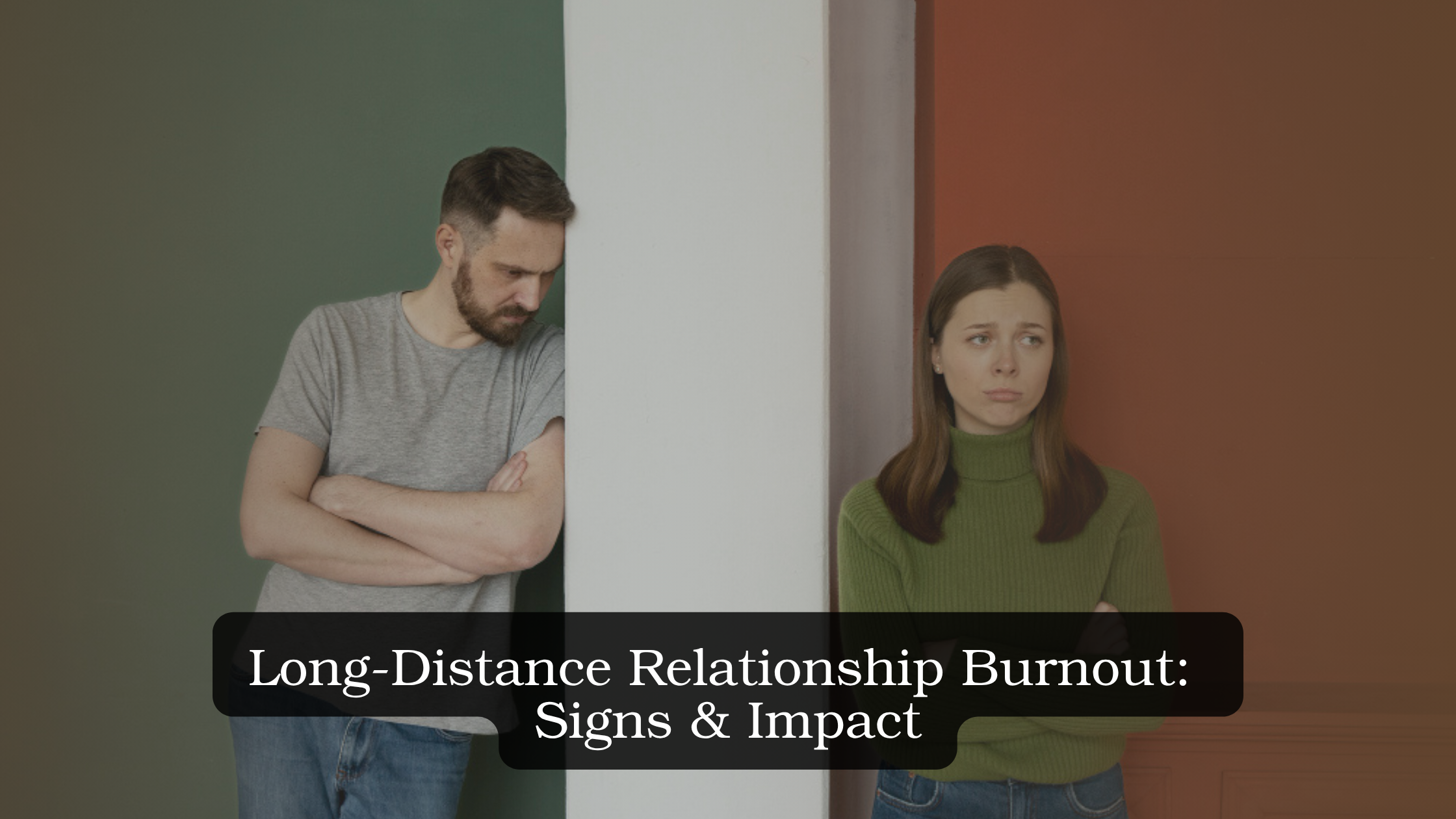
Long-Distance Relationship Burnout: Signs & Impact
Long-distance relationships can be deeply meaningful, but they can also become exhausting. You may love your partner and still feel tired of planning calls, counting down to visits, working around different schedules, or missing ordinary moments together. Sometimes the relationship doesn’t feel “bad” enough to leave, yet it doesn’t feel easy either. You may notice yourself replying less, feeling irritated during calls, or wondering why something that once felt exciting now feels like another responsibility. This is where relationship burnout can begin to show up.
Here we’ll explore the common signs of long-distance relationship burnout, why the distance can become emotionally draining, how burnout affects connection and communication, and what couples can do when the relationship starts feeling more exhausting than enjoyable.
What Long-Distance Relationship Burnout Looks Like
Long-distance burnout does not necessarily mean you have stopped loving your partner. Sometimes, it simply means you are tired of the emotional work that comes with being apart.

You Feel Tired Of Staying Connected
At the beginning of a long-distance relationship, talking every day can feel exciting. Over time, constant calls and messages can start feeling like another responsibility.
You might notice:
- Feeling tired before a video call
- Avoiding messages because you have no energy
- Feeling pressured to reply quickly
- Wanting more time alone
- Feeling relieved when a call gets cancelled
For example, you may still miss your partner but not feel excited about another long video call. That doesn’t automatically mean your feelings have disappeared. You may simply be emotionally tired.
This kind of tiredness can become easier to understand when you look at how your everyday conversations have changed.
Your Conversations Feel Repetitive
Distance can make conversations follow the same pattern every day.
You might find yourselves talking about:
- How your day went
- What you ate
- What you’re doing
- When you’ll meet next
- How much you miss each other
These conversations can still be affectionate, but they may eventually start feeling predictable.
You may miss having spontaneous conversations while cooking together, driving somewhere, or simply sitting beside each other.
When talking starts feeling like a routine rather than a meaningful connection, burnout can quietly grow.
That emotional fatigue can also change how you respond to the small things your partner does.
Small Things Start Annoying You More
When you’re already emotionally drained, minor disappointments can feel much bigger.
You may become unusually irritated when:
- Your partner replies late
- A planned call gets cancelled
- They seem distracted during a conversation
- Plans change unexpectedly
- They forget something you mentioned
The reaction may seem bigger than the situation itself.
Sometimes, the latest disagreement is simply where all the built-up exhaustion comes out.
Recognizing these signs can help you pause before assuming that every difficult feeling means something is wrong with the relationship.
Why Long-Distance Love Can Feel So Draining
Being apart creates challenges that couples who live near each other may not experience in the same way. Even ordinary parts of a relationship can require planning and effort.
Constant Planning Can Become Exhausting
When you cannot simply meet after work, connection often has to be scheduled.
You may have to work around:
- Different time zones
- Work schedules
- Family responsibilities
- Travel costs
- Limited holidays
- Unpredictable routines
Even something as simple as having dinner together may require planning.
Over time, constantly organizing your relationship can make it feel like something you have to manage rather than something you simply get to enjoy.
That feeling becomes even stronger when you start missing the ordinary parts of being together.
You Miss The Little Things
People often say they miss their partner. What they may really miss are the everyday moments that normally make a relationship feel natural.
You might miss:
- Having coffee together
- Running errands side by side
- Watching a movie on the same sofa
- Giving each other a hug after a difficult day
- Celebrating small achievements together
- Sitting in silence without needing to plan anything
These moments may seem small, but they are often a big part of feeling connected.
When they are missing for months or years, the emotional weight of the distance can become harder to carry.
And when there is no clear idea of when that distance will end, another layer of stress can appear.
Uncertainty Makes The Distance Harder
Some couples have a clear plan for eventually living in the same place. Others don’t know when or whether that will happen.
That uncertainty can leave you wondering:
- “How long can we keep doing this?”
- “When will we finally live together?”
- “What if our plans change?”
- “Are we working toward the same future?”
Not having answers can make an already difficult situation feel even heavier, and it often feeds relationship anxiety.
These pressures can affect not only how you experience the relationship, but also how you communicate with your partner.
How Burnout Can Change Your Relationship
Emotional exhaustion rarely stays in one area. It can slowly affect communication, intimacy, conflict, and the way partners experience each other.
You Become Less Emotionally Available
When you are tired, you may have less energy for meaningful conversations.
You might:
- Give shorter replies
- Avoid difficult topics
- Stop sharing little details about your day
- Feel less curious about your partner
- Keep conversations focused on practical matters
Your partner may interpret this as losing interest, a version of the pursuer-distancer cycle when they respond by reaching out more.
You may simply be exhausted.
That difference matters because one partner’s burnout can easily be mistaken for rejection by the other.
Once that happens, misunderstandings can start creating more conflict.
Small Problems Turn Into Bigger Arguments
When you’re already emotionally tired, even small things can feel much bigger than they normally would. A late reply may suddenly feel like your partner doesn’t care, while a cancelled call can turn into a much bigger conversation about commitment.
For example, you might think:
- “Why didn’t you reply?”
- “Do I even matter to you?”
- “You don’t make me a priority anymore.”
The original issue may have been a missed message, but the emotion underneath it could be loneliness, insecurity, rustration that has been building for a while, which is how resentment builds in a relationship without a single big fight. Burnout can make it harder to pause before reacting, understand what your partner is trying to say, and repair the conversation once it becomes tense. When these small conflicts keep repeating, they can eventually affect closeness and intimacy too.
Intimacy Starts Feeling Like Another Task
Long-distance couples often depend heavily on messages, calls, video chats, and other forms of digital intimacy.
When burnout sets in, even these forms of closeness can start feeling tiring.
You may notice:
- Less excitement about calls
- Less interest in romantic conversations
- Fewer affectionate messages
- Avoiding conversations about intimacy
- Feeling disconnected despite talking regularly
This can feel confusing.
You can miss someone terribly and still feel too emotionally tired to connect with them.
That doesn’t make your feelings contradictory. It may simply mean the relationship needs a different kind of care.
How Burnout Can Affect Your Own Well-Being
Long-distance burnout can affect more than the relationship. It can also change how you experience your own daily life.

You Feel Emotionally Drained
You may start feeling like you are constantly maintaining the relationship instead of enjoying it.
You might feel:
- Tired
- Lonely
- Irritable
- Anxious
- Overwhelmed
- Emotionally disconnected
For example, you may spend the entire day looking forward to your scheduled call, only to feel exhausted once it finally begins.
That can create guilt.
You may wonder:
“I love this person. So why does talking to them feel so difficult?”
Sometimes the answer is emotional exhaustion rather than a lack of love.
That becomes especially important when the relationship starts taking up more mental space than your own life.
Your Own Life Starts Taking A Back Seat
Distance can sometimes make couples organize their lives around the relationship.
You may find yourself:
- Turning down plans because of calls
- Constantly checking your phone
- Planning everything around the next visit
- Putting your own needs aside
- Feeling like your life is waiting to begin
A healthy relationship needs room for both connection and individuality.
Keeping your own friendships, routines, interests, and goals can help prevent the relationship from becoming your only source of emotional connection.
That balance can also make the relationship feel less like a constant obligation.
What Couples Can Do When Burnout Starts
Burnout usually isn’t solved by simply talking more. Sometimes couples need to change how they stay connected.
Take The Pressure Off Constant Communication
You don’t have to talk all day to prove that you care, and small habits of connection are covered in relationship maintenance.
Instead, couples can agree on communication that feels realistic for both people.
This could mean:
- Having fewer but more meaningful calls
- Sending voice notes instead of long conversations
- Having evenings where each person does their own thing
- Not expecting instant replies
- Allowing conversations to happen naturally
For example, instead of forcing a two-hour video call every night, a couple might have three meaningful calls during the week and leave the other evenings more flexible.
The goal is to make connection feel enjoyable again.
Make Room For Your Own Life
Distance becomes harder when every part of your routine revolves around your partner.
Make space for:
- Friends and family
- Hobbies
- Exercise
- Work or studies
- Personal goals
- Time alone
Having a full life outside the relationship does not make you less committed.
It can actually give you more experiences, energy, and things to share when you reconnect.
And sometimes, the relationship needs more than a change in routine.
Talk Honestly About What Is Feeling Heavy
If you are exhausted, pretending everything is fine can create more distance.
Choose a calm moment and explain what you are experiencing.
You might say:
“I’m not tired of you. I’m tired of how difficult the distance has become for me.”
That distinction can completely change the conversation.
You can also talk about:
- What feels hardest right now
- What each person needs more or less of
- Whether your communication routine is working
- How you can make visits more manageable
- Whether you have a shared plan for the future
Honest conversations can help couples understand whether they need a small adjustment or a deeper change.
When Couples May Need Professional Support
Not every difficult period means a relationship needs couples therapy. Long-distance relationships naturally have challenging phases.
Professional support may be worth considering when the same problems continue despite your efforts.
Look for patterns such as:
- Constant arguments about communication
- Feeling emotionally disconnected for a long time
- Avoiding meaningful conversations
- Growing resentment toward your partner
- Feeling lonely even when you are talking regularly
- Repeated uncertainty about the future
- Difficulty repairing after conflict
- Feeling like the relationship has become an obligation
For example, a couple may keep arguing about missed calls when the deeper issue is that neither person feels secure about where the relationship is going.
Therapy can give couples a place to explore that deeper issue rather than repeatedly fighting about the same missed call.
How Dr. Harel Papikian Can Help You
Dr. Harel Papikian works with couples who are struggling with communication, emotional disconnection, and relationship patterns that have become difficult to break.
For a long-distance couple experiencing burnout, Dr. Harel’s ARM Method can provide space to slow things down and understand what each partner is experiencing.
Couples can work on:
- Understanding each partner’s needs
- Improving communication
- Reducing recurring conflict
- Rebuilding emotional connection
- Managing difficult conversations
- Creating healthier relationship patterns
The goal isn’t simply to help couples communicate more often.
It is to help them communicate in ways that feel meaningful, supportive, and sustainable.
When the distance itself cannot immediately change, changing how the couple handles that distance can still make a meaningful difference.
Final Thoughts: Distance Does Not Have To Mean Disconnection
Long-distance relationship burnout can be confusing because you can deeply love someone and still feel exhausted by the relationship. Constant planning, missed everyday moments, uncertainty, repetitive conversations, and emotional pressure can slowly drain both partners. Recognizing the signs early can help you understand what is really happening instead of assuming your feelings have disappeared.
Small changes, such as taking pressure off communication, making room for your own life, and talking honestly about what feels difficult, can help. If you and your partner remain stuck, Dr. Harel Papikian can help you understand the patterns affecting your connection and work toward .A healthy relationship needs room for both connection and individuality, the balance explored in healthy independence vs. emotional distance.
Frequently Asked Questions
Can you love someone and still feel burned out?
Yes. Emotional exhaustion does not automatically mean your love has disappeared. You may care deeply about your partner while feeling tired of the planning, communication demands, uncertainty, and emotional effort that come with being apart.
Is feeling tired of talking to my partner normal?
It can happen, especially when couples feel pressure to communicate constantly. Wanting some space does not necessarily mean you want less of the relationship. It may mean your current communication routine has become emotionally tiring.
Does burnout mean a long-distance relationship is failing?
Not necessarily. Burnout can reflect the strain of distance rather than a lack of love. Couples may be able to improve things by changing communication patterns, creating more balance, and discussing what each partner needs.
How can I tell if I am emotionally withdrawing?
You may notice that you avoid calls, share less about your life, feel irritated during conversations, or no longer look forward to connecting. One difficult week is different from a pattern that continues for a long time.
Can taking a break from communication help?
A short, mutually agreed period of reduced communication can sometimes relieve pressure. The important part is communicating clearly about the change so that one partner does not interpret the space as rejection or abandonment.
How can couples stay connected without talking constantly?
Connection does not have to mean hours of conversation every day. Couples can share photos, voice notes, playlists, small updates, or planned activities while still maintaining independent routines and personal space.
When should a long-distance couple consider therapy?
Therapy may help when burnout has become persistent or is creating repeated conflict, emotional withdrawal, resentment, or uncertainty. A therapist can help partners understand what is happening and develop healthier ways of staying connected.
Can long-distance relationships become healthy again after burnout?
They can, depending on the relationship and the willingness of both partners to address what is causing the exhaustion. Honest communication, realistic expectations, individual space, and professional support can all help couples make meaningful changes.

Harel Papikian
Dr. Harel Papikian is a clinical psychologist and couples therapist with more than 15 years of experience. He offers marriage counseling and couples therapy in los Angeles. It help’s couples navigate their relationship challenges and deepen their connection. Our clinic uses a unique ARM method (Awareness, Release, Mastery) to achieve rapid and profound results for our clients. We serve a diverse clientele, including LGBTQ+ and heterosexual couples, addressing issues like communication breakdowns, conflict resolution, intimacy, and trust. You can also get individual therapy sessions for concerns like depression, anxiety, and trauma.
Leave a Reply