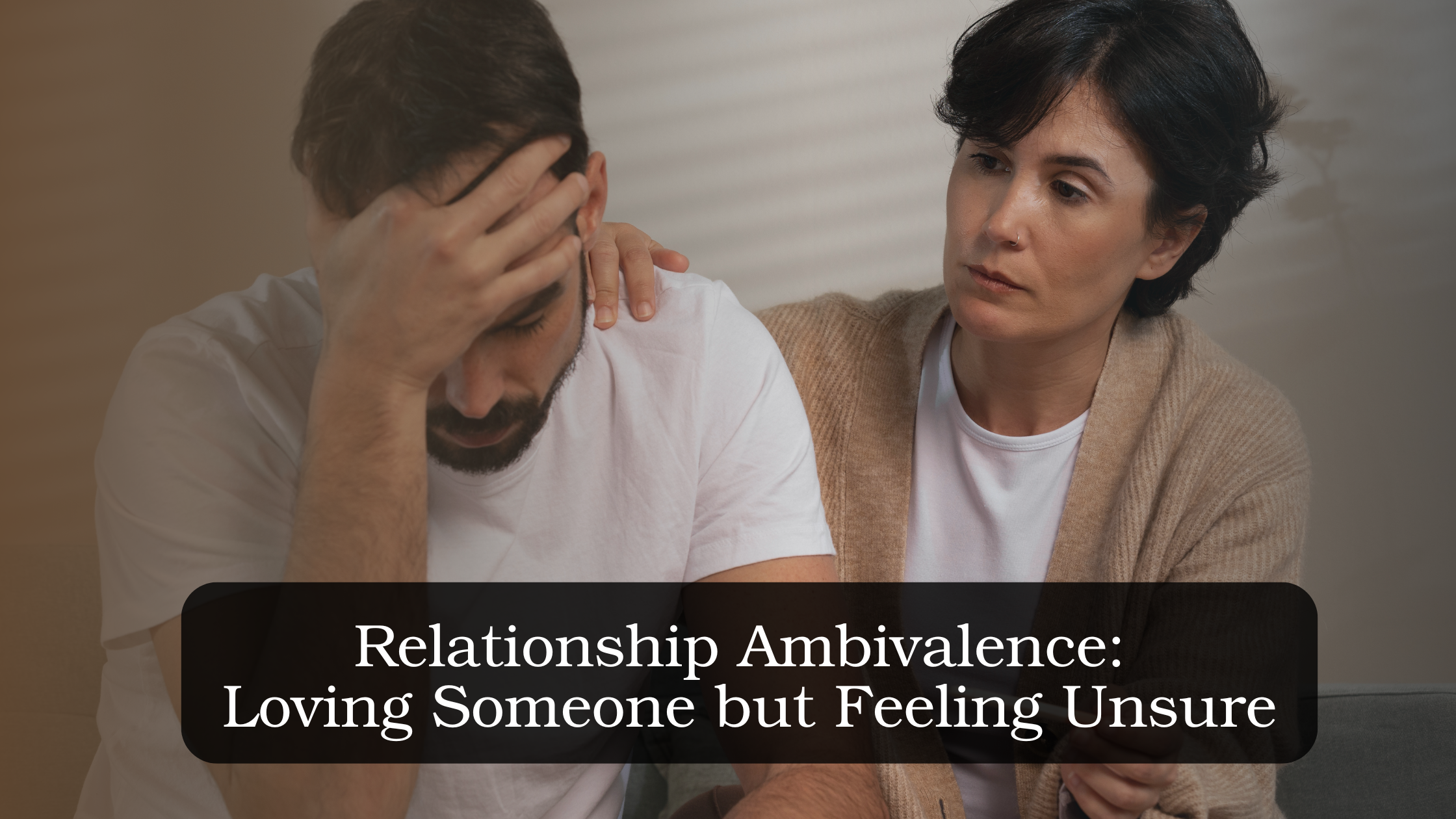
Relationship Ambivalence: Loving Someone but Feeling Unsure
Love does not always come with complete certainty. You can deeply care about your partner while questioning your compatibility, emotional needs, or future together. This tension is often described as relationship ambivalence: holding genuine affection alongside persistent uncertainty about the relationship.
Ambivalence can feel confusing because neither staying nor leaving seems completely clear. You may value what you have built while wondering whether something important is missing. These doubts do not automatically mean a relationship is failing, but they are worth understanding rather than ignoring.
Exploring where the uncertainty comes from can help you make thoughtful decisions instead of reacting to fear, pressure, or the need for absolute certainty.
What Is Relationship Ambivalence?
Relationship ambivalence refers to experiencing mixed or conflicting feelings about a romantic relationship. Unlike a passing doubt after an argument or during a stressful period, ambivalence may persist and create an ongoing internal debate about whether the relationship is right.
A person experiencing ambivalence may continue to love their partner, enjoy their time together, and imagine a future with them while simultaneously feeling that something remains unresolved.
Relationship ambivalence may sound like:
- “I love them, but something feels missing.”
- “I cannot imagine breaking up, but I cannot imagine feeling this uncertain forever.”
- “Our relationship is good, so why do I keep questioning it?”
- “What if I make the wrong decision?”
Living with this uncertainty can become emotionally exhausting, particularly when someone feels compelled to find a definitive answer immediately.

Why Loving Someone Does Not Always Mean Feeling Certain
Love is an important part of a relationship, but it does not answer every question about long-term compatibility.
Healthy relationships also involve communication, trust, emotional responsiveness, shared values, mutual respect, and the ability to navigate differences. Two people can genuinely love each other while struggling in one or more of these areas.
For example, someone may feel deeply connected to their partner while repeatedly encountering communication problems. Another person may feel secure in the relationship but question whether their long-term goals still align after a significant life change.
Uncertainty, therefore, does not automatically mean that love has disappeared. Sometimes it reflects legitimate relationship concerns. At other times, it may arise from anxiety, personal expectations, or changes in one’s own identity and priorities.
Understanding the source of the uncertainty is often more useful than immediately asking, “Should I stay or leave?”
Common Reasons Relationship Ambivalence Develops
Ambivalence usually develops from a combination of experiences rather than one isolated event.
Common contributing factors include:
- Ongoing communication problems
- Differences in values, priorities, or future goals
- Emotional needs that feel consistently overlooked
- Work, financial, parenting, or family-related stress
- Anxiety or insecurity around relationships
- Fear of making the wrong long-term decision
- Changes in identity, priorities, or personal growth
- Unresolved resentment or recurring conflict
Sometimes the relationship itself is contributing to the uncertainty. In other situations, personal fears or emotional patterns may be playing a larger role.
That distinction matters. If the uncertainty comes primarily from unresolved relationship problems, those issues may need to be addressed directly. If it is largely driven by anxiety or fear of uncertainty, repeatedly analyzing the relationship may actually make clarity more difficult.
How Earlier Experiences Can Influence Relationship Ambivalence
Our earlier experiences can shape how we understand closeness, trust, conflict, and emotional security.
Someone who experienced inconsistent caregiving or unpredictable relationships growing up may become particularly sensitive to signs of rejection or abandonment. Another person who witnessed frequent conflict may interpret ordinary disagreements as evidence that a relationship is becoming unsafe or unstable.
These experiences can contribute to underlying beliefs such as:
- “People eventually leave.”
- “Love is difficult to trust.”
- “I have to earn affection.”
- “If I become too comfortable, I will eventually get hurt.”
Such beliefs may operate outside conscious awareness. As a result, a person can feel uncertain even when their current relationship is relatively stable.
This does not mean childhood experiences determine adult relationships. Rather, they can influence the emotional expectations people bring into them.
When Relationship Anxiety Looks Like Ambivalence
Sometimes persistent uncertainty is driven less by actual relationship problems and more by anxiety.
An anxious mind often seeks certainty. But no relationship can provide complete certainty about the future. There will always be unknowns about compatibility, life circumstances, attraction, personal growth, and what the future may bring.
This can lead to recurring questions such as:
- “Do I really love them enough?”
- “What if someone else would make me happier?”
- “What if I am settling?”
- “Why don’t I feel completely sure?”
- “How do I know this is the right relationship?”
Repeatedly trying to eliminate every doubt can create a cycle of reassurance seeking and further questioning. The temporary relief that comes from finding an answer may quickly disappear, prompting the person to analyze the relationship again.
When this pattern becomes persistent or distressing, it can be useful to explore whether anxiety is contributing to the uncertainty.
How Life Changes Can Create Temporary Doubt
Relationship feelings can shift during major life transitions. Marriage, parenthood, career changes, relocation, financial pressure, or caring for aging parents can alter routines, responsibilities, and emotional availability.
During these periods, couples may have less time for intimacy and meaningful conversation while facing substantially more demands. The resulting disconnection can sometimes be interpreted as evidence that the relationship itself has changed permanently.
Before reaching that conclusion, it can help to consider the broader context.
Ask yourself:
- Has the relationship changed, or have our circumstances changed?
- Have we had enough time and energy to reconnect?
- Are current doubts stronger during periods of stress?
- What happens to my uncertainty when life feels calmer?
Temporary disconnection does not necessarily indicate permanent incompatibility. see how major life transitions affect relationships even when the bond itself hasn’t changed.
How Overthinking Can Make Uncertainty Worse
When people feel uncertain, it is natural to try to think their way toward a perfect answer. However, relationships rarely offer the kind of certainty that can be reached through analysis alone.
Someone experiencing ambivalence may replay conversations, compare their relationship with other couples, search online for signs that they should stay or leave, or repeatedly evaluate how they feel about their partner.
Reflection can be helpful when it leads to greater self-understanding. Rumination is different: it repeatedly revisits the same questions without producing meaningful clarity.
The goal is not to stop thinking about the relationship. It is to recognize when thinking has shifted from useful reflection into an exhausting search for certainty that may not be possible.

Questions That Can Help You Understand Your Feelings
Instead of immediately deciding whether to stay or leave, consider exploring what the uncertainty is actually telling you.
Ask yourself:
- Do I feel emotionally safe and respected in this relationship?
- Can we discuss difficult issues without fear or contempt?
- Are my important emotional needs acknowledged?
- Do we support each other’s growth?
- Are our core values and long-term priorities compatible?
- Is the uncertainty connected to the relationship or primarily to my own fears?
- Do I still feel hopeful about building a future together?
- When relationship problems are addressed, does my sense of connection improve?
These questions encourage curiosity rather than forcing an immediate conclusion.
How Couples Can Work Through Relationship Ambivalence
When both partners remain invested in the relationship, ambivalence can become an opportunity to examine what needs attention.
Couples may benefit from:
- Discussing unmet needs honestly and respectfully
- Identifying recurring relationship patterns rather than focusing only on individual incidents
- Listening with curiosity instead of immediately becoming defensive
- Clarifying values, expectations, and future priorities
- Creating intentional time for emotional connection
- Addressing unresolved resentment or recurring conflict
- Seeking professional support when uncertainty becomes overwhelming
Clarity often develops gradually. A single conversation may not resolve years of uncertainty, but honest conversations can reveal whether the relationship has the capacity and willingness to grow.
How Couples Therapy Can Help
Relationship ambivalence can make it difficult for couples to understand whether they are facing a temporary struggle or deeper relationship concerns. Couples therapy provides a structured space to explore these conflicting feelings together.
Therapy can help couples:
- Understand the patterns contributing to relationship uncertainty
- Express emotional needs and concerns more openly
- Explore differences in values, expectations, and future goals
- Improve communication when difficult topics arise
- Understand whether anxiety or relationship issues are contributing to doubt
- Consider possible changes without immediately making a decision
The goal is not to push either partner toward staying together or separating. Instead, couples therapy can help both partners better understand the relationship and determine what they need moving forward.
How Dr. Harel Approaches Relationship Ambivalence
Dr. Harel approaches relationship ambivalence by helping clients slow down and understand what their uncertainty may be communicating, rather than treating doubt as an immediate sign that a relationship should end.
In his Los Angeles practice, he helps individuals and couples explore whether uncertainty is connected to relationship concerns, unmet emotional needs, anxiety, past experiences, or differences in values and future goals.
Therapy may help clients:
- Identify what is driving their uncertainty
- Separate relationship concerns from anxiety or overthinking
- Clarify emotional needs, values, and expectations
- Understand recurring relationship patterns
- Evaluate whether differences can be addressed
The goal is not to eliminate every doubt or push clients toward staying or leaving. It is to help them develop greater clarity and make thoughtful decisions based on their needs and values.
Final Thoughts
Relationship ambivalence can be difficult because two seemingly contradictory experiences can exist at the same time. You can love your partner and still have serious questions. You can appreciate your relationship while wondering whether it meets your needs. You can feel connected in some areas while uncertain about others.
The presence of doubt alone does not provide an automatic answer about what you should do next.
Instead, uncertainty can be an invitation to slow down and examine what is underneath it. Are there unresolved relationship problems? Are your values and goals changing? Is anxiety driving the search for certainty? Or has the relationship genuinely stopped feeling compatible?
Understanding those questions can help you move toward decisions based on greater self-awareness rather than fear or pressure.
Healthy relationships do not require the complete absence of doubt. They require the willingness to approach difficult emotions honestly, communicate openly, and examine whether both people can continue growing together.
Frequently Asked Questions
Yes. Mixed feelings can occur in relationships, particularly during periods of stress or major life transitions. Persistent uncertainty that causes significant distress, however, may be worth exploring more closely.
Yes. Love and uncertainty can coexist. You may deeply care about your partner while questioning compatibility, future goals, emotional needs, or other aspects of the relationship.
Not necessarily. Ambivalence is a reason to explore what is creating the uncertainty, not an automatic instruction to end the relationship.
Relationship ambivalence involves genuine uncertainty or conflicting feelings about the relationship. Relationship OCD, or relationship-focused obsessive-compulsive symptoms, can involve intrusive doubts and repetitive behaviors such as reassurance seeking, checking feelings, comparing relationships, or repeatedly analyzing whether the relationship is “right.” A qualified mental health professional can help determine what may be contributing to these experiences.
Yes. Anxiety can increase the desire for certainty, while relationships inherently involve some uncertainty. This can lead to repeated analysis or reassurance seeking even when significant relationship problems are not present.
Honest communication can be helpful, but the way the conversation is approached matters. Rather than presenting uncertainty as a final decision, you can explain what you are experiencing and identify the specific concerns you want to understand together.
It can change when the underlying factors are addressed. Improved communication, reduced anxiety, resolution of relationship problems, or adjustment to major life changes may all affect how uncertainty is experienced. Persistent concerns, however, should not simply be dismissed.

Harel Papikian
Dr. Harel Papikian is a clinical psychologist and couples therapist with more than 15 years of experience. He offers marriage counseling and couples therapy in los Angeles. It help’s couples navigate their relationship challenges and deepen their connection. Our clinic uses a unique ARM method (Awareness, Release, Mastery) to achieve rapid and profound results for our clients. We serve a diverse clientele, including LGBTQ+ and heterosexual couples, addressing issues like communication breakdowns, conflict resolution, intimacy, and trust. You can also get individual therapy sessions for concerns like depression, anxiety, and trauma.
Pingback: What Is Relationship OCD and How Is It Different From Normal Doubt?