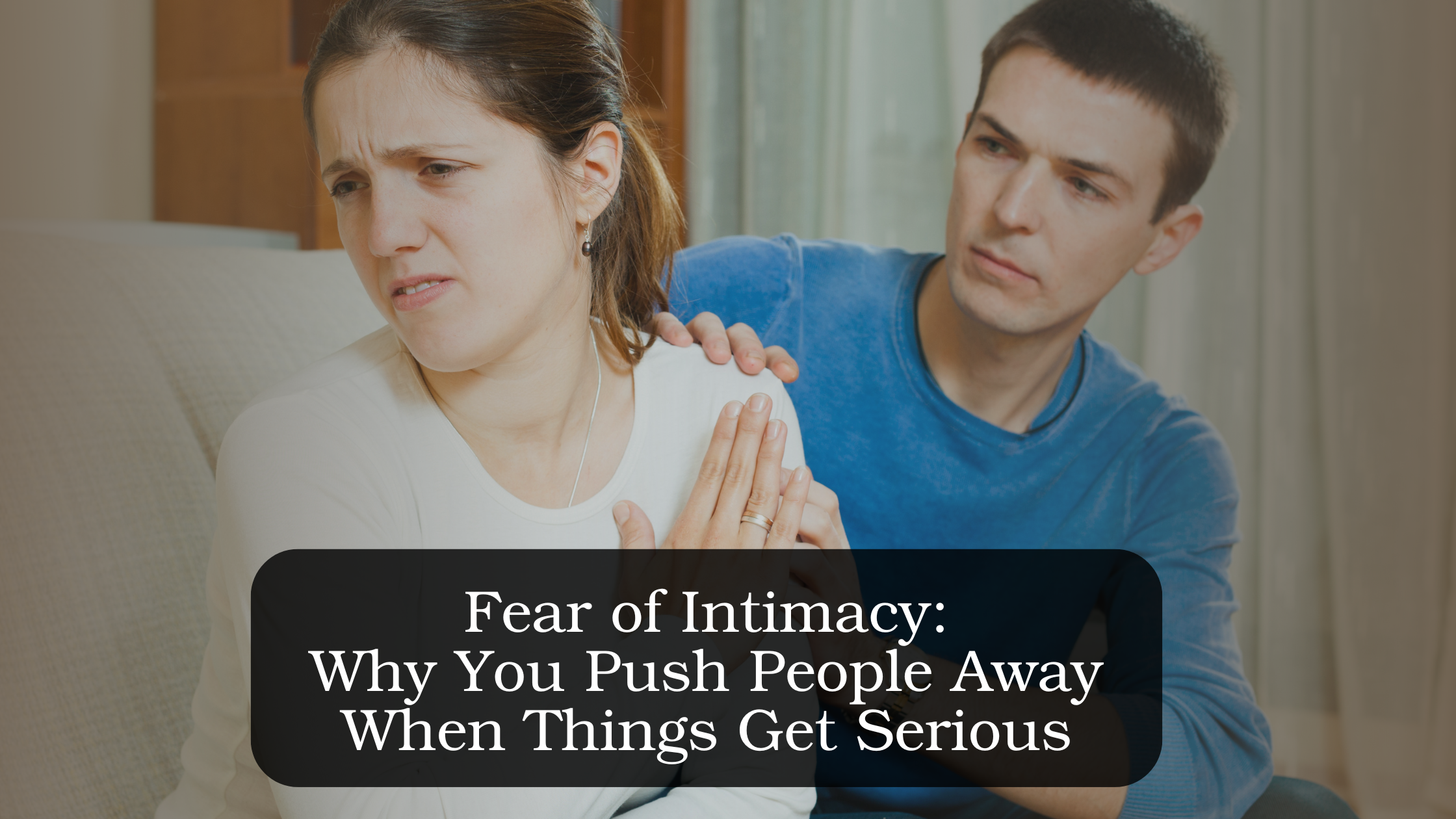
Fear of Intimacy: Why You Push People Away When Things Get Serious
A relationship can feel exciting when it is new, uncertain, and still unfolding. But as emotional closeness increases, something may change. You might become more guarded, start noticing flaws you previously overlooked, feel an urge to create distance, or suddenly question whether you want the relationship at all. For some people, this pattern is connected to a fear of intimacy.
Fear of intimacy is not necessarily a fear of relationships. You may genuinely want a close partnership while finding emotional vulnerability difficult once another person begins to matter deeply. The closer the relationship becomes, the more exposed you may feel to rejection, disappointment, loss, or being hurt.
Understanding why you pull away can help separate genuine incompatibility from a protective response to vulnerability. When these patterns become clearer, it becomes possible to develop greater emotional safety without forcing yourself into closeness before you are ready.
What Is Fear of Intimacy?
Fear of intimacy involves difficulty becoming emotionally close to another person, particularly when vulnerability, trust, dependence, or emotional exposure increases.
Intimacy involves more than physical closeness. It can include:
- Sharing fears and insecurities
- Allowing someone to know you deeply
- Depending on another person
- Accepting emotional support
- Expressing needs
- Being seen when you do not feel confident
- Allowing another person to influence you emotionally
- Remaining connected during disagreement or uncertainty
For someone who fears intimacy, these experiences can create conflicting feelings.
You may want a relationship but become uncomfortable once it starts becoming emotionally significant. You may enjoy dating until your partner begins talking about the future. You may feel attracted to someone but lose interest once they reciprocate strongly.
This does not automatically mean that you have a fear of intimacy. Sometimes losing interest simply means that a relationship is not right for you. The pattern becomes more meaningful when the same cycle repeatedly occurs across relationships.

Why Do You Push People Away When Things Get Serious?
Pushing someone away can serve a protective function. If closeness is associated with emotional risk, creating distance can temporarily reduce that discomfort.
You might:
- Become unusually critical of your partner
- Start looking for reasons the relationship will fail
- Stop communicating as openly
- Delay responding to messages
- Avoid conversations about the future
- Become emotionally unavailable
- Pick unnecessary arguments
- Focus intensely on your partner’s flaws
- Convince yourself that you are better off alone
- End the relationship shortly after becoming emotionally close
From the outside, these behaviors may look like a sudden loss of interest. Internally, however, they may be connected to anxiety about what greater intimacy could mean.
Distance can create immediate relief. The difficulty is that the relief may reinforce the pattern. If withdrawing makes uncomfortable feelings temporarily disappear, your mind may learn that distancing yourself is the safest response whenever intimacy increases.
How Fear of Intimacy Creates a Push-Pull Pattern
Fear of intimacy can sometimes create a cycle of wanting connection and then retreating from it.
For example:
You meet someone → feel attracted → become emotionally close → feel vulnerable → experience anxiety → create distance → feel relief → miss the connection → reconnect → become close again.
This can become a repeating pattern.
The person may genuinely want love and companionship. At the same time, emotional closeness may activate fears that make connection difficult to tolerate.
This is sometimes described as a push-pull dynamic. It can be confusing for both people because the person withdrawing may not fully understand why their feelings seem to change so quickly. This is closely related to the pursuer-distancer cycle, where one partner’s withdrawal intensifies the other’s pursuit.
Signs You May Be Afraid of Intimacy
There is no single checklist that establishes a fear of intimacy, but certain recurring experiences may be worth examining.
You feel uncomfortable when someone becomes emotionally available
You may feel more comfortable pursuing someone who is uncertain or emotionally distant than someone who is consistently available.
Once another person clearly expresses affection, your own desire may seem to decrease.
You become focused on their flaws
Everyone has imperfections. But when intimacy increases, you may suddenly become preoccupied with relatively minor characteristics.
You might think:
“They chew too loudly.”
“They’re not ambitious enough.”
“Maybe I’m not attracted to them after all.”
Sometimes these concerns reflect genuine incompatibility. At other times, intense fault-finding can function as a way to create emotional distance.
You start questioning your feelings
You may repeatedly ask yourself:
“Do I really love them?”
“What if I meet someone better?”
“Shouldn’t I feel more certain?”
The search for absolute certainty can itself become a way of avoiding the vulnerability involved in continuing a relationship.
You feel trapped by commitment
As the relationship becomes more serious, you may experience a strong desire for freedom.
Even ordinary relationship expectations can begin to feel restrictive. You might interpret commitment as losing independence rather than choosing a relationship while retaining your individuality.
You withdraw after moments of closeness
Sometimes the trigger is not conflict but intimacy itself.
After sharing something deeply personal, having sex, meeting family, discussing the future, or receiving strong affection, you may suddenly want space.
You prefer relationships that remain emotionally limited
You may repeatedly become involved with people who are unavailable, inconsistent, geographically distant, or otherwise difficult to become deeply connected with.
This can create the appearance of wanting relationships while reducing the likelihood of experiencing significant vulnerability.
Where Can Fear of Intimacy Come From?
Fear of intimacy can have different origins. Understanding possible contributors can provide context without reducing someone’s experience to a single cause.
Earlier relationship experiences
Experiences of betrayal, rejection, abandonment, bullying, emotional neglect, or painful breakups can influence expectations about future relationships.
If closeness has previously resulted in significant pain, emotional distance may begin to feel safer.
Family relationships
The emotional environment in which someone grows up can influence what intimacy feels like.
If emotions were dismissed, privacy was not respected, conflict was unpredictable, or affection was inconsistent, closeness may not automatically feel safe in adulthood.
This does not mean that everyone with difficult childhood experiences will fear intimacy. People develop in complex ways, and relationships are influenced by many factors. This connects to the broader patterns explored in how childhood experiences affect adult relationships.
Fear of rejection
Allowing someone to know you deeply creates the possibility that they may reject aspects of you that you normally keep private.
Keeping relationships emotionally limited can reduce that perceived risk.
Fear of losing independence
For some people, intimacy becomes associated with losing autonomy.
They may worry that being deeply connected means having fewer choices, less privacy, or less control over their own lives.
Healthy intimacy does not require giving up individuality the same distinction explored in hyper-independence and how it damages relationships.
Difficulty trusting others
Trust usually develops gradually. If someone expects betrayal or abandonment, they may remain emotionally guarded even when their partner has not given them a reason to distrust them.
Fear of Intimacy vs. Not Wanting the Relationship
This distinction matters.
Not every desire to leave a relationship is avoidance.
You may genuinely recognize that your values are incompatible, that attraction has changed, or that the relationship does not meet your needs.
The question is whether your doubts consistently appear when intimacy increases.
Consider the broader pattern:
| Possible incompatibility | Possible intimacy-related avoidance |
| Concerns remain relatively consistent | Concerns intensify as closeness increases |
| You can discuss problems openly | Vulnerability itself creates discomfort |
| You can imagine closeness without feeling trapped | Commitment triggers a strong urge to escape |
| Leaving feels sad but appropriate | Leaving produces immediate relief followed by longing |
| Similar concerns may exist across contexts | The same withdrawal pattern appears repeatedly across relationships |
This is not a diagnostic test. Relationship decisions involve many factors, and a therapist can help you explore the difference when the pattern is difficult to understand on your own.
Why Criticizing Your Partner Can Become a Form of Protection
One way people create emotional distance is by shifting their attention from vulnerability to evaluation.
Instead of asking:
“Why am I suddenly uncomfortable being close to this person?”
the mind may focus on:
“Maybe they’re not attractive enough.”
“Maybe they’re too needy.”
“Maybe I could find someone more compatible.”
There may be legitimate concerns within those thoughts. But if criticism consistently intensifies immediately after emotional closeness, it may be useful to examine what happens underneath the judgment.
Sometimes finding reasons to leave feels easier than acknowledging:
“I care about this person, and that makes me feel vulnerable.”
How Pushing People Away Can Affect Your Relationships
Repeated withdrawal can affect both partners.
The person who withdraws may experience temporary relief but later feel lonely, regretful, or confused about why relationships keep ending.
The other partner may experience uncertainty, rejection, or emotional whiplash. They may not understand why the relationship felt secure one week and distant the next.
Over time, this can create a self-reinforcing cycle:
Fear of vulnerability → withdrawal → relationship instability → loss or breakup → confirmation that closeness is painful.
Recognizing this cycle does not mean blaming yourself. It creates an opportunity to understand the protective strategy and consider whether it is still serving you.
How to Stop Pushing People Away When You Want Connection
Changing an intimacy pattern usually involves learning to tolerate vulnerability rather than forcing yourself to become comfortable immediately.

Notice the moment you want to withdraw
Pay attention to what happened immediately before the urge to create distance.
Did your partner express stronger feelings?
Did you discuss becoming exclusive?
Did you have an emotionally vulnerable conversation?
Did they ask for greater commitment?
Identifying the trigger can make the pattern easier to understand.
Pause before making major relationship decisions
If you suddenly feel certain that you need to end a relationship, consider giving yourself some time before acting, particularly if the urge appeared immediately after an emotionally intimate experience.
This does not mean staying in a relationship you genuinely do not want. It means creating enough space to distinguish a considered decision from an anxiety-driven reaction.
Separate discomfort from danger
Feeling vulnerable is not necessarily evidence that something is wrong.
You can ask:
“Am I uncomfortable because this relationship is unhealthy, or because being emotionally close feels unfamiliar and risky?”
That distinction can be difficult to make alone, but even asking the question can interrupt an automatic response.
Communicate instead of disappearing
Rather than suddenly withdrawing, try explaining what is happening.
For example:
“I care about you, and I’ve noticed that I become anxious when relationships start feeling more serious. I need some time to understand what I’m experiencing rather than pulling away without explaining.”
Honest communication does not guarantee a particular outcome, but it gives both people more information.
Practice gradual vulnerability
You do not need to disclose everything at once.
Start with manageable forms of emotional openness. Share a concern. Ask for support. Express a preference. Tell your partner when you are anxious.
The goal is to discover that vulnerability can be tolerated and that closeness does not automatically mean losing control.
When Couples Therapy May Help
Consider speaking with a therapist if you repeatedly notice that:
- You want a relationship but become uncomfortable once it becomes serious
- You repeatedly end relationships after becoming emotionally close
- You feel safest when the other person is emotionally unavailable
- You struggle to trust partners even when they have been consistent
- You experience intense anxiety around vulnerability
- You feel confused by your own relationship patterns
- You repeatedly regret withdrawing from people you cared about
- Attempts to change the pattern on your own have not helped
Therapy can provide a place to examine these patterns without assuming that every relationship should be preserved.
The goal is greater understanding and choice. You can learn to recognize when you are protecting yourself from genuine harm and when you are protecting yourself from the ordinary vulnerability that comes with meaningful connection.
Final Thoughts
Fear of intimacy can create a difficult conflict: you may genuinely want love and connection while feeling an urge to pull away when someone gets too close. Recognizing this pattern does not mean that every relationship should be saved or that every doubt is caused by fear. It means giving yourself the opportunity to understand what is happening before automatically responding by creating distance.
If you repeatedly find yourself pushing people away when relationships become serious, therapy can help you explore the fears, relationship patterns, and experiences behind that response. Dr. Harel can help you distinguish genuine incompatibility from protective withdrawal and develop healthier ways to experience vulnerability while maintaining your boundaries and sense of independence.
How Dr. Harel Approaches Fear of Intimacy
Dr. Harel can help individuals and couples explore what happens when emotional closeness begins to feel threatening.
The focus is not simply on convincing someone to stay in a relationship. Instead, therapy can help clarify the difference between genuine incompatibility and protective withdrawal.
This may involve exploring:
- What happens emotionally when a relationship becomes more serious Dr. Harel’s ARM Method offers one structured framework for exploring these patterns.
- Previous experiences that may influence expectations of closeness
- How vulnerability is experienced in the body and mind
- Patterns of pursuing and withdrawing
- Fear of rejection, abandonment, dependence, or loss of independence
- How each partner interprets distance and reassurance
- Ways of communicating needs without abruptly shutting down
- How to build tolerance for emotional closeness gradually
For couples, therapy can also examine the interaction between both partners. One person’s withdrawal can increase the other’s pursuit, which can then make the withdrawing partner feel even more overwhelmed.
Understanding that cycle can create room for a different response.
For someone who repeatedly pushes people away despite wanting a close relationship, the goal may be to develop a greater capacity for intimacy while preserving healthy boundaries and individuality.
Frequently Asked Questions About Fear of Intimacy
Yes. Being in a long-term relationship does not necessarily mean that emotional intimacy feels easy. Someone may maintain a relationship while keeping certain emotions, needs, fears, or vulnerabilities carefully protected.
Reciprocal affection can increase emotional exposure. For some people, that shift can activate anxiety that was not present when the relationship was uncertain. However, changes in attraction can also have many ordinary explanations, so the broader pattern matters more than one experience.
Yes. Emotional intimacy is not limited to romantic relationships. Someone may also struggle when friendships become emotionally close, particularly if they feel uncomfortable depending on others, sharing personal information, or being emotionally seen.
People can be drawn to emotionally unavailable partners for many reasons, and there is no single explanation. In some cases, an unavailable relationship can feel safer because it provides connection without requiring the same degree of vulnerability. Exploring whether this pattern repeats can provide useful insight.
Absolutely. Wanting commitment and being afraid of intimacy are not mutually exclusive. A person may strongly desire companionship and a long-term partnership while simultaneously feeling anxious about the vulnerability required to sustain one.
They are related concepts but should not be treated as interchangeable diagnoses. Attachment patterns describe tendencies in how people experience closeness and relationships, while fear of intimacy refers more broadly to discomfort or fear around emotional closeness. A therapist can help explore the specific pattern rather than relying on a label alone.
Yes. A painful betrayal, rejection, or breakup can affect how safe future relationships feel. Some people become more cautious afterward. For others, the experience can contribute to a stronger tendency to withdraw whenever a new relationship begins becoming emotionally significant.
Wanting independence is not the same as fearing intimacy. Healthy relationships can include substantial personal space, friendships, hobbies, privacy, and individual goals. The important question is whether independence is a freely chosen part of how you relate or primarily a way to avoid emotional vulnerability.

Harel Papikian
Dr. Harel Papikian is a clinical psychologist and couples therapist with more than 15 years of experience. He offers marriage counseling and couples therapy in los Angeles. It help’s couples navigate their relationship challenges and deepen their connection. Our clinic uses a unique ARM method (Awareness, Release, Mastery) to achieve rapid and profound results for our clients. We serve a diverse clientele, including LGBTQ+ and heterosexual couples, addressing issues like communication breakdowns, conflict resolution, intimacy, and trust. You can also get individual therapy sessions for concerns like depression, anxiety, and trauma.
Leave a Reply