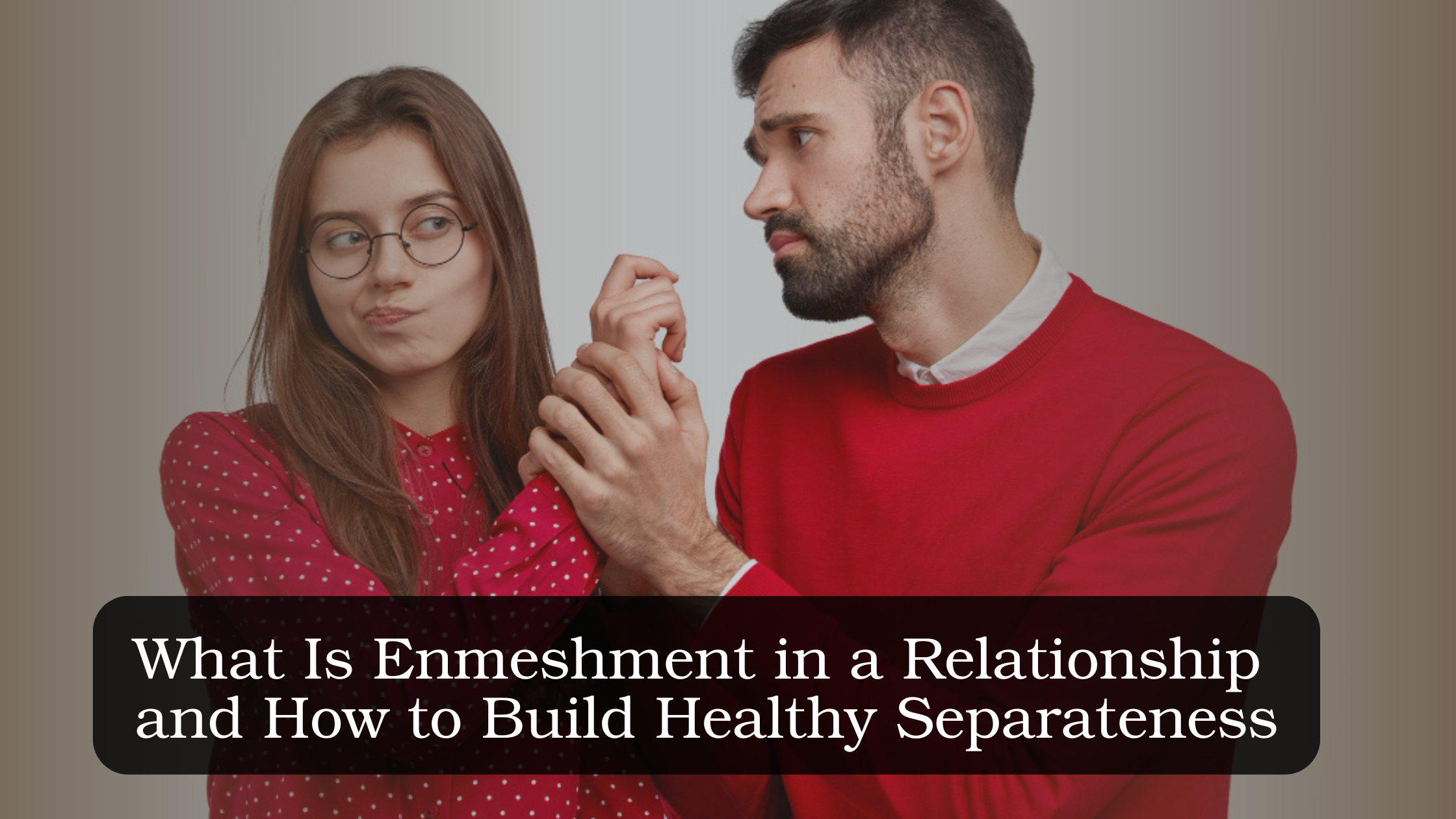
What Is Enmeshment in a Relationship and How to Build Healthy Separateness
A close relationship can feel deeply connected without requiring two people to share every thought, decision, friendship, or emotional experience. But sometimes closeness becomes difficult to distinguish from dependence. One partner may feel responsible for the other’s emotions, personal boundaries may become unclear, or spending time apart may create guilt, anxiety, or conflict. This pattern is sometimes described as enmeshment.
Enmeshment does not necessarily mean that a relationship is unhealthy simply because partners are very close. Couples can share routines, values, finances, friendships, and major life decisions while still maintaining a sense of individual identity. The concern arises when personal autonomy becomes difficult to maintain without fear, guilt, conflict, or emotional withdrawal.
Understanding enmeshment can help couples identify where connection has started to come at the expense of individuality. With greater awareness, communication, and appropriate boundaries, partners can work toward a relationship in which emotional closeness and personal independence can exist at the same time.
What Is Enmeshment in a Relationship?
Enmeshment describes a relationship dynamic in which the emotional and personal boundaries between people become unusually blurred. Instead of experiencing themselves as two individuals who are connected, partners may begin to function as though their emotions, decisions, needs, and identities must constantly be coordinated.
In an enmeshed relationship, one person’s feelings can have a disproportionate effect on the other. A partner might feel responsible for preventing the other person from becoming upset, disappointed, lonely, or anxious. Alternatively, someone may feel that making an independent decision is a betrayal of the relationship.
This does not always happen intentionally. Enmeshment can develop gradually through family patterns, attachment experiences, cultural expectations, previous relationship experiences, or periods when partners have had to rely heavily on one another.
The important distinction is that interdependence allows closeness and individuality to coexist, while enmeshment can make individuality feel unsafe or disloyal.

Enmeshment vs. Healthy Interdependence
Healthy relationships involve dependence on one another. Partners turn to each other for comfort, advice, companionship, practical support, and emotional connection. Needing your partner is not inherently unhealthy.
The difference lies partly in whether each person can remain a separate individual within the relationship.
| Healthy interdependence | Enmeshment |
| Partners can rely on each other while maintaining individual identities | Individual identity may become difficult to separate from the relationship |
| Time apart can be comfortable | Separation may trigger guilt, anxiety, or conflict |
| Each person can have different opinions | Differences may feel threatening or disloyal |
| Boundaries can be discussed and respected | Boundaries may be interpreted as rejection |
| Partners support each other’s friendships and interests | Outside relationships may create insecurity or resentment |
| Emotional support is mutual | One person may feel responsible for regulating the other’s emotions |
| Decisions can involve both partners without requiring constant agreement | Independent decisions may feel unacceptable |
Healthy separateness does not mean becoming emotionally distant the same distinction explored in the difference between healthy independence and emotional distance.It means having enough psychological space to remain yourself while participating fully in the relationship.
Signs of Enmeshment in a Relationship
Enmeshment can look different from couple to couple. Some common patterns include:
Feeling responsible for your partner’s emotions
You may constantly monitor your partner’s mood and change your behavior to prevent them from becoming upset. Their disappointment might feel like something you have failed to manage.
Difficulty making independent decisions
You may feel uncomfortable choosing where to go, whom to spend time with, what activities to pursue, or even what opinions to hold without your partner’s approval.
Guilt about having separate interests
Spending time alone or enjoying an activity without your partner may create guilt. You may feel that choosing yourself means neglecting the relationship.
Limited privacy
Partners may expect access to each other’s messages, conversations, friendships, schedules, or personal thoughts. Privacy can become confused with secrecy, even when there is no evidence of betrayal.
Constant emotional involvement
You may feel that you need to know what your partner is thinking or feeling at all times. When they are quiet or emotionally unavailable, you may immediately assume that something is wrong.
Difficulty saying no
A partner may agree to things they do not want because saying no feels selfish, hurtful, or dangerous to the relationship.
Conflict around independence
Requests for space can become arguments. One partner may interpret “I need some time alone” as “I don’t love you anymore.”
Losing touch with your own preferences
Over time, you may become uncertain about what you actually enjoy, want, believe, or need because so much of your attention is organized around the relationship.
Not every one of these experiences means that a relationship is enmeshed. Context matters, including how frequently the pattern occurs, how much distress it creates, and whether both partners can adjust when a boundary is expressed.
Why Does Enmeshment Develop?
There is no single explanation for enmeshment. Relationship patterns often develop through a combination of individual experiences and the dynamics between partners.
Family experiences
Some people grow up in families where emotional boundaries were unclear. Children may have been expected to manage a parent’s emotions, share personal information freely, or prioritize family needs over their own.
These experiences can influence what feels normal in adult relationships the same territory covered in how childhood experiences affect adult relationships.
Fear of abandonment
Someone who has experienced significant rejection, inconsistency, or loss may find separation particularly difficult. Staying constantly connected can become a way of reducing anxiety about being left a dynamic explored further in relationship anxiety.
Relationship insecurity
If trust has been damaged, partners may begin seeking reassurance through constant communication, monitoring, or involvement in each other’s lives.
Cultural or family expectations
Some families place a strong emphasis on togetherness, loyalty, or collective decision-making. These values are not inherently enmeshed. The issue is whether an individual can maintain reasonable autonomy without being shamed or punished for doing so.
Major life transitions
Moving in together, marriage, parenthood, illness, relocation, financial stress, or other major changes can temporarily increase dependence. Sometimes those temporary patterns become the relationship’s default.

Why Healthy Separateness Matters
A strong relationship does not require two people to become indistinguishable from one another.
Healthy separateness can allow partners to maintain friendships, interests, opinions, goals, and private emotional experiences while still investing in the relationship. It can also reduce the pressure for one person to meet every emotional and social need of the other.
Individuality can strengthen a relationship because partners continue bringing different experiences and perspectives into their shared life.
Healthy separateness may involve:
- Having individual hobbies and interests
- Maintaining friendships outside the relationship
- Spending some time alone
- Expressing different opinions respectfully
- Making some personal decisions independently
- Having reasonable emotional and digital privacy
- Developing personal goals alongside shared goals
- Being able to tolerate temporary discomfort when a partner needs space
The goal is not distance. The goal is connection without losing yourself.
How to Build Healthy Separateness in a Relationship
Creating healthier boundaries is usually a gradual process rather than one dramatic conversation.
1. Identify where your boundaries have become unclear
Start by noticing situations in which you feel responsible for your partner’s emotions or unable to make independent choices.
Ask yourself:
- What do I avoid doing because I worry about my partner’s reaction?
- Which decisions do I feel I need permission to make?
- Do I feel guilty when I spend time alone?
- Have I stopped doing things that used to be important to me?
- Can I disagree with my partner without feeling that the relationship is threatened?
These questions can help identify patterns without immediately assigning blame.
2. Reconnect with your own interests
If much of your life has become organized around the relationship, start small.
Return to an old hobby. Spend time with a friend. Take a class. Read something you enjoy. Develop a personal goal.
The purpose is not to create distance from your partner. It is to strengthen your sense of self.
3. Practice expressing preferences
Enmeshment can make even small preferences difficult to communicate.
Instead of automatically asking, “What do you want to do?” try identifying your own preference first.
You can say:
“I’d actually like to stay home tonight, but I’d be happy to spend time together tomorrow.”
This communicates both individuality and connection.
4. Learn to tolerate your partner’s disappointment
One of the hardest parts of developing boundaries is accepting that your partner may occasionally feel disappointed.
A healthy boundary does not guarantee that the other person will always feel comfortable with it.
You can care about someone’s feelings without taking responsibility for eliminating every uncomfortable emotion they experience.
5. Create intentional time apart
Time apart can initially feel uncomfortable when a couple is accustomed to constant connection.
Start with manageable periods. One partner might spend an evening with friends while the other pursues an individual activity.
Over time, separation can become less threatening when both partners experience that connection can remain intact even when they are not physically or emotionally involved every moment.
6. Develop shared and individual goals
Couples can have goals they work toward together while also maintaining personal aspirations.
For example, partners might share a goal of buying a home while one person pursues a professional certification and the other develops a creative project.
A shared future does not require identical individual paths.
7. Talk about boundaries explicitly
Boundaries work better when they are discussed rather than assumed.
Couples may need to talk about:
- Time alone
- Friendships
- Family involvement
- Finances
- Digital privacy
- Personal hobbies
- Social commitments
- Emotional support
- Household responsibilities
The purpose is to understand what each person needs rather than creating rigid rules.
What If One Partner Wants More Independence Than the Other?
This is common, particularly when partners have different attachment needs or different expectations about closeness.
One partner may see regular time apart as healthy, while the other experiences it as rejection.
Rather than debating who is right, couples can explore what each person’s request means, approached with genuine curiosity.
The partner asking for space may need to communicate that independence is not withdrawal from the relationship.
The partner who feels anxious may need reassurance while also working toward tolerating uncertainty without requiring constant closeness.
For example:
“I want to spend Saturday afternoon with my friends. That isn’t about wanting less of you. Having time with people outside our relationship is important to me, and I’d also like us to have dinner together afterward.”
This combines a clear boundary with reassurance about connection.
When Enmeshment Becomes a Relationship Problem
Closeness becomes more concerning when one or both partners feel that autonomy is unsafe.
This may happen when:
- Setting a boundary consistently leads to punishment or retaliation
- A partner is expected to give up friendships or activities
- Privacy is treated as evidence of disloyalty
- One person’s emotional state determines what everyone else is allowed to do
- Independent choices repeatedly trigger intense conflict
- A person feels they cannot disagree without consequences
- The relationship has become the person’s only meaningful source of emotional support
It is also important to distinguish enmeshment from controlling or abusive behavior. A person who is monitored, isolated, threatened, intimidated, or punished for asserting reasonable boundaries may be experiencing more than simply blurred emotional boundaries. In those circumstances, safety and professional support should be considered.
How Couples Therapy Can Help With Enmeshment
Couples therapy can provide a structured setting for identifying patterns that are difficult to recognize from inside the relationship.
A therapist may help partners slow down recurring conflicts and examine what happens beneath them. For example, an argument about one person going out with friends may actually involve fears about abandonment, trust, rejection, or feeling unimportant.
Therapy can also help partners practice new ways of responding to boundaries.
Instead of:
“If you really wanted to be with me, you wouldn’t need so much time alone.”
The conversation can gradually move toward:
“When you ask for time apart, I notice that I become afraid that we’re becoming disconnected. I want to work on that without asking you to give up your independence.”
Similarly, the partner requesting space can learn to communicate the boundary clearly without becoming dismissive of the other’s feelings.
The objective is not to determine which partner is the problem. It is to understand the cycle the couple has developed and create a healthier way of relating.
How Dr. Harel Approaches Enmeshment and Healthy Separateness
Dr. Harel can help couples explore the patterns that make closeness and independence difficult to balance.
Rather than treating closeness itself as the problem, therapy can examine what happens when one partner asks for space, expresses a different opinion, spends time independently, or makes a decision without the other person’s involvement.
This can include looking at questions such as:
- What does independence mean to each partner?
- What emotions arise when one person asks for space?
- Does reassurance actually reduce anxiety, or does it create a cycle of needing more reassurance?
- How were boundaries handled in each person’s family?
- Which expectations about togetherness are explicit, and which have simply become assumed?
- How can partners communicate needs without framing autonomy as rejection?
The work, often guided by Dr. Harel’s ARM Method, may involve improving communication, identifying recurring interaction patterns, and strengthening individual boundaries.
For some couples, the goal is not to become less close. It is to make their closeness more flexible, so that each person can remain connected without feeling that they must give up a separate sense of self.
Final Thoughts
Enmeshment can make emotional closeness feel inseparable from giving up your own needs, boundaries, or identity. A healthy relationship does not require partners to think, feel, or do everything together. It allows both people to stay connected while maintaining their own interests, friendships, opinions, and sense of self.
If setting boundaries, spending time apart, or maintaining your individuality has become a source of anxiety or conflict, couples therapy can help you understand the patterns beneath these struggles. Dr. Harel can help you and your partner work toward a relationship where closeness does not require losing yourself, and where independence can exist alongside emotional connection.
Frequently Asked Questions About Enmeshment
Yes. Enmeshment is not defined only by relationship dissatisfaction. A couple may feel very close and experience little conflict while still having difficulty maintaining individual identities or tolerating separation. The question is whether both people have meaningful freedom to maintain appropriate individuality within the relationship.
Not necessarily. Curiosity and emotional openness can be healthy parts of intimacy. It becomes more concerning when knowing everything is treated as an obligation, when privacy is considered inherently suspicious, or when one partner feels unable to keep reasonable personal boundaries.
Yes. Relationships are dynamic, and certain circumstances can temporarily increase emotional dependence. A couple going through grief, illness, relocation, or another major transition may become unusually dependent on one another. This does not automatically mean the relationship is fundamentally unhealthy.
No. Partners naturally depend on each other for comfort and support. Healthy dependence becomes problematic when one person is expected to be the other’s only source of emotional stability or when either partner cannot function comfortably without constant involvement from the other.
A boundary and a demand are not the same thing. A boundary communicates what you are comfortable with and what you will do to take care of yourself. It does not give you control over another person’s choices. If reasonable attempts to establish boundaries repeatedly result in intimidation, punishment, or isolation, additional professional support may be appropriate.
Yes. Individual therapy can be useful when someone wants to understand why setting boundaries feels difficult, why separation triggers intense anxiety, or why they repeatedly take responsibility for other people’s emotions. Couples therapy may be appropriate when both partners want to understand the relationship pattern together.
There is no fixed timeline. Some couples may notice changes after practicing a few specific boundaries, while longstanding patterns can take considerably longer to change. Progress often depends on how deeply the pattern is established, whether both partners participate, and whether the relationship feels safe enough for each person to practice greater independence.
Not necessarily. Healthy separateness is about having meaningful individuality, not meeting a specific quota of time apart. A couple can spend most of their free time together and still maintain healthy boundaries if both people can express different opinions, maintain individual interests, and choose connection rather than feeling forced into it.

Harel Papikian
Dr. Harel Papikian is a clinical psychologist and couples therapist with more than 15 years of experience. He offers marriage counseling and couples therapy in los Angeles. It help’s couples navigate their relationship challenges and deepen their connection. Our clinic uses a unique ARM method (Awareness, Release, Mastery) to achieve rapid and profound results for our clients. We serve a diverse clientele, including LGBTQ+ and heterosexual couples, addressing issues like communication breakdowns, conflict resolution, intimacy, and trust. You can also get individual therapy sessions for concerns like depression, anxiety, and trauma.
Leave a Reply