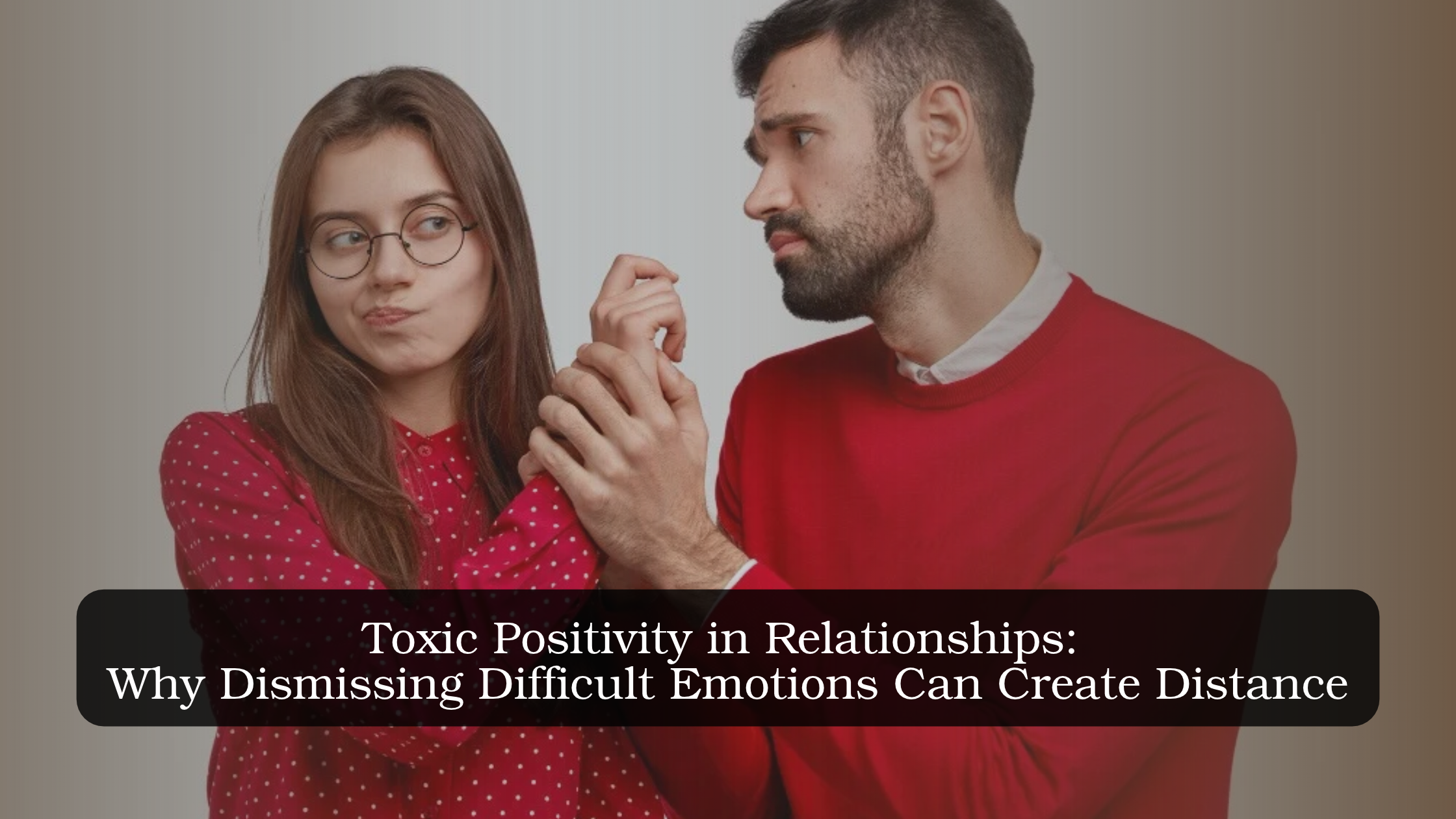
Toxic Positivity in Relationships: Why Dismissing Difficult Emotions Can Create Distance
A partner tells you they have had a difficult day, and you respond, “Look on the bright side.” When they express worry about the future, you remind them that everything happens for a reason. You may intend to comfort them, but these responses can leave them feeling unheard. Over time, even well-meaning reassurance can create emotional distance when it replaces genuine understanding.
Toxic positivity in relationships occurs when positive thinking is treated as the only acceptable response to difficult emotions. Sadness, anger, fear, disappointment, and frustration are pushed aside rather than acknowledged.
Understanding the difference between offering encouragement and dismissing emotions can help couples build trust, communicate more openly, and feel safer being vulnerable with each other.
What Is Toxic Positivity in a Relationship?
Toxic positivity refers to the tendency to maintain a positive outlook in situations where difficult emotions also need attention. In relationships, it can appear when one partner consistently encourages the other to focus on the good, move on quickly, or stop dwelling on upsetting experiences.
For example, imagine that one partner feels disappointed because an important anniversary was forgotten. Instead of listening to why the occasion mattered, the other responds, “At least we have each other. Why make such a big deal out of it?”
The response may be intended to reduce tension, but it overlooks the underlying hurt. The disappointed partner may feel that their emotions are inconvenient or unreasonable.
Toxic positivity does not always involve obvious statements or deliberate invalidation. It can also appear through changing the subject, rushing to find a solution, minimizing a concern, or repeatedly reminding someone to be grateful.
There is an important distinction between helping a partner find perspective and telling them how they should feel. Healthy optimism makes room for difficult emotions while offering hope. Toxic positivity tries to replace those emotions with a more comfortable response.
5 Signs of Toxic Positivity in Relationships
Toxic positivity can become a recurring communication pattern rather than a single unhelpful comment. Recognizing how it appears can help couples understand why conversations sometimes leave one partner feeling more alone.

1. Dismissing Difficult Emotions
When a partner expresses sadness, anger, anxiety, or disappointment, you might respond with phrases such as “It could be worse,” “Just be positive,” or “You have nothing to worry about.”
These statements can minimize the experience instead of acknowledging it. Even when a concern seems small from one person’s perspective, it may carry significant meaning for the other.
2. Rushing to Find the Bright Side
Some people feel uncomfortable when their partner is upset and immediately try to reframe the situation. They might point out what went well, explain why the problem is not serious, or insist that everything will work out.
Although reassurance can be helpful, offering it too quickly may prevent the person from explaining what happened or why it hurt. Sometimes, a partner needs to be heard before they are ready to consider a different perspective.
3. Treating Negative Emotions as a Problem
Statements such as “You’re always so negative” or “Why can’t you be happy?” can communicate that sadness or frustration is unacceptable.
This may lead one partner to believe they must remain cheerful to preserve the relationship’s harmony. Instead of discussing difficult feelings, they may hide them to avoid criticism or conflict.
4. Comparing Pain or Minimizing Concerns
A partner might respond to a stressful work situation by saying that other people have much bigger problems. While the comparison may be factually true, it does not make the original experience less meaningful.
Comparisons can discourage honest communication by suggesting that someone must justify their feelings before receiving support.
5. Using Positivity to Avoid Difficult Conversations
Sometimes, positive language becomes a way to avoid uncomfortable topics. A partner may insist on focusing on the future rather than discussing a breach of trust, unresolved resentment, or recurring conflict.
When difficult conversations are repeatedly postponed, the underlying issue may remain unresolvedeven when the couple appears happy on the surface, a pattern explored in emotional avoidance and how it slowly destroys relationships.
Why Toxic Positivity Creates Emotional Distance
Emotional closeness depends partly on whether partners feel safe sharing experiences that are uncomfortable, complicated, or difficult to explain. When one person’s feelings are repeatedly dismissed, that sense of safety can weaken.
It Makes One Partner Feel Unheard
When someone shares a concern, they are often looking for understanding before advice. If their partner immediately offers a positive interpretation, they may feel that the original concern was never acknowledged.
Over time, they might stop sharing certain experiences because doing so seems unlikely to lead to a meaningful conversation , unlikely to lead to a meaningful conversation, which is why feeling heard matters more than being right in a relationship.
It Discourages Vulnerability
Vulnerability involves sharing feelings that may be difficult to express, including insecurity, disappointment, grief, or fear. If these emotions are met with impatience or forced optimism, a partner may become more guarded.
They might continue discussing everyday matters while keeping deeper concerns to themselves. The relationship can begin to feel less emotionally connected, even when partners spend considerable time together.
It Creates Resentment
Repeated emotional dismissal can lead to frustration and resentment, which tends to build quietly. One partner may feel responsible for maintaining a positive atmosphere, while the other feels that their emotional needs are consistently overlooked.
Neither person may fully understand what is happening. The partner offering reassurance may believe they are being supportive, while the person receiving it experiences the interaction as invalidating.
It Prevents Problems From Being Resolved
Acknowledging difficult emotions can help couples understand what needs attention. If they rush past discomfort, they may miss important information about unmet needs, boundaries, or relationship expectations.
For instance, recurring disappointment about unequal household responsibilities cannot be resolved simply by focusing on the positive aspects of the relationship. The couple needs to discuss the imbalance and decide how to address it.
Why Partners May Rely on Toxic Positivity
Toxic positivity does not always come from a lack of care. Sometimes, it reflects a person’s own discomfort with difficult emotions or uncertainty about how to respond.
Discomfort With Emotional Distress
Seeing someone you love upset can be difficult. You may want to reduce their distress immediately because their sadness makes you feel helpless.
Offering reassurance can feel easier than sitting with uncertainty. However, learning to remain present during difficult conversations can help you support your partner without needing to fix every feeling.
Family and Cultural Expectations
Some people grow up in environments where expressing sadness, anger, or fear is discouraged. They may have learned to cope by staying strong, remaining grateful, or avoiding conversations that feel emotionally uncomfortable.
These habits can carry into adult relationships, a dynamic covered in how childhood experiences affect adult relationships.
Fear of Conflict
A partner may use positive language to prevent an argument or keep the relationship peaceful. They might say that everything is fine rather than acknowledge a concern that could lead to disagreement.
Although this can reduce tension temporarily, avoiding difficult conversations may create greater distance over time.
A Desire to Help
Sometimes, people believe that pointing out the positive will make their partner feel better. They may not realize that reassurance offered before acknowledgment can sound dismissive.
Recognizing this intention can help couples discuss the impact of their communication without assuming that one partner is deliberately trying to cause harm.
How Couples Can Respond to Difficult Emotions More Effectively

Changing toxic positivity does not mean abandoning optimism. It means making space for difficult feelings while remaining open to hope, perspective, and solutions.
1. Acknowledge the Emotion Before Offering Advice
When your partner shares something upsetting, pause before trying to improve their mood. A simple acknowledgment can help them feel understood.
You might say, “That sounds really frustrating,” or “I can understand why that affected you.”
Acknowledgment does not require you to agree with every interpretation, and it’s one of several ways to be a better listener. It communicates that you recognize your partner’s emotional experience and are willing to understand it.
2. Ask What Kind of Support They Need
Not every difficult conversation requires advice. Sometimes, a partner wants to talk, while at other times they may appreciate practical help or a different perspective.
Try asking, “Would you like me to listen, help you think through it, or offer suggestions?”
This gives your partner a say in how the conversation unfolds and reduces the likelihood of offering support that does not meet their needs.
3. Replace Dismissive Statements With Validating Responses
Small changes in language can make difficult conversations feel less isolating.
| Instead of saying | Try saying |
| “Just be positive.” | “I can see this is difficult for you.” |
| “It could be worse.” | “I understand why this matters to you.” |
| “Don’t overthink it.” | “Would you like to talk through what’s worrying you?” |
| “Everything happens for a reason.” | “I’m sorry this has been difficult. I’m here with you.” |
| “At least you have me.” | “You don’t have to work through this alone.” |
The goal is not to find the perfect phrase. It is to respond with curiosity rather than immediately trying to change your partner’s emotional state.
4. Make Room for Different Emotional Responses
Partners do not always process experiences at the same pace. One person may want to talk immediately, while the other needs time to reflect. One may recover from disappointment quickly, while the other needs more time and reassurance.
Neither response automatically means that one partner is healthier or more committed. Discussing these differences can help you establish ways to support each other without imposing a particular emotional timeline.
5. Return to Unresolved Issues
Validation is an important first step, but it does not replace problem-solving when a practical issue needs attention.
Once both partners feel heard, discuss what might help. If the concern involves finances, responsibilities, trust, or recurring conflict, identify the specific change needed and agree on a realistic next step.
This approach allows emotional understanding and practical action to work together.
How Couples Therapy Can Help Couples Address Toxic Positivity
When dismissing difficult emotions becomes an established pattern, couples may struggle to change it on their own. They may repeatedly have the same conversation, with one partner seeking acknowledgment and the other responding with reassurance, advice, or defensiveness.
Couples therapy can help partners recognize these patterns and understand how their responses affect the relationship. A therapist can support more constructive conversations, helping each person express concerns while listening to the other’s perspective.
Therapy may also help individuals explore their own discomfort with sadness, anger, or uncertainty. Understanding where these reactions come from can make it easier to remain present when a partner is distressed.
For couples experiencing emotional distance, therapy can create opportunities to rebuild trust through consistent listening, validation, and follow-through. The aim is not to eliminate positive thinking, but to develop a relationship where hope and difficult emotions can coexist.
How Dr. Harel Helps Couples Navigate Difficult Emotions
Dr. Harel’s relationship-focused work can help couples examine communication habits that leave one partner feeling dismissed or misunderstood. Rather than assuming that either partner intends to cause hcoupl, the focus is on understanding the interaction, its impact, and what each person needs from the relationship.
Through online couples counselling for partners in Los Angeles, Dr. Harel helps couples explore recurring disagreements, emotional responses, and expectations around communication. His approach may incorporate the ARM method (Awareness, Release, Mastery) and Neuro-Linguistic Programming (NLP), depending on the couple’s concerns and therapeutic goals.
Couples can use this process to become more aware of their reactions, discuss difficult experiences with greater openness, and practise responding to each other more constructively. This can be especially helpful when one partner tends to minimize problems while the other feels increasingly reluctant to share their feelings.
The aim is to help partners build greater understanding and develop communication habits that support emotional connection.
Building a Relationship Where Every Emotion Has Space
A strong relationship does not require both partners to remain positive through every challenge. It requires the ability to acknowledge difficult experiences, listen without rushing to judgment, and work through problems together. When partners feel safe expressing sadness, frustration, or uncertainty, they have more opportunities to understand each other and maintain emotional closeness.
If dismissing difficult emotions has become a recurring pattern in your relationship, counselling can help you explore what is happening and develop more constructive ways to communicate.
Dr. Harel offers online couples counselling for partners in Los Angeles, California. Book a Free Phone Consultation to discuss your relationship concerns and explore the support available.
Frequently Asked Questions
No. People may use positive statements because they want to help, reduce distress, or avoid conflict. However, even well-intentioned responses can feel dismissive when they leave little room for difficult emotions.
Yes. Encouragement and optimism can help couples manage uncertainty and work through challenges. Positivity becomes unhelpful when it is used to deny problems, minimize emotions, or pressure a partner to feel differently.
Choose a calm moment and explain how specific responses affect you. For example, you might say, “I know you’re trying to reassure me, but I need you to listen before offering solutions.” This communicates your needs without assuming harmful intent.
Try discussing the specific situations in which this happens. Explain what you are experiencing and ask what your partner finds difficult about these conversations. The goal is to understand each other’s perspectives rather than decide whose emotional response is correct.
Repeatedly feeling unheard may cause someone to share less, become guarded, or develop resentment. Over time, this can weaken emotional intimacy and make meaningful communication more difficult.
Consider couples therapy when the same communication problems keep recurring, difficult conversations lead to defensiveness, or one or both partners feel emotionally disconnected. A therapist can help you understand the pattern and practise healthier ways of responding.

Harel Papikian
Dr. Harel Papikian is a clinical psychologist and couples therapist with more than 15 years of experience. He offers marriage counseling and couples therapy in los Angeles. It help’s couples navigate their relationship challenges and deepen their connection. Our clinic uses a unique ARM method (Awareness, Release, Mastery) to achieve rapid and profound results for our clients. We serve a diverse clientele, including LGBTQ+ and heterosexual couples, addressing issues like communication breakdowns, conflict resolution, intimacy, and trust. You can also get individual therapy sessions for concerns like depression, anxiety, and trauma.
Leave a Reply