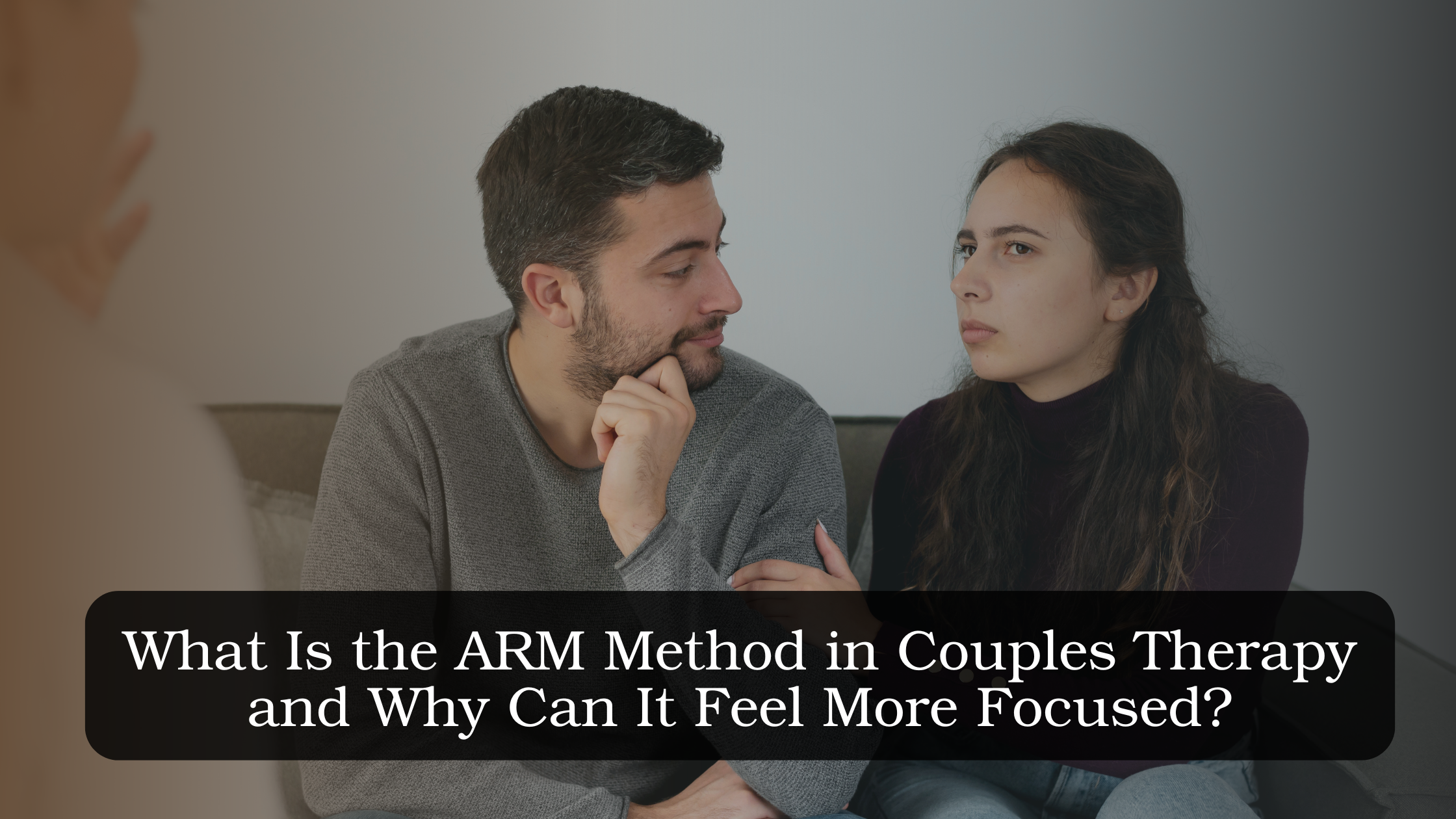
What Is the ARM Method in Couples Therapy and Why Can It Feel More Focused?
When couples consider therapy, they often want more than a place to talk about their problems. They want to understand why the same arguments keep happening, why conversations become so difficult, and whether their relationship can actually change. These questions become especially important when a couple has been stuck in the same pattern for months or years.
Some couples are dealing with frequent conflict. Others have become emotionally distant without having major arguments. Some are trying to rebuild trust after betrayal, while others simply want to reconnect after years of responsibilities taking priority over their relationship. In many cases, the problem is not a lack of love but patterns that have become difficult to recognize and change.
The ARM Method, developed by Los Angeles clinical psychologist Dr. Harel Papikian, provides a structured framework for working through these patterns. ARM stands for Awareness, Release, and Mastery. The approach moves from understanding what is happening, to addressing emotional patterns that maintain it, to developing healthier ways of responding. Its structured nature can help couples develop a clearer sense of direction during therapy.
What Is the ARM Method in Couples Therapy?
The ARM Method is organized around three stages:
Awareness: Understanding the emotional and relational patterns beneath recurring problems.
Release: Addressing beliefs, reactions, and emotional habits that continue to influence the relationship.
Mastery: Developing and practicing healthier ways of communicating, responding, and repairing the relationship.
The purpose is not to divide every relationship problem neatly into three steps. Rather, the framework gives therapy a direction while allowing the work to be adapted to the couple’s circumstances.
A disagreement about money, for example, may appear to be about budgeting. But one partner may associate financial uncertainty with instability, while the other may experience financial conversations as criticism or control.
The practical question then becomes more than, “How should we manage our money?”
It becomes, “What is happening emotionally between us when we talk about money?”
That distinction can change how a couple approaches the problem.

Phase One: Awareness
Understanding the Pattern Beneath the Argument
Couples usually know what they are fighting about. They may disagree about parenting, intimacy, household responsibilities, finances, extended family, or time together.
What is often harder to identify is the interactional pattern surrounding those disagreements.
One partner may become more insistent when they feel ignored. The other may withdraw because the conversation feels overwhelming. The withdrawal then increases the first partner’s anxiety, leading them to pursue the conversation even more strongly.
Eventually, both partners feel justified in their reactions.
Awareness helps couples step back and recognize the cycle itself.
Instead of asking only:
“Who started this?”
They can begin asking:
“What happens between us once this cycle begins?”
What Awareness Can Help Couples Identify
Awareness may involve exploring questions such as:
- Why do we keep having variations of the same argument?
- What situations trigger particularly strong reactions?
- What does each partner tend to do when they feel hurt or threatened?
- Does one partner pursue while the other withdraws?
- Are we reacting to what is happening now or interpreting it through earlier experiences?
- What does each person actually need during moments of conflict?
For example, a couple in Pasadena might repeatedly clash over parenting decisions. One partner wants to discuss disagreements immediately, while the other shuts down and asks for space.
Rather than treating one person as “too emotional” and the other as “uncaring,” therapy can explore what each response represents.
The pursuit may be connected to a need for reassurance and resolution. The withdrawal may be connected to a need for emotional safety or a learned tendency to avoid conflict a dynamic explored directly in the pursuer-distancer cycle.
Once the pattern becomes visible, the couple has something specific to work on.
Why Awareness Matters
You cannot intentionally change a pattern you do not recognize.
A couple may try communication techniques repeatedly, but if neither partner understands why they become defensive, withdrawn, critical, or anxious in certain situations, the same cycle can return.
Awareness does not immediately resolve the conflict. It gives the couple a clearer map of what is happening.
| Surface Problem | Possible Emotional Dynamic |
| Arguments about money | Security, control, or fear of instability |
| Jealousy | Fear of losing connection |
| Conflict about intimacy | Need for closeness, reassurance, or acceptance |
| Frequent criticism | Resentment or unmet expectations |
| Emotional withdrawal | Self-protection, overwhelm, or fear of rejection |
These are possibilities rather than fixed explanations. The purpose of therapy is to understand what a particular pattern means for the people involved.
Phase Two: Release
Moving Beyond Patterns That No Longer Help
Awareness can create insight, but insight alone does not always change behavior.
A person can understand that they become defensive during conflict and still become defensive the next time their partner raises a difficult subject.
The release stage focuses on the emotional habits, assumptions, and protective responses that may keep the relationship stuck.
These can include:
- Persistent defensiveness
- Difficulty being vulnerable
- Unresolved resentment
- Automatic negative assumptions about a partner
- Fear of rejection or abandonment
- Avoidance of difficult conversations
- Protective behaviors that unintentionally create distance
Consider a couple in Manhattan Beach. One partner feels that vulnerability will eventually lead to criticism, so they avoid discussing their feelings. The other interprets that avoidance as rejection and begins pursuing reassurance more intensely.
The pattern becomes predictable:
One withdraws → the other pursues → the first withdraws further → the second becomes more distressed.
Neither partner necessarily intends to create this cycle.
The work involves understanding what maintains it and developing alternatives to the responses that have become automatic.
Releasing Old Emotional Narratives
People bring beliefs about relationships into their adult partnerships.
These beliefs may sound like:
- “I have to handle everything myself.”
- “If I make a mistake, I will be rejected.”
- “People eventually leave.”
- “Conflict always ends badly.”
- “If I don’t push the issue, nothing will change.”
When these assumptions become activated, neutral events can take on a much larger emotional meaning often rooted in how childhood experiences affect adult relationships.
A request for space may feel like abandonment. A delayed response may feel like rejection. A disagreement may feel like proof that the relationship is failing.
The release process can help partners examine these interpretations rather than automatically acting on them.
That does not mean dismissing genuine relationship problems. It means distinguishing what is happening in the present from what each partner may be carrying from previous experiences.
Phase Three: Mastery
Turning Insight Into Relationship Skills
Understanding a pattern is important. Couples also need ways to respond differently when that pattern appears.
This is the focus of mastery.
Depending on the couple’s needs, therapy may involve practicing:
- Direct communication of needs
- Active listening
- Emotional regulation
- Managing difficult conversations
- Responding without immediate defensiveness
- Repairing after conflict
- Setting appropriate boundaries
- Creating greater emotional safety
Imagine a couple in Brentwood who repeatedly argue about household responsibilities.
Previously, one partner complained, the other became defensive, and the conversation ended with both feeling resentful.
With practice, they can learn to replace accusations with specific requests, listen before responding, clarify expectations, and return to unresolved issues without restarting the entire argument.
The disagreements may not disappear.
The difference is that the couple becomes better equipped to handle them.
That is an important distinction. Mastery is not about creating a conflict-free relationship. It is about becoming more capable of navigating conflict without damaging the connection.

Why Can the ARM Method Feel Faster?
A Structured Process Can Create Greater Direction
It would be misleading to say that the ARM Method guarantees faster results than other approaches to couples therapy. Therapy outcomes vary considerably depending on the couple, the concerns they bring to treatment, their willingness to participate, and other circumstances.
However, a structured framework can make therapy feel more focused.
Instead of discussing one argument after another without identifying the larger pattern, the couple has a framework for asking:
What is happening?
What keeps it going?
What needs to change?
How do we practice that change?
The ARM structure connects insight with action. Awareness helps identify the pattern. Release addresses emotional barriers that may maintain it. Mastery focuses on practicing new ways of responding.
For couples who feel overwhelmed by years of unresolved conflict, having this kind of structure may make progress easier to recognize.
Who May Benefit From the ARM Method?
The framework may be relevant for couples dealing with concerns such as:
- Repetitive arguments
- Communication difficulties
- Emotional disconnection
- Trust concerns following betrayal
- Difficulty expressing needs
- Intimacy concerns
- Major relationship or life transitions
- Anxiety or stress affecting the relationship
- Long-standing patterns of pursuing and withdrawing ( which often show up as recurring relationship patterns more broadly.)
It can also be useful for couples who are not in crisis but recognize that their relationship has become more distant or reactive over time a point echoed in why couples therapy can help even outside a crisis.
The specific focus depends on the couple. One relationship may need to rebuild trust, while another may primarily need to improve communication and emotional connection.
How Dr. Harel Papikian Uses the ARM Method
Dr. Harel Papikian is a licensed clinical psychologist in Los Angeles with more than 16 years of experience working with individuals and couples.
His ARM Method provides a framework for understanding relationship difficulties at both the emotional and practical levels. Rather than treating every disagreement as an isolated problem, the work can focus on identifying recurring relational patterns, understanding what drives them, and helping partners develop different ways of responding.
For couples, this can mean looking beyond the immediate argument to understand the interaction underneath it.
If a couple repeatedly fights about communication, for example, therapy may explore not only how they communicate but also what each partner experiences emotionally when communication breaks down.
The goal is not simply to determine who is right. It is to help the couple understand the cycle and develop a healthier way of navigating it.
Final Thoughts
The ARM Method is built around a straightforward progression: Awareness, Release, and Mastery.
Couples first work toward understanding the patterns affecting their relationship. They then examine emotional habits and beliefs that may be keeping those patterns in place. Finally, they work on developing and practicing healthier ways of communicating, managing conflict, and reconnecting.
The approach does not promise instant results or eliminate every disagreement. Relationships are complex, and meaningful change takes participation from both partners.
What a structured framework can provide is direction.
Instead of simply asking, “How do we stop fighting?” couples can begin asking better questions: “What keeps happening between us? What is driving it? What needs to change, and how can we respond differently?”
That shift can be an important starting point for lasting relationship change.
FAQs
ARM is a structured therapeutic framework developed by Dr. Harel Papikian. It can be used to organize couples therapy around Awareness, Release, and Mastery while adapting the work to the couple’s individual concerns.
No. No couples therapy approach can guarantee a specific timeline for improvement. The ARM framework may feel more focused because it gives therapy a clear progression from understanding patterns to working through them and practicing new responses.
The couple works toward identifying recurring emotional and relational patterns. This may include examining triggers, communication cycles, defensive responses, withdrawal, pursuit, and the meanings partners attach to each other’s behavior.
Release involves examining emotional habits, beliefs, resentment, fears, and protective responses that may no longer be helping the relationship. The goal is to reduce the influence of these patterns on present-day interactions.
Mastery focuses on applying what the couple has learned. Depending on their needs, this may involve communication, emotional regulation, conflict management, listening, expressing needs, and repairing after disagreements.
Yes. Couples do not need to be in constant conflict to seek therapy. Emotional distance, recurring misunderstandings, difficulty expressing needs, or a desire to strengthen the relationship can also be reasons to seek professional support.

Harel Papikian
Dr. Harel Papikian is a clinical psychologist and couples therapist with more than 15 years of experience. He offers marriage counseling and couples therapy in los Angeles. It help’s couples navigate their relationship challenges and deepen their connection. Our clinic uses a unique ARM method (Awareness, Release, Mastery) to achieve rapid and profound results for our clients. We serve a diverse clientele, including LGBTQ+ and heterosexual couples, addressing issues like communication breakdowns, conflict resolution, intimacy, and trust. You can also get individual therapy sessions for concerns like depression, anxiety, and trauma.
Pingback: 10 Signs You Need Couples Therapy Before It's Too Late